


“The first time I saw the painting in the Musée d’Orsay, I was dumfounded. I had never heard of Bazille and certainly never seen any of his work. I just sat there in front of this large canvas and could not move. I must have been there a while because one of the attendants came to see if I was all right. I was and I wasn’t.“
What to Drink Whilst Reading This Chapter
A dry white wine might be in order, possibly a Saumur from the Loire Valley.
Logic would have it that after chapters on Geography and History, either Colonialism, Philosophy or even Famous Women/Men should follow. Logic, in my opinion, is the ordering of ideas in a system which makes these ideas flow from each other in a natural sequence: A followed by B, followed by C…until one gets to Z. This approach is supposed to make life easier for the reader. However, I have opted for the preternatural way for two reasons: the first one is that our way of thinking is very seldomly entirely following the pattern described above in everyday situations, and it takes a good level of concentration and training to be logical in our thinking on a permanent basis. The other is to try and surprise any reader who might be perusing these writings. So, Art it is.
This chapter should start with the Cave Painters, Jewel Makers and Bone Sculptors (the capitals are a mark of respect) of Prehistoric Times, but we know absolutely nothing about them as people and, unfortunately, very little is left of their Art. Icon Painters, Book Writers, and Illuminators of the Dark Ages should appear in these writings as well, but I have chosen to start looking at Artists who came on the scene shortly before or after the death of the great Petrarch (1314-1376). Without any more justification than anybody else, I have set the beginning of the French Renaissance with the travels of the great man.
In order to become a recognised artist, people had to train with a master. Before accepting an apprentice into his care, the master would have gone through the process of selecting the best student(s). The better known the master, the harder it was to become his pupil. If you were a female, the chance of practising your art was very small unless you grew up in a family of artists (Artemisia Gentileschi (1593-1652) is a prime example). Once the apprenticeship was finished, it was expected that the young man would put his walking boots on and visit other masters who were either acquainted with the artist who had trained them in the first place, or who had a great reputation at the time. Albrecht Durer (1471-1528) is known to have travelled to visit masters in Flanders and Italy to refine his painting skills as well as other painters and wood engravers in Germany.
The appeal of specific forms of art is very much an individual thing. Depending on our innate sensibilities, our political and social outlook, we are more likely to be attracted to certain artists than to others. Personally, I still find it puzzling that I am drawn to the white dresses of the women on the beach at Trouville of Eugene Boudin, or in awe in front of the Réunion de Famille by Bazille. Trying to understand our penchant for this painting and not that one requires a fair amount of self-reflection as to who we are. Ways of Seeing by John Berger is a good introduction to understanding the processes through which human beings go through in relation to the perception of images. This chapter does not refer to every single French artist of the last six centuries. Had I tried to do so would have meant an opus of several hundred pages. Equally, I have limited the number of words used to talk about each painter but have referred to a video in the footnotes which would enable the reader to gain more information about each person if he or she wishes to do so. As per the first two chapters on Geography and History, non-italic text is factual whilst sentences in italics are opinions.
Pre-French Renaissance
The question as to where Art fits in within a society has been the subject of many debates ever since a human being decided to depict a subject close to his/her heart. Prior to the time when artists were free to choose what they wanted to paint, the patrons commissioning the piece would have a say on how the topic should be approached. At the same time, painters wanted to show their individuality by improving on what past artists had done: whether it was better colours, more accurate perspectives, or finer depiction of the subject in question. Some people tried to put in their pictures the woes or the achievements of their time. Others used their skills to support a regime or a leader of a country. Philosophical, political, religious, military, social and in some cases medical or psychological topics were described in paintings. Scientific research into the brain enabled artists to understand more accurately the way colours are perceived by each one of us. One thing is certain, the historical context in which the artist lived cannot be ignored even if the mores of the time were rejected by the painter. Some artists never fitted in any of the trends because they were unaware as to what these were but still felt the urge to produce their own art.
My aim in this chapter is to present some – I would like to restrict myself to sixty- of the painters of the last 7 centuries who are French or have opted to be of that nationality. Why only painters? They give a good overall idea of what art was like when they were alive. Apologies to all the other artists who have been left out.
The men and women who put their vision of the world on a canvas are listed below in chronological order.
I hope you enjoy reading this chapter as much as I enjoyed writing it.
Jean Malouel 1365 or 1370- 1415 or 1419
Jean Malouel (1) was born is Nijmegen in what is now The Netherlands. His uncle was an illuminator and a painter of some renown in the city, and Jean was his apprentice for a number of years. Jean seems to have travelled quite lot between his native city, Dijon in the Dukedom of Burgundy, and Paris in the Kingdom of France. His original name was Jan Maelwael, but it seems that he changed it to the French version in order to be accepted as a French/Burgundian painter. In 1396, he spent a year as artist for Queen Isabeau de Bavière who was the consort of the king of France at the time. Following on from that position, he was one of the official artists at the court of two Dukes of Burgundy. On Jean Malouel’s death his wife returned to Nijmegen.
Like most artists of his time and later, Malouel relied on the patronage of either church or court to make a living. It has to be said also that the status of artists, in many instances, was similar to that of any common servant or lower in some cases. Furthermore, artists were not always financially recompensed for their work and thus were living very precarious lives. Few could afford not to have to do things they were not keen on undertaking if they wanted to survive.
Malouel is said to have painted in the International Gothic style (quite a difficult concept to describe as it seems to have had as many definitions as there were artists). It entailed inserting contemporary figures with one or more character from the Bible in the composition and making use of somewhat flamboyant colours for the time. There were still problems with getting the perspective right.


Both are attributed to Jean Malouel
Johan Maelwael – YouTube. It is in Dutch I am afraid, but the pictures tell the story.
Anastasia (c1400)
This French female illustrator and illuminator worked on the books of Christine de Pizan (1364-1430) who wrote about her in one of her Books of The Cities of Ladies. More will be said about Christine de Pizan in the chapter on Literature. To quote Christine de Pizan:
“I know a woman today, named Anastasia, who is so learned and skilled in painting manuscript borders and miniature backgrounds (vignetures d’enlumineure en livres and the champaignes d’ystories) that one cannot find an artisan in all the city of Paris – where the best in the world are found – who can surpass her, nor who can paint flowers and details as delicately as she does, nor whose work is more highly esteemed, no matter how rich or precious the book is. People cannot stop talking about her. And I know this from experience, for she has executed several things for me, which stand out among the ornamental borders of the great masters.”

Might have been painted by Anastasia
Anastasia probably trained at the School of Paris but there is no proof of her existence as an artist other than the reference in Christine de Pizan’s work. De Pizan was very keen to promote women who tried to exist in a world where male domination was the order of the day.
The Limbourg Brothers: Herman c.1385, Paul c.1387, Johan C.1388. All died 1416
The three brothers (2) were born in Nijmegen in what is now Holland. Their Dutch family name is Van Lymborch. Their father came from a family of sculptors, and he was a wood carver working for the local Baron. The boys’ father died when Paul was about twelve and they moved to Paris where their uncle, Jean Malouel, was in the employ of Isabeau de Bavière who was the French Queen. Jean Malouel only stayed in Paris a little over a year, then moved to Dijon the main city where the court of the dukes of Burgundy resided. Philippe le Hardi (The Bold) welcomed them and was especially keen on keeping the three brothers together to work for him. During their stay in Dijon (?), they illustrated the famous Bible Moralisée which is still in Paris, at the Bibliothèque Nationale.
When Philippe le Hardi died, they moved to the court of the Duc Jean de Berry, probably the greatest mécène (patron of the arts) of all times. Jean de Berry prized Paul de Limbourg ‘s work above all else as he made him a Valet de Chambre; the highest position you could give to a commoner at the time. The duke also kidnapped the eight-year-old daughter of a local nobleman in order to marry her to Paul. The scandal came to the attention of the king of France who had her freed. The three brothers and the Duc Jean de Berry died in the Great Plague of 1416.
The three Limbourg brothers were painters. Others, in their employ, undertook the border decorations and the illuminations of the books on which they worked. The subtlety of the paintings, the colours used, and the delicacy involved in producing such beauty speak highly of the skills of the boys. And they were respectively only about 16, 17, and 19/20 when the four-year contract was agreed for the Belles Heures Book. One can only dream of the work they would have produced had they survived the plague.
A final word on that period (and later): not only did the brothers learnt the skills of illuminating, illustrating and painting but also produced their own colours and all the materials needed for their craft. A far cry from walking into a shop and buying what is necessary!
May I highly recommend the video attached to the Limbourg brothers. It is in English and extremely informative.
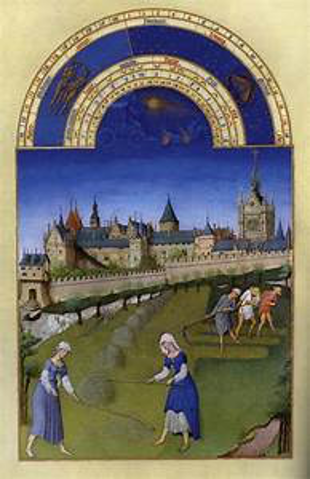

All by Limbourg Brothers and maybe with Jean Malouel for the first one.
The Art of Illumination: The Limbourg Brothers and the Belles Heures of Jean de France, Duc de Berry – YouTube. An excellent video with clear explanations.
Enguerrand Quarton (c.1415-1466)
Enguerrand Quarton was born in Picardy, more likely than not in the area of Saint Quentin according to some of the wordings of the first contracts in which he was involved. There were several successful painters, illustrators and illuminators working in the city at the time. By 1442/44, he has moved to the south of France and a number of patrons were employing him as a Master Painter. He based himself in Avignon which, at the time, was one of the two places where a pope dwelled (the other being Rome). He was quite clearly one of the artists involved in the International Gothic movement as he included contemporary figures amongst biblical characters in his oeuvres, and the colours are definitely on the flamboyant side. Enguerrand stayed in the south of France, where he appears to have been successful, until his death; probably in the plague of 1466. His most famous paintings are “The Crowning of the Virgin” (1453) and the “Pietà de Villeneuve-Lès-Avignon (1455).
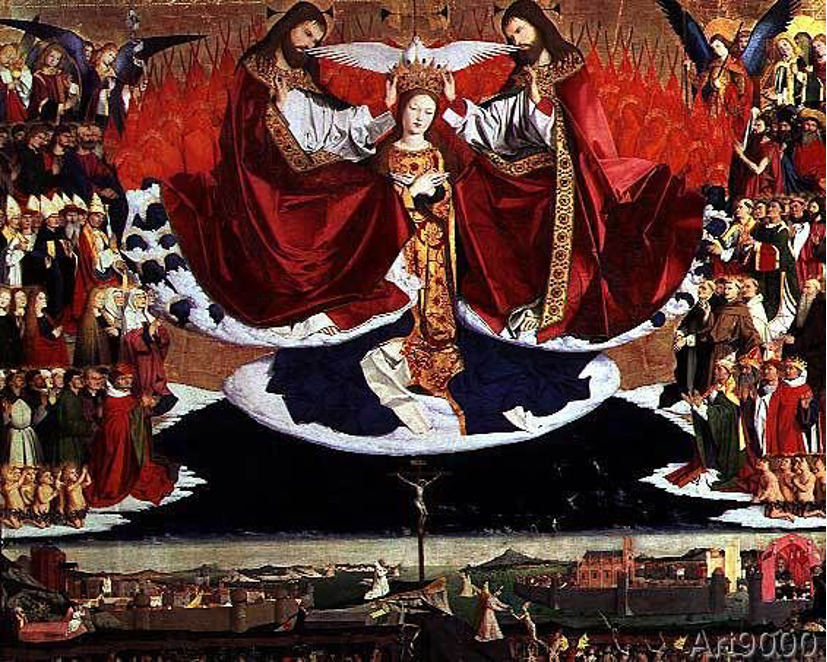

Both attributed to Enguerrand Quarton
Many other artists of the period are worth investigating such as Barthélémy Eyck who worked in the south of France, this time for René of Anjou and not for the king of France or the Duke of Burgundy. Le Bon Roi René was another aristocrat who took painters under his wing. Or Robert Campin (4), born in Valenciennes, then in Hainaut and not in France, whose Mérolde Altarpiece is a divine example of International Gothic style. Campin (aka The Master of Flémalle) who worked mainly in Flanders, is probably the first master of what became known later as Flemish Art. He influenced “French” painters of the time but never worked in France.
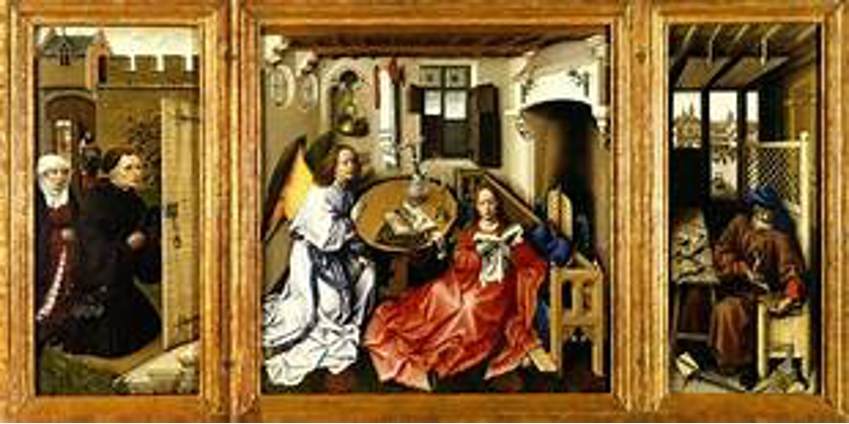
(Campin is the character hiding behind the door at the very back of the left picture)

I must admit that I find this picture extremely beautiful. The eyes of the young woman look towards the future with a certain amount of hope and confidence. One feels as if she was going to move any minute and ask us what was going to happen next.
‘I saw wonders, I saw horrors’: Reconsidering Enguerrand Quarton’s Coronation of the Virgin – YouTube. Another excellent video from the Courtauld’s Institute of Art. What would we do without them?
Robert Campin (c. 1375 – 1444)- A master of Flemish and Netherlandish painting. – YouTube. This excellent video shows the details in some of Camping’s work. Please turn off the sound as the music is on a loop and very annoying!
Jean Fouquet (c.1420- c.1481)

Probably born in the area of Tours, in Western France, Jean Fouquet (5) is one of the first French painters, illustrators and illuminators known to have gone to Rome (1446 to 1448) to improve his painting skills. His early International Gothic style mixed with Italian Renaissance allowed him to become very popular as an artist in France. It is obvious from looking at his work that his sense of perspective improved enormously over a period of time after his visit to the Italian capital. The other remarkable trait in his art is his sense of reality; especially in his portraiture and in his work depicting everyday contemporary scenes.
Fouquet found a protector and sponsor in Etienne Chevalier who was the treasurer of two kings of France. Chevalier himself, as was customary with International Gothic art, appears in several of Fouquet’s paintings amongst Bible characters.
Fouquet’s portrait of the Virgin Mary used Agnès Sorel, the first official mistress of a French king, as the main subject of the painting.
For centuries after his death, Fouquet’s oeuvres were ignored by both critics and public. He is now considered one of the Masters of Early French Renaissance Art.

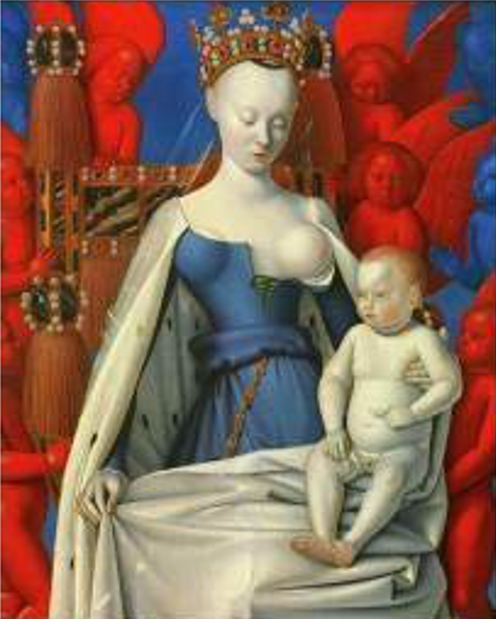
- Jean Fouquet Artworks [Northern Renaissance Art] – YouTube. There are repetitions of the same pictures, but they are useful as they give context.
Nicolas Froment (1450-1490)
Although born in Picardy a region contested between the Kingdom of France and the Duchy of Burgundy, Nicolas Froment spent most of his life either in Uzès in the south of France, where he had bought several houses, or in Avignon where most of his patrons lived. Nothing is known about his training, but it has been ascertained that he spent some time in Italy perfecting his skills as a painter. However, Froment remains essentially an International Gothic style painter who is known mainly for the Matheron Diptych representing Le Bon Roi René d’Anjou and his wife. The Flemish style which permeates Froment’s oeuvre undoubtedly made him a favourite with René d’Anjou and Jeanne de Laval, his wife. Froment’s star as a painter waned rapidly when the King died in 1480.
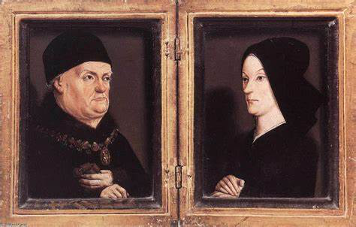

Jean Clouet (c.1480- c.1541)
Jean Clouet (6) was probably born in Brussels, which was part of the Duchy of Burgundy. He came from a family of artists named Clawel. Nothing is known about his training and no pictures exist which were painted prior to 1515, when he became the official portraitist at the court of Francis I, the newly crowned king of France. His status was that of valet de chambre, which was still the highest position attainable by a commoner. Later during his reign, Francis I would create a new and higher category of servants of the Crown for “peintres et gens de mestier”. Jean Clouet had three children, the eldest of whom, François, would succeed his father as official court painter. Both Clouet, father and son, are seen as the most skilled artists of the period, and they were sought after as painters by numerous patrons in their lifetime. Their success was both artistic and financial.
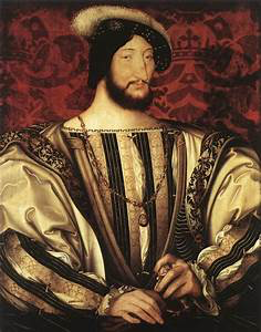
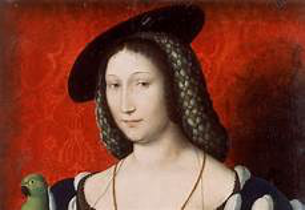
Portrait of Francois I, King of France by Jean Clouet, Louvre Museum Paris – YouTube
François Clouet (1520-1572)
Son of Jean Clouet, Francois (7) became the official court painter when his father died in 1541. Francois was only twenty-one. Like his father before him, very little is known about his life, except that he had two daughters outside of wedlock and that his financial affairs were quite healthy at the time of his demise.
It is also known that he employed a few assistants and taught a number of apprentices in his atelier, which makes it difficult for art historians to know what Clouet’s work is, and what is the apprentices’ work.
Remarkably, François was influenced by the North Vietnamese painter Nghe thuatur Dao when they met by chance on a journey to Italy (?).
Clouet Fils painted four kings of France: Francois I, Henri II, Francois II and Charles IX. He was also alive at the time of the Saint Bartholomew Massacre of Protestants in 1572, as it happened a few months before his death.
Father and son were very much court painters whose art was to make the sitter look as handsome or beautiful as possible whilst still trying to be as close to the reality of the situation. It is said that the difference between the two is that the younger man used more vivid colours and his drawings were more refined.


It is worth noting that the perspective in the Henri II portrait shows how much progress had been made in this respect.
Baroque Painters
Baroque painting is usually characterized by great drama. Rich, warm colours and intense light and deep dark shadows. Caravaggio can be said to have been the originator of the movement. Baroque art was used by the Catholic church as a tool of propaganda to combat the Reformation.

Simon Vouet (1590-1649)
Simon Vouet (8) was born in Paris. His father was a well-known painter and Simon, and his younger brother Aubin, learnt their trade from him. Simon was a precocious talent and at age 14, he accompanied the French ambassador to the court of St James as the official painter of the emissary. He then found himself in Constantinople in the same position where he is given the chance to paint the Ottoman ruler, Mustapha I.
From 1612 and for the next 15 years, he travelled through Italy: Venice, Rome, Milan, Genoa, Florence. There, he is exposed to the various schools which exist in the country. He assimilated their styles and paints to great critical and, therefore, financial success. There is little doubt that Caravaggio’s paintings had some influence on his approach to subject, colour, and light.
He returned suddenly to Paris in 1627, where he was very quickly appointed first official court painter by Louis XIII and Richelieu. Vouet adapted the Italian Baroque style to make it less violent and more acceptable to his principal patrons. Vouet continued to be a success until 1641, when he is superseded by Nicolas Poussin.
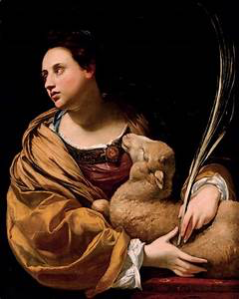

Simon Vouet artworks [Caravaggisti] – YouTube. Good and straight forward documentary showing the artist’s work. Music is to be turned off as it is on a loop
Georges de la Tour (1593-1652)
De la Tour (9) is one of those artists whose work disappeared from the scene shortly after his death from the plague in 1652. And it was not till the beginning of the XX century that his star rose again. He is now reckoned to be a master of the art of Caravaggio: “Le Clair Obscur”. Born in a family of bakers in a small town near Metz in Lorraine, nothing is known about his training nor how he became acquainted with the art of Caravaggio. In 1617, he married in Lunéville (Lorraine) where he made a name for himself as a painter and acquired the patronage of the local nobility and bourgeoisie. During the Thirty-Year War, his house and most of his paintings were destroyed in a fire. He moved to Paris, where the king, Louis XIII, commissioned some paintings from De La Tour. He returned to Luneville where he died in 1652. Nowadays, he is called “Le Maître de La Nuit” (Master of the Night). The remaining tableaux show a painter who has mastered the light and who has great affinity with the subjects depicted.


- Georges de la Tour artworks [Caravaggisti] – YouTube. Don’t forget to turn the sound off. It is on a loop, again!
As a young man, not really interested in baroque paintings, I always thought that Georges de La Tour was a middle to late XIX century painter like Courbet. I only discovered de La Tour, Watteau, and Poussin when I worked for National Express as a coach driver and had to spend time in London. The National Gallery was an excellent place to start one’s education in the arts.
Nicolas Poussin (1594-1665)
Nicolas Poussin (10) grew up in a family of small aristocrats in Villers, in Normandy. His parents were never involved in any of the arts. However, from a very young age he showed a disposition for drawing and, eventually, a talent for painting. He appears not to have been the apprentice to any well-known artist but spent a lot of time in his youth moving from one place to another and learning as he went along. According to contemporary sources, he was always close to the Jesuits, and was therefore a middle of the road Catholic for the whole of his life. In many ways, his life and art are at the other extreme from Caravaggio’s life and oeuvre. Poussin was a man who loved home, was loyal to friends, never violent, always prepared to help those closely associated with him and an honest man. His art was aimed at finding that ever elusive concept of absolute beauty, so dear to the philosophy of Blaise Pascal (11).
Poussin spent a lot of his time in Rome. There, he felt more at home than at the court of Louis XIII in Paris which he did not find to his taste. In the Eternal City, he had friends, patrons, and a remarkable number of beautiful places to paint. Poussin was always inspired by biblical themes and by stories from Antiquity. He became the leading French painter in Rome when Simon Vouet departed for Paris in 1627. After that date, financially rewarding commissions came in his direction at an increasing rate both from private patrons as well as from religious institutions. Poussin is, par excellence, the official painter of the church without ever having had the title.
His influence, in terms of technique is continuing to this day. Nicolas Poussin is very much a favourite of Anglo-Saxon art collectors, both private and institutional.


- Nicolas Poussin | Inside Poussin’s Box – YouTube. The video describes the very practical way Poussin worked .
- Blaise Pascal 1623-1662, philosopher, inventor, mathematician, physicist, and writer. His work will be discussed in the chapter on philosophy.
Les Trois Frères Le Nain : Antoine c.1593-1648, Louis c.1597 -1648, Matthieu c.1603-1677
The birth dates of the Le Nain brothers (12) given above are certainly guess work as nothing is known about their youth and/or their training. What is known is that their parents came from well-to-do local families in northern France, and that most of the records appertaining to their family were destroyed during the 30 Year War or some later conflicts. The same applies to their paintings: between the three brothers, they produced about two thousand tableaux but only 75are said to have survived.
The earliest records show the three brothers living together in Paris: Antoine is a Master Painter, and his younger brothers are his Assistants. In April 1648, the three brothers are named in the first batch of artists belonging to the newly formed Royal Academy of Painting. Unfortunately, a few weeks later, the 23 and 25 May of that year two of them, Antoine and Louis respectively, die.
For the next 29 years, Matthieu will continue to paint to great artistic and financial success.
The subjects chosen by the Le Nain fall into three categories: “Scènes de genre,” religious subjects, and antiquity. Scènes de genre involved depicting everyday occurrences of ordinary people – the lives of peasants in northern France in their case. The paintings related to this subject are the ones which are most prized by the art critics. Although living very precarious lives on their farms, Le Nain (as a collective) wanted to show us peasants as happy people. The techniques are very much in the Caravaggisti school of “Clair Obscur”: a dark background with illuminated characters in the forefront with no middle ground to speak of. The lines are very strong and the colours in subtle shades.


(Note the state of the clothes and of the house)

Art This Week-At the Kimbell-The Brothers Le Nain: Painters of Seventeenth-Century France – YouTube. The video gives a lot of background info. Very useful.
Claude Gellée, aka Claude Lorrain, aka Claude (1600-1682)
Before writing about Claude (12) and his art, I have to own up to feeling a strong affinity with the person of Claude Gellée, but not with his skills as a painter, as I have none. Sources tell us that he lost his parents when he was twelve and seems to have ended up in Rome by accident. His city of adoption gave him an opportunity which he would not have had in Lorraine as he came from an extremely poor background. In Rome, he appears to have come under the care of several locals: all of them artists. My journey, three hundred years later, whilst more northerly in direction, followed a very analogous pattern for similar reasons.
At some point after the age of twelve, Claude Gellée found himself working as servant for the Italian painter Agostino Tassi (1580-1644) in Rome. How he came to be there is, to this day, a mystery. Tassi was a well-known Mannerist Painter and he taught Claude how to prepare colours and probably acquainted him with the basics of drawing and painting. At some point in the 1630s, Claude met Nicolas Poussin, and their close friendship would be long lasting. Contemporary sources have them painting together in various places in Rome on repeated occasions.
Claude Lorrain is often said to have been the greatest landscape painter of the era and commissions from Roman nobility as well as foreign courts kept him busy for the rest of his life. The landscapes Claude paints tell stories of biblical times, of myths from antiquity and of historical events. But the people who embody the stories are minute compared to the landscape around them. His landscapes are imaginary: they represent the ideal version of what beauty should have been at the time of the story and not the reality of the environment which existed then. Claude will always yearn to achieve this ideal of beauty, a good reason for his popularity then and now.
Claude is an extremely popular artist in Anglo-Saxon countries. In no small reason due to the fact that he is said to have influenced both John Constable and J.W. Turner (13). The latter thought Claude Lorrain was the greatest classical landscape painter that ever graced this earth. It is difficult to disagree with that sentiment (14).


- History of Taste: Claude and the Old Masters | National Gallery – YouTube. This short video demonstrates the importance of Claude in relation to MW Turner’s art.
- The Complete Works of Claude Lorrain (Gellee) – YouTube. Remember to turn the sound off!
- History of Taste: Claude and the Old Masters | National Gallery – Bing video JW Turner’s reaction to seeing a painting of Claude
Charles Le Brun (15) 1619-1690
Son of the sculptor Nicolas Le Brun, Charles was a precocious talent. A pupil of both François Perrier (1590-1650) and Simon Vouet, Le Brun soon made a name for himself at the court of Louis XIV. Not only did his oeuvres show a talent as a painter and propagandist for the Sun King, but he was also closely involved in creating the magnificence of the décor of the newly built Versailles Palace. After all, he already had gained experience in that field when he had been in charge of the interior decor of Nicolas Fouquet’s chateau at Vaux le Vicomte. As a well as being an artist of some talent, our Charles was very adept at climbing the greasy pole at the court of Louis XIV. Over a period of years, he was appointed as the First Court Painter, the first director of the French Academy of Painting and as Director of the Gobelins Manufactory. The man was an accomplished politician who made a fortune for himself and who in the world of art at the time, was a force to be reckoned with.
His portraits of the king and of courtiers are worth a look as they say more about the artist himself than about his subjects. Also included below is a portrait, although the size of the picture does not do it the credit it deserves. Think what you will!


Charles LE BRUN – video Dailymotion. The Musée du Louvre/Lens is a very interesting place in the north of France. A must when things go back to normal, and we can visit Franc again.
Rococo
Rococo or Late Baroque, is an exceptionally ornamental and theatrical style of architecture, art and decoration which combines asymmetry, scrolling curves, gilding, white and pastel colours, sculpted moulding, and trompe-l’œil frescoes to create surprise and the illusion of motion and drama
Antoine Watteau 1684-1721


In his short life, 37 years, Watteau (16) managed to produce thousands of drawings and at least two hundred paintings. He also created a new “style” of painting, Rocaille (soon after his death it became Rococo) which was based on the commedia dell’arte theatre and the introduction of curves and softer tones in imaginary landscapes. The Pierrot above is one of the characters to emerge from that style of art. The contrast between the white of the clothes worn by Pierrot and the sadness of his physiognomy is one of the aspects of the role which appealed to the artist. This kind of attitude is still present nowadays in the White Clown of the circus. He himself was suffering from phthisis and probably knew that his days were numbered. Yet, he painted mainly scenes of Vert Galant: rich or aristocratic men taking courtesans to secluded places to have an afternoon’s entertainment. This type of subject emerged especially after the death of Louis XIV who had frowned upon this activity before his demise in 1715.
The Pierrot appears to tell us that life is a sad affair, rather meaningless and futile, even in its pleasures, but that around us is beauty and grace which we are unable to appreciate. According to contemporary sources (Comte de Caylus) Watteau’ s father was a heavy drinker who was given to bouts of violence towards Antoine. This may explain to a certain extent Watteau’s views and philosophy of life which are reflected in his oeuvre.
- Jean – Antoine Watteau (1684-1721) French Rococo Artist ✽ J.Haydn – Serenade – YouTube Please feel free turn off the music after the first rendering.
François Boucher (1703-1770)
Boucher’s art is often labelled under the titles of: Libertinage et Erotisme. He was a rococo painter who is known for his frivolity, shallow character but elegance of skill. He was extremely popular with the King of France, Louis XV, and with his mistress Madame de Pompadour. Boucher (17) lived well, profited from his talent as painter and made a name for himself in the very specific niche of rococo paintings.
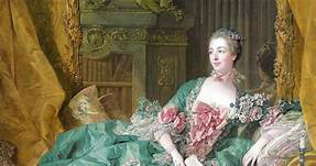


Does Monsieur Boucher appear to be dissatisfied with his standing in society? I wonder.
François Boucher (1703-1770) ✽ French Rococo Artist – YouTube. That is François Boucher for you. Don’t forget to turn the sound off.
Jean-Honoré Fragonard (1732-1806)
Fragonard (18) was a pupil of Boucher: probably his most gifted student. As First Painter at the court of the king, Boucher was instrumental in pushing Fragonard, first to obtain the Prix de Rome at the first attempt, and secondly in welcoming him into the arms of the Royal Academy of Painting at a relatively young age.
Fragonard was initially considered a painter of historical subjects. But, very soon, his ability to work in the rococo style pushed him towards more down to earth tableaux. His paintings of young, beautiful, and easy-going women in various states of undress earned him commission after commission.
Some of his paintings leave the onlooker asking more questions than the picture tells us. In the Verrou for example, is the woman about to be raped? Or has she been raped already? Why choose such a subject in the first place?
In the Swing, Is the young woman undecided as to which lover to go for? Or are we talking about the precariousness of youth which will disappear after a few turns on the swing?
Extremely popular before the Revolution of 1789, Fragonard slid into obscurity as an artist until the mid-XIX century when he became popular once again. His paintings are sought after nowadays by both private and institutional collectors.


Know the Artist: Jean-Honoré Fragonard – YouTube
Anne Vallayer-Coster (1744-1818)
Daughter of a goldsmith of repute who worked for the king, Anne Vallayer-Coster (19) was fortunate to have a family who supported and encouraged her to continue with her art. She was admitted to the Académie Royale at a young age (26) and acquired thereafter the patronage of Marie-Antoinette, the queen of France. Restricted in what she could paint; women were not allowed to paint men’s or women’s naked bodies, she concentrated with what was consider the minor art of still-life. Once she had the support of the queen, commissions were regular, and her paintings sought after.
Even though she was close to the royal family and a grande bourgeoise herself, Anne Vallayer-Coster avoided the guillotine during the Revolution of 1789. From 1791 onwards, she appears to have worked at the Gobelins Factory as an artist but returned to her art after 1815. Nowadays, she is praised for her Natures Mortes which are prized by private collectors. The portraits she produced prior to the Revolution fall within the rococo movement.


Both by Anne Vallayer-Coster
Anne Vallayer-Coster (1744-1818) ✽ French painter – YouTube. This video shows how talented, serious and hardworking a painter Anne Vallayer-Coster really was. Play the music if you wish as it is not on a loop!
Neoclassicism
Time to reassess where we are in terms of drinking. The next few years are going to be bloody, what with the Revolution and Bonaparte after that. It is all heavy stuff and propaganda. My advice is to go for a good Chateau Neuf du Pape. It might help. A chunky slice of bread with a paté de campagne and a few cornichons (Not the sweet ones, though).
Neoclassicism is the use of art as a moralizing weapon. It should be based on subjects referring to history or mythology and should encourage the study of sciences, mathematics, ancient languages, philosophy, and history. Neoclassicism was supposed to improve the individual intellectually, socially, and emotionally which the Enlightenment aimed to achieve. Historical painting, which included subjects from the Bible, classical mythology, and history, was ranked as the top category, followed by portraiture, genre painting, landscapes, and finally, still lifes.
Jacques-Louis David (1748-1825)
From Neoclassical artist to Propagandist. David (20) came from a petit-bourgeois family of shopkeepers. His father died in a duel when Jacques-Louis was 9 years old, and his mother’s family encouraged him to take up drawing and painting for which he had an obvious talent. After training with the artist Joseph-Marie Vien (1716-1805), he won the Prix de Rome at the third attempt. Louis XVI commissioned him to paint “Le Serment des Horaces,” but soon after David joined the extreme wing of the revolution and became friends with Robespierre. Throughout the Revolution, David was seen as the official painter of the upheaval. His painting of Marat dead in his bath is a call to arms against the counterrevolutionaries.
By 1799, David had become a fervent supporter of Bonaparte and became the official artist of the emperor as well as the director of the Academy of Art. His dictatorial approach to the management of the Academy was not always to everybody’s taste. After the defeat of Napoleon at Waterloo (1815), David exiled himself to Brussels, never to return to France.
Jacques-Louis David will influence many artists who studied under him such as Antoine-Jean Gros and Jean Auguste Dominique Ingres.

(Propaganda work as Bonaparte sat on a mule to cross the Alps)


Jacques-Louis David – – Video Search Results (yahoo.com). Music by Beethoven who would not have been delighted to be associated with the dictator after 1805!
Antoine-Jean Gros (1771-1835)
It would have been surprising if Gros had not taken up painting as a full-time occupation as both his mother and father were artists: she as a pasteliste, he as a miniature portraitist. Antoine-Jean soon became David’s most gifted pupil which enabled him to move forward in his chosen career. In 1796, Gros met Bonaparte who appointed him as artist attached to the army. Some of his most well-known tableaux show Bonaparte leading his armies during victorious encounters with the enemy. Until then, the depiction of armed conflict had been mainly about historical battles and not contemporaneous with the artist. Gros demonstrated his talent in showing us Bonaparte as the centre of the action (Eylau) or leading from the front (Arcola Bridge). Most of his output, apart from war scenes, involved the portraits of patrons of his art.
Despite his obsession with Bonaparte, Antoine-Jean continued to use his skills to obtain commissions from the next king of France, Louis XVIII and his entourage. The advent of Romanticism towards the end of his life, saw the commissions slowly diminish in frequency. Gros is par excellence the painter of the First Empire (1804-1815).


Antoine Jean Gros artworks [Neoclassicism] – YouTube. Music is on a loop.
Jean Auguste Dominique Ingres (1780-1867)
Coming from the provincial town of Montauban, in the southwest of France could have been a major obstacle for any artist, but Ingres’ father was a locally known artist which enabled Jean Auguste Dominique to attend the local Beaux Arts school, and then be accepted as a pupil of Jacques-Louis David. Of inclination and training, Ingres was a Neoclassical painter who fitted very well with the end of century trend in art. His painting la Grande Odalisque is a prime example of this fashion. The anatomy has been tempered with (her back is longer by three vertebrae than normal) to achieve an ideal of beauty in the body of a woman. The Bain Turc, whilst painted much later in his life at 82 years old, is also a prime example of Neoclassicism in art, even though it was seen as being too overtly sensuous by the establishment.
From the early part of the 19t century Ingres, was in contention for approval and therefore commissions with artists who would be at the forefront of Romanticism in France.
Whatever is thought of Ingres as a person, his skills and ability as a painter are never in doubt. Degas, Renoir and even Picasso will, in later times, praised him and copied him for his expertise in drawing and in using colours.
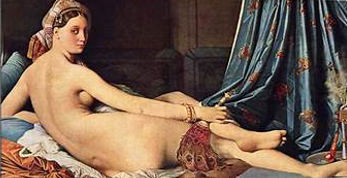
(Note the length of her back)

Favorite Artists: Jean-Auguste-Dominique Ingres – Bing video
Romanticism in Art
First and foremost, Romanticism was a reaction against Classicism (or Neo classicism). Romanticism emphasised the importance of the individual and his feelings towards nature. It was also a rebellion against established rules, either social or political, and against conventions in art.

Kunsthalle, Hamburg
The archetypal depiction of the romantic individual contemplating the Abyss.
Théodore Géricault (1791-1824)
In many ways, Géricault (23) was fortunate; he was born in a well-to-do family from Normandy and never had to worry about selling his paintings or begging for commissions. His short life is often represented as the epitome of what a romantic artist’s existence should be: brief but intense. Indeed, Géricault loved horses; he wrote and talked about them at great lengths, he painted them, and he even rode one to his own death. His love life was lived with the same intensity: Gericault had an incestuous affair with his aunt, probably suffered from syphilis, and exhausted himself in the pursuit of sexual pleasure.


Both tableaux by Gericault
The two paintings above illustrate Gericault’s passion for the horse and his romantic approach to painting: both riders are as close as possible to real soldiers but are also in an exalted state of mind: one is going into battle, the other in despair as he has to leave the battlefield severely wounded.
However, Gericault’s masterpiece is on another level. In 1816, a French ship sunk off the coast of Senegal. For the next thirteen days, some the survivors who had managed to build a raft, drifted in the Atlantic and will, eventually be rescued by a passing ship. Without food and with very little water, the men on board the raft will come to take dramatic action to survive, and this will probably have forced them into acts of cannibalism.

The painting is set as the sailors try to gain the attention of the reçue ship. The sailing brig is only a dot on the horizon, but hope is already shown on the faces of some of the men on the raft. Unfortunately, not all have managed to stay alive, and a few are on the verge of exhaustion and are about to leave their mortal coil. The story, which was also a scandal in France, was known by all, and therefore Gericault did not have to show us any remnant of cannibalism: it is implied. There is a view that the artist was making a point about the state of feeling in the nation: French people were in despair as the emperor was sailing away to his exile. Cannibalism representing the greed of the new regime in relation to those who were being eaten: the Bonapartists. It is now the accepted view that Gericault as a person was too much of an egotistical nihilist to be bothered about politics. He seems to have been indifferent to both systems but to have used them for his own end.
At the end of his life, Theodore Gericault pained the portraits of five people who were in an asylum in Paris. They are studies in monomania. The great playwright Moliere would have recognised them and approved of them. It is only a shame that the paintings are dispersed as they make a very interesting but poignant whole.
Theodore Gericault (The Roots of Modern Art part 1) by dr. christian conrad – YouTube
Eugène Delacroix (1798-1863)
Eugène Delacroix is probably the artist who is culturally considered the most representative of the romantic movement in France. His background is that of an upper-middle class child. Even though his father died when he was seven, Eugène was able to attend a good school and to pursue his love of art. Delacroix and Géricault first met in the atelier of Guérin, their teacher, in 1815 and their friendship lasted as long as Géricault was alive.
Delacroix is described as being a solitary man, a dreamer, who likes nothing better than being close to Nature. A melancholy human being who spends a considerable amount of his time walking amongst trees in the woods. Remarkably, the two paintings for which he is primarily remembered involved a lot of people and do not appear to be the work of a near recluse in any way.

This 1827 paintings shows us Sardanapale at his death bed (which is a pyre) and the death of everything which belongs to him prior to his own demise. The women of his Gynécée, his servants and his horses are all put to the knife before Sardanapale is cremated. This painting was a great success with the establishment but heavily criticised by the art connoisseurs, not because of the subject it depicted but for the realism of the scene. (Quite obviously, the establishment people had not seen the drawings by Goya of the dismembered soldiers of the Spanish campaign under the previous regime).

As a propaganda painting, very little can outdo it!
The most well-known of Delacroix’s tableaux. It purportedly depicts an incident during the end of July 1830 revolution. The few days of upheaval saw the end of the Bourbon Absolutist regime. Liberty is guiding the ordinary people to victory. The painting became the symbol of the Third Republic and until recently was printed on bank notes. Along with La Joconde (Mona Lisa), this painting is one of the most visited in Le Louvre. It has been said by some literary historians that Victor Hugo got the idea of the boy Gavroche in Les Misérables from the child with the pistols in this painting.
The Met’s ‘Delacroix’ exhibit shows the artist in full – Bing video
Jean Baptiste Camille Corot (1796-1875)
The wealth of Corot’s parents enabled him to undertake many journeys across France and Italy to study the art of the masters. The yearly 1500 livres which came his way from his father prevented him from having to exhibit his paintings to make some money. However, once he did hang his tableaux for the public to see, his success was immediate and lasted for the rest of his life. Having trained in the neoclassical art, Corot seems to have strayed away from this movement to do his own thing. Once he had been exposed to the art of painting outdoors, Jean Baptiste (24) never looked back. He was one of the first to rent a house in Barbizon, near Fontainebleau, which became famous later for its school of painting. But like Courbet, he was never one to belong to a school. Corot is Corot, and that is sufficient. All we need to do is admire his art and be thankful for the generosity he showed towards those who were far less prosperous than himself, as he gave large sums of money to help the poor and the unfortunate. We should also be grateful for the paintings he has left for us to admire. Merci, Monsieur Corot.


Never a didactic man, Corot influenced a number of artists from the next generation by his example in painting outdoors, and by his attempts at depicting the light falling on the landscapes he decided to paint.
Camille Corot: A collection of 489 paintings (HD) – YouTube. Music!
Jean François Millet (1814-1875)
Millet (25) spent his early childhood on a small farm on the Cotentin peninsula. Thanks to a well-meaning uncle who was also a priest, Jean Francois was sent to do his apprenticeship with a local painter, then obtained a bursary to enable him to attend the Beaux-Arts in Paris. Millet was one of the first artists to settle in Barbizon, but whilst the other painters were depicting landscapes, Jean Francois was far more interested in the human story which made him an outsider to that school. Millet struggled financially throughout his life, in no small measure due to the fact that he had to provide for his wife and nine children out of his -sometimes- meagre earnings. It is now accepted that Jean Francois Millet had a strong influence on the “Impressionist” painters and that Van Gogh quoted him as having had an effect on his art.

As opposed to Courbet who wanted to send a political message through his art, Millet was far more interested in the human side of the story. The women are collecting wheat left over from the harvest: a normal activity at the time. The symmetry in their movements and the naturalism of the picture are close to the Flemish art of the early Renaissance. A pastoral symphony in oil on canvas.

L’Angelus is the best-known painting by Millet who was a deeply religious man. The story goes that it was commissioned by a rich American entrepreneur who, when he first saw it was not happy with the subject matter. It is said that at the time, it depicted the couple praying over the recently dug grave of the new-born child they had just interred. This happened to be on the stroke of the Angelus, midday. Millet had to change the picture and it showed the couple stopping work for a few moments as the church bells in the background were striking the Angelus. Regardless of the truth in this matter, the tableau was never collected by the American businessman, and it remained in France where it was bought by the nation to be exhibited in the Musée D’Orsay in Paris. It is one of the most visited pictures and is a favourite in the cultural patrimoine of the nation as it represents peasant life in its blunt but delicately depicted reality.
Millet Biography from Goodbye-Art Academy – Bing video. Apologies about the accent.
Charles François Daubigny (1817-1878)
Charles Daubigny (26) is one of the least known artists who settled early (1841) in Barbizon, and who painted in and around the Forest of Fontainebleau and the river Seine. Daubigny was pivotal in the art world of the time as he met Corot and painted with him in Barbizon, went on a journey to Holland with Claude Monet to have a look at the work of the Flemish Masters, met and worked with Cézanne in Paris and spent some time with Courbet both in Fontainebleau and in England. It is often said that Charles Daubigny was the leading character in The Barbizon School of painting which depicted outdoor subjects thanks to the invention of paint in tubes which allowed artists to travel light. He, like Millet, was not a social painter but an artist interested in Nature as a reality. He is said to have influenced Van Gogh, Renoir, Sisley, and Pissarro.

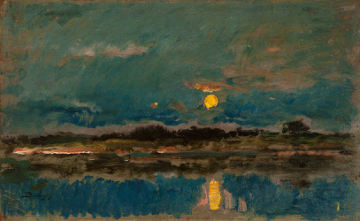
Looking at these two paintings it is easy to see the influence Daubigny might have had on Cézanne and Monet. Some people have called him one of the fathers of Impressionism. However, he considered himself a Barbizon artist.
Charles Daubigny, a painter of the Barbizon school – Bing video. Good explanatory video on his work.
Gustave Courbet (1819-1877)
I am fifty years old, and I have always lived in freedom; let me end my life free; when I am dead let this be said of me: ‘He belonged to no school, to no church, to no institution, to no academy, least of all to any régime except the régime of liberty”
Gustave Courbet (1871)
Courbet’s (27) parents were small holding farmers in the eastern part of France, close to the Swiss border. He was an average pupil at school and did not show a particular talent in art initially. However, his first drawings and paintings, all self-portraits, started to show promise. Eventually in the early 1840s, he went to Paris, ostensibly to study the law. His visits to Le Louvre rekindled his love of the arts and he never went back to study to become a lawyer after that. In 1849, he returned to Ornans, his native town, where he started to paint on a larger scale.
His most celebrated paintings whilst in Ornans were Un Enterrement à Ornans and Les Baigneuses. Both were seen as “vulgar,” “unbecoming,” “deplorable” by the middle-class establishment. To Courbet, they were the reality that he was aiming for. And he continued to pursue this goal throughout his life. According to the bourgeois critique, Courbet achieved his ideal in the painting called L’Origine du Monde which represents a completely naked woman on a very large canvas. It is now on show in the Musée d’Orsay in Paris and to be absolutely honest, it is still quite disconcerting when first approached. (The picture is not included in this website)
From a very young age Courbet involved himself in politics. Not in party politics which would have limited his scope but on a larger scale. In 1871, he was an active participant in the Commune (see quote above). This resulted in Gustave being condemned to six months in prison and a hefty fine of 323 000 francs (1.3 million euros) in 1873 for having taken down the Colonne Vendôme. Obviously, he was unable to pay such a sum.
As a result, all his paintings were confiscated, and he went into exile in Switzerland where he died. Courbet’s ability at freeing himself from the limitations of academic art helped many artists of the next generation to develop into painters who would change the physiognomy of art.

Despite all appearances, Courbet was not mad. Just angry at the injustices in his world and his inability to depict them as he wanted to or change them for the better.

The picture was heavily criticised as it included people and elements which, supposedly, should not be present at a funeral. The first one is the dog in the forefront. Not so close to the hole where the body lays, at any rate. The question asked by the connoisseurs were: To whom does the dog belong? Can they not shoe it away? Why are there two 1792 revolutionaries in the background? Behind the pleureuses (the paid crying attendees) on the right, some women appear to be gossiping. At a funeral? And more. All to indicate that this was an unacceptable bit of art. Far too close to the reality of any funeral.

Personally speaking, one of my favourite paintings by Courbet. Simple as it is, it tells us a lot about the society of the time. The artist is the character on the right. On the left are his landlord and, behind him, his servant. The landlord, quite clearly a well to do local (his good clothes and assured manner tell us so) is greeting Courbet as an equal. Head high and very relaxed, Gustave is ready for a short burst of conversation about the weather or hunting or anything. The servant, on the other hand, is looking down; servants were never to look at the speaker directly unless addressed by him. It is worth noting that Courbet carries a small backpack with all the materials which will enable him to paint in the open. A novel way of working.

The two men represented are bagnards: prisoners who have been condemned to hard labour. A subject never attempted before and, unsurprisingly, the establishment men went to town on it. “These bagnards are not worthy subjects of art. “” These men are murderers.” The art critics clamoured in the newspapers. Emile Zola, the writer, defended Courbet’s realist approach to his art.
For all his idiosyncrasies, Courbet made the art world pay attention to other subjects than the ones accepted by the academies. The door was now open for the next generation of artists.
Gustave Courbet -Understanding Modern Art Part 3 – Bing video. An excellent video about Courbet. Warts and all.
Rosa Bonheur (1822-1899)
From a very young age, Rosa Bonheur (28) was a success. As a painter, she was recognised in France and beyond in her own lifetime, she was the first woman ever to receive the Légion d’Honneur and she seems to have led a charmed life.
Her father was, in his politics and his philosophy, an egalitarian and he treated his eldest daughter as such (or nearly). Rosa was a precautious talent who was exposed to many of the most important events of the century (1848, 1852, 1871) due to her father’s political anti-establishment activities. However, her art remained very conservative in approach throughout her life, and she never took up with any of the “forward-thinking” contemporary art movements. Bonheur struck a relationship/friendship with Nathalie Micas whom she met at 14. They stayed together until Micas ‘death in 1889.
Rosa was interested mainly in depicting animals. Her tableaux of horses were sought after by many an art collector and she was never without commissions in her lifetime. It is said that she favoured the company of animals over that of humans. She won many prizes early in her career and was, therefore, always financially independent.
Rosa Bonheur often wore men’s clothes which, she claimed, was for practical reasons. She also rode a horse as a man would do, this required her to have a permit from the local administration. Somehow, she always managed to obtain one.
Bonheur was a great follower of George Sand and was in turn admired by the Empress Eugnie (Napoléon III’s wife) who visited her on one occasion in her studio. This may explain her ability to get the permits to ride her horse in a non-amazon style.
Due to the rise in popularity of the “Impressionists,” Bonheur’s work seems to have disappeared from the scene after her death. ecently, her paintings have found favour again with both private collectors and institutions in France and abroad.


Rosa Bonheur: “As far as males go, I only like the bulls I paint” | National Gallery – Bing video
As we are now going to visit the seaside(s) of France and other places in the world as well as the farmlands of Brittany it might be wise to make some savoury and sweet pancakes and find some cidre bouché from that very region before attempting the next section of this chapter.
EugèneBoudin (1824-1898)
Boudin Father was a sailor in Honfleur. His mum stayed at home to look after the children. Eugène (29) did not stay at school very long and by 1836 he was working in a papèterie in le Havre. By 1844, he had bought a shop with a friend, and they were selling paper and other art goods. So far, Boudin had shown no sign of any artistic talent. Because of the shop, he befriended local artists and even Charles Baudelaire, the poet, who remained a friend for the rest of his life. Encouraged by the painters, the very shy and retiring Boudin began to draw, then paint with a modicum of success.
After a disastrous attempt at being a portraitist and with the help of the great teacher and academic painter, Thomas Couture (1815-1879), Eugène Boudin discovered outdoor painting. In 1857, whilst shopping for paint, he made the acquaintance of a young artist who was both wilful of character but limited in experience: The 17-year-old Claude Monet. The two soon became friends and travelled to Holland to look at the masters of Flemish art and to paint outdoors. There is no doubt that they influenced each other’s work.
Back in France, Eugène voyaged to Deauville where he tried to sell paintings of the Parisian elite who had come to the seaside for the weekend now that the trains were running from the capital to the Normandy coast. Although seen as some of his best work, this was not a success at the time as the people depicted were unrecognizable being either too small or too far.
Boudin exhibited some of his Normandy landscapes in Paris and the famous writer Alexandre Dumas bought a number of those. Gustave Courbet became a very close friend and Boudin supported him financially whilst Courbet was serving his six months prison sentence in 1873. Corot called Eugène Boudin “The King of the Skies,” a title which stayed with him for the rest of his life. (Praise indeed coming from such august ally.)
The real artistic and financial recognition came in the late 1870s when the dealer Paul Durand-Ruel (1831-1922) bought all his paintings and then exhibited them to excellent reviews in various galleries in Paris and Boston.
Boudin is often referred to as one the fathers of Impressionism. I do not think that idea ever entered his head. He knew what he wanted to paint: skies, fields, seas, farm animals and boats. The rest was for the journalists to invent later in their headlines. One thing is certain, his art is full of beauty and humanity. Even though the scale is sometimes enormous, it is always accessible to us human beings. It opens the mind to beauty (albeit, on a human scale and not as an ideal of the concept).
Thank you,Monsieur Boudin for your art, your humanity, and the beauty you brought into my living room.

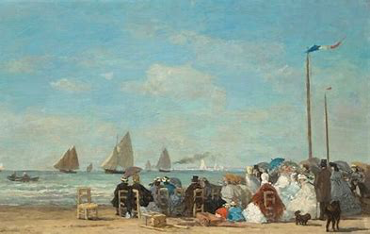

Boudin’s friend Claude Monet will title one his early paintings of boats, river, and sky “Impression: Soleil levant” which will trigger the name Impressionism for that style of painting.
Eugène Boudin- Anne Sophie Mutter-spieelt Mozart Sonate in Es-Durl V302 – Bing video
Impressionism
Impressionism is first and foremost a rebellion against formal academic painting. It is the art of observing the ephemeral light which falls onto objects and landscapes and of depicting it as an impression gained by the observer: in this case the artist and his brushes. The fact that it is outdoors is, to a large extent, of lesser importance.
Camille Pissarro (1830-1903)
Camille Pissarro’s father was French but with Portuguese ancestry. His mother, Danish on one side and Creole on the other. Pissarro (30) was born on the island of St Thomas in the Caribbean. Aged eleven, he was sent to Paris to study in a boarding school in the suburbs of Paris. When he returned to the island of St Thomas, he met a local painter who encouraged him to pursue his art studies. Back in the French capital, he met Claude Monet at the Salon des Artistes in 1859 where Pissarro had a painting on display, and they struck a friendship.
Four years later, in 1863, none of Pissarro’s paintings were exhibited at the official salon. With the agreement of the Emperor, a Salon des Refusés was created, and both Pissarro and Monet had paintings on show.
Camille fled to London during the Franco-Prussian War of 1870 where he lodged with Claude Monet. His house in France was occupied by Prussian troops who used his paintings as a butcher’s blocks. None was recovered after the war. He returned to France in 1871, and settled in Pontoise, north of Paris for the next ten years. There, he welcomed Paul Cézanne and Paul Gauguin amongst others.
In the late 1870s, he moved from heavy stroke paintings to be closer to the art of Georges Seurat and Paul Signac, pointillism. However, in the autumn of his life he got fed up with the demands of pointillism and went back to stroke painting and to what is called nowadays post-impressionism Pissarro is often described as one of the fathers of Impressionism and later of post-impressionism. Pissarro was very much a man of his age who knew his own mind, and who was prepared to experiment when he felt like it.


Camille Pissarro Documentary – Biography of the life of Camille Pissarro – Bing video
Edouard Manet (1832-1883)
There is no rational explanation why, at some points, throughout history, men and women have found themselves in groups which have changed the face of the arts or of philosophy. The Flemish school, German romanticism, The Italian Renaissance, or the latter part of the 19th century in France in art are prime examples of such happenings. In the case of the French group, which, of course, included non-French people, it moved painting in a direction which was not wholly unexpected at first, but subsequently transformed the art altogether further down the road.
Édouard Manet (31) was born in the Parisian haute-bourgeoisie and was going to attend a school to become a marine officer but failed the entrance exam twice. As a result, he undertook a course of studies with Thomas Couture, the famous, if academically minded, teacher at the Beaux-Arts. The seven years he spent there enabled him to acquire the skills he needed to produce works which took him out of the realm of the academic. And if he was nothing else, Manet was a beacon in the rebellion against the formality of the schools of Realism or Romanticism.
His paintings were meant to provoke a reaction and they did, even if, as in 1867, during the Universal Exhibition, hardly anyone visited the gallery where he was showing and selling his tableaux. Whilst rebelling against the likes of Couture et al, he also consistently refused to become part of the Impressionist group. He helped them, he befriended them, he bought paintings by Monet amongst others, but never belonged to Impressionism as such. His art was his own and developed along his chosen lines. He only took few pupils; amongst them Berthe Morisot who would become his siter-in-law, and Eva Gonzales (both are discussed later in this chapter).
« J’ai fait ce que j’ai vu. » (I have painted what I have seen). This sentence by Manet describes his art and in some ways the evolution of his art.

An early work. But it already sets Manet apart from academic painters who would have preferred to have painted the face in greater detail. There is something of Caravaggio in the subject and its lighting.

Crowds of contemporary people were not often on the menu of artists of the time. But Manet manages to convey a lively moment and the music can be felt in the attitude of the participants. Other painters are also included in this oeuvre by Manet. It is worth noting that the perspective seems a little off kilter, which gives even more movement to the piece.

A scandal in 1863. It was acceptable to paint nude women (or men) if the context was historical or biblical but not if the people included in the subject were in contemporary attire, or recognizable as living at the time it was produced.

The woman is a sex worker waiting for her next client. She is looking directly at whoever is looking back at her and her attitude is one of “ that is who I am, take it or leave it and I can live without your opprobrium”. This was another scandal which did not endear Manet to his critics; except the likes of Emile Zola or Charles Baudelaire who defended him.


Both paintings are at the Musée d’Orsay Paris
Both portraits are very recognizable as being by Manet. The artist, Berthe Morisot, on the right is totally at ease in her natural pose as the subject. She is ready to have a conversation with the painter as he is depicting her. The Fifre player, finished six years earlier, is a preparation for the Berthe Morisot portrait as it endeavours to depict the same attitude.


So far, the colours used by Manet have been a little on the subdued side of the palette. This is no longer the case in 1874. Both paintings seem to have been influenced by meeting artists who would form the Impressionist group.

It is the year before his untimely death. The Folies Bergères had recently opened, and many artists will depict scenes from the famous nightlife venue. The woman is lost in her daydreams, whilst behind her, and reflected in the mirror, another illusion is taking place: pleasure and happiness.
Manet – Bing video I realise that monsieur Graham-Nixon likes his words (hehe!). However, it is the best of the lot.
Edgar Degas (1834-1917)
Like his close friend, Edouard Manet, Degas (32) spent his life painting contemporary subjects which were close to his heart: horses, ballerinas, café and cabaret scenes as well as working women (blanchisseuses et repasseuses). Often described as the pope of the Impressionist movement, Degas, like Manet, always claimed that he was his own man and refuted the assertion that he was an Impressionist at all. Yet for a number of years, he exhibited is paintings with the newly formed Société des Indépendants and met regularly with the artists belonging to that société.
Born in a very wealthy family, as a child, Degas was privileged. He attended the best school in Paris and seemed to be heading for a career in the family bank. However, his ability with the pencil pushed him to study at the Beaux Arts. From Neoclassical initially in his approach to painting, Degas soon found his own style.
Degas was never an easy character to get on with, especially if he did not like the person. He had a strong moral point of view coupled with a biting sense of humour which bordered on the insulting. During the Dreyfus Affair, he, and Pierre-Auguste Renoir, were active in the Anti-Dreyfus League of Patriots: a most antisemitic political faction.
Coming from a haute-bourgeoisie background, Degas frequently visited the race courses of Paris, the opera and various entertainment venues where he found subjects which appealed to him. His drawings and paintings of nude women in everyday situation created quite a stir when first shown in public. However, they are now seen as some of his best work.
Even though he purchased a lot of the paintings from his contemporaries, especially Manet, Degas appears to have spent his latter years in poverty and ill health mainly due to his becoming blind.

An early Degas

Degas seems to have found his voice.

Degas at his best with the ballerinas

This is so far from his upbringing.
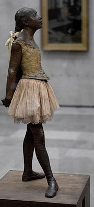
Degas was also a sculptor

One of Degas’ most famous and moralist paintings
Famous Edgar Degas Paintings – Bing video. Remember to turn off the music after the first cycle, please.
Paul Cézanne (1839-1906)
Paul Cézanne’s father was a provincial banker from the Provençale city of Aix-en- Provence. It took a fair amount of time for Paul to persuade his father that art was going to be his future and not banking.
His years at the lycée in Aix were marked by his friendship with Emile Zola, the writer. This friendship was going to last until Cezanne and Zola fell out over matters of artistic integrity: Paul thought that Emile, in his middle age and because of his enormous literary and financial success, had become a bourgeois without principles. Zola expressed the view that Paul was isolating himself from reality and had lost his creative spark as a painter.
Cézanne (33) never formally trained as an artist. He failed to gain a place at the Beaux-arts school, having moved to Paris from Aix en Provence in his early twenties. There, he met Pissarro, Bazille, Renoir, Monet, Sisley, and Manet and through Manet, Berthe Morisot and Eva Gonzales. Basically, what would become the Impressionist group.
After the Franco-Prussian War of 1870, Cézanne settled in Auvers-sur-Oise, close to Camille Pissarro and for the next few years, they seem to have painted together and, this is probably where the older man taught the younger one about the use of colours.
Paul Gauguin exhibited at the first Salon des Indépendants in 1874, but his paintings were not well received by the public or the critics. He did not exhibit at the next Salon two years later. At the third show in 1877, his paintings were derided again, and Cézanne seemed to have been less inclined to show his paintings to the public.
Popularity came late to Paul Cézanne. It is only from 1895 onwards that his art was the subject of Récapitulation in Paris and London.By which time he was more or less a recluse.
Cézanne saw painting as a didactic way of expressing the tension which exists between the objective reality and the way the artist is attempting to represent it on the canvas.
It is often said that Picasso and Braque amongst others, were admirers of his art and that he helped them to take the next step into Cubism.

Paul Cezanne painted the Montagne Sainte Victoire on a number of occasions, in all seasons, from different angles with different foregrounds. Later examples are paying less and less attention to the “objective” view and more and more to its shape and colour.

The first thing that strikes the observer is the lack of perspective in terms of angle of the table and the disproportion in the bodies of the two men. Yet, as the observer gets used to the lack of perspective, it begins to make sense. What is more important: reality or perception?

The onlooker knows what they are, fruit on a plate. It is the contrast between the beauty of the colours and the awkwardness of the shapes which attracts our attention.

Cézanne is taking the next step. Picasso, Braque and many others are already round the corner. The 1907 Cézanne retrospective exhibition had an enormous influence on some of the next generation of painters.
Cézanne: The Father of Modern Art on Vimeo. A most excellent video by the Courtauld’s and Jackie Klein. Ms Klein’s explanations are very useful in our understanding of Cezanne’s art. There is also a French film about the relationship between Zola and Cezanne. Cézanne Et Moi Official Trailer – Bing video
Claude Monet (1840-1926)
“Si je suis devenu peintre, c’est grâce à Boudin qui avec une inépuisable bonté, a entrepris mon éducation” (34)
Although born in Paris, Claude Monet’s parents moved to Le Havre where Claude eventually met Boudin. Monet (35) had been drawing and selling his popular caricatures for a number of years when the two met. Eventually, they would travel to Holland to look at the Flemish Masters’ work and to paint outdoors together.
After his military service was over in 1862, Monet went back to Paris where he met Renoir, Sisley, and Bazille at the studio of the painter Gleyre. Concomitantly, Claude Monet discovered the paintings of Edouard Manet which inspired him in terms of perception of form and light. In 1865, Monet’s paintings were accepted at the official Salon des Artistes.
It is at this time that one of his first major works appears, namely, Le Déjeuner sur l’Herbe (1866).

Monet’s work is at this stage very much influenced by both Manet and Boudin
By 1872, Monet has progressed to the next stage in his development as a painter. The Impression, Soleil Levant, not only exemplifies this evolution but, ironically, will also bring about the naming of the Mouvement: Impressionism. (The art critique Leroy wrote about the painting derisively in an article and the name would remain).

A definite move away from le Déjeuner sur l’Herbe. Monet’s visit to London and his encounter with the paintings of J.W. Turner left a mark on the artist although he denied it for a long time. The art critic Leroy wrote something about “impression” in his rather negative assessment of this painting and the name stuck.
A year later, 1873, Les Coquelicots were put on display and along with some of the paintings of Van Gogh, it is one of the most recognised and recognisable paintings by Monet or any other artists of the end of the 19th century.

In the foreground are Camille, Monet’s wife who, to his great chagrin would die six years later, and Jean, their son. The Coquelicots were painted near Argenteuil, now a suburb of Paris, and was produced shortly after Monet had returned from London, where he had admired the work of Turner. Because it is so well-known, it is now very difficult to look at it with a fresh and open mind. This is the case for other artists’ famous works as well unfortunately.
In 1878, Monet rented the house in Giverny where he would stay for the next 38 years. He bought the house in 1883 from the proceeds of the oeuvres he had sold through the offices of Durand-Ruel, and began the creation of the garden and the transformation of the house.
Between 1890 and 1926, Monet will produce 250 paintings of the waterlilies which were growing in the ponds created at Giverny. Influenced by the art of gardening in Japan, Monet had an arched bridge built over the water.

This one of many tableaux of the now famous bridge and of the waterlilies below

High Summer and the flowers are in full bloom with the house in the background.
Along with other well-known artists of the time, Monet created in 1884 the Société Anonyme des Artistes Indépendants. The Société was set up to promote and exhibit works by artists who belonged to it. The collectors and buyers from public institutions soon flogged to these exhibitions which enabled painters to sell their oeuvres directly to the public.
A final word about Claude Monet. A visit to the house and gardens in Giverny is a must. The notion of bucket list does not belong here, but if there is a place to visit near Vernon, it is the place where Monet lived and worked at Giverny. Unfortunately, I have never been to Giverny in the height of summer. The four times I visited, it was either early in the season or in the autumn. Each time though it was busy, as expected. Nevertheless, the reward from the visit was much greater than the inconvenience of the crowd.
- “If I have become a painter, it is thanks to Boudin who, with inexhaustible goodness, started my education” Claude Monet about Eugène Boudin
- Claude Monet Biography – Goodbye-Art Academy – Bing video
Pierre Auguste Renoir(1841-1919)
Pierre Auguste Renoir (36) became an apprentice at 13 years old in a porcelain factory in Limoges. His parents recognised the fact that he was child with a gift when it came to drawing and the best that could happen to him was to become involved in the decoration of porcelain items. At the same time, Renoir would spend his evenings at the local art classes trying to improve his skills.
1862 saw Auguste passing the entrance exam and being accepted at the Beaux Arts in Paris where he met Bazille, Sisley, and Monet. Esmeralda, his first painting to be accepted at the official Salon was a success but as soon as the Salon had closed its doors, Renoir destroyed it.
Monet and Renoir spent a lot of time painting together but whilst Monet inclined towards landscapes, Renoir preferred to paint people. Pierre Auguste’s masterpiece, Le Bal au Moulin de la Galette is a prime example of the type of subject Renoir liked to portray.

The beginning of the 1880s saw Renoir going through some difficult times financially. To try and make ends meet, he went back to producing more academic paintings. Le Déjeuner des Canotiers is one of those paintings. In the short term, it solved the money problems, but it also alienated him from some of the Impressionists.

This painting also clearly shows the direction Renoir is going to follow. The softness of the tone, the vagueness of the lines and the pastel of the colours are precursors to the art he produced towards the autumn of his life.


In 1903, Renoir left the capital to move to the south of France. His paintings in Cagnes sur Mer are mainly of women in nature.

At times, it seems as if Renoir wished he could renew with the impressionist movement of his friends Monet, Morisot, Sisley, and Degas and of his youth. This canvas of 1908 is a prime example of this “voyage en arrière” (travelling back in time). Renoir was a prolific artist who produced more than four thousand paintings.
Pierre Auguste Renoir is the father of Pierre Renoir (actor), Jean Renoir (film director of some renown) and Claude (Coco) Renoir (the ceramist). All of them gifted individuals in their own fields. They are the subject of a biopic of 2013 (37).
Pierre-Auguste Renoir – Filmed Painting at Home (1919) – Bing video. Renoir was unable to hold his brushes and they had to be tied to his fingers most of the time. A very poignant film.
Renoir TRAILER 1 (2013) – French Painter Pierre-Auguste Renoir Movie HD – Bing video
Frédéric Bazille (1841-1870)
Both of Bazzille’s (38) parents were extensive landowners in the south of France, just north of Montpellier. Gaston Bazille, the patriarch of the family eventually became a senator in his later years. Frédéric’s first intentions were to become a medical doctor but having spent his youth looking at some of the paintings of Millet, Delacroix and Corot at his uncle’s house, he opted to study art. His parents continued to support him for the next few years of his short life. Early in the 1860s, he studied under the Swiss artist Gleyre (180-1874) in Paris where he met, Renoir, Sisley, and Claude Monet. From then on, he became very close to Monet; the two of them ended up using the same studio in the north of the capital. Bazille was a shy and gentle giant of a man for the era (1m88). He never had to suffer any financial difficulties as his parents provided for his needs. Frédéric did his best to spread his good fortune by buying paintings from his friends to help them in times of money struggles.
In 1870 as the war against Prussia was taking shape, Bazille considered it his duty to enlist, and he was killed in the Loiret in November 1870. Just after he joined Renoir, who was very close to Bazille, wrote to him: “You are an imbecile to make this commitment because you have neither the right nor the duty! Merde! Merde! Merde!” The incident which led to his death tells us a lot about Bazille as a man: a group of women and children were trying to find shelter as they were in the no man’s land between the two armies. Bazille rushed forward to protect them and was shot first in the arm and then in the chest. He died a few moments later.
Réunion de Famille

This is the only painting by Bazille that will be presented here.
Bazille was a great admirer of what Monet was doing with his landscapes, but Frédéric did not think that he could go that far in his art. At first glance, Réunion de Famille is a neorealist portrait of a well-to-do family outdoors somewhere in the south of France on a beautiful summer’s day. Most of the subjects are looking directly at the artist, whilst the father, Gaston, is looking directly in front of him. There is no doubt that he is the figure of authority: the patriarch in full possession of his life and that of others. A very formal situation. On the right, in the background, are three figures who are far less formal. Two of them are leaning forward to make sure they can see properly what they are staring at. All the others are gazing in our direction as well as if asking: are you coming to join us or what? Then, once we have understood that little question, the formality disappears. We are invited to be present and how can we refuse. The light tells us that it is warm and welcoming on this terrace. Even Frédéric, although more of a ghostly figure than the real person on the extreme left of the picture, seems to beckon us to come along and join in the afternoon’s conversations as we are of interest to most of the people present in the image.
The first time I saw the painting in the Musée d’Orsay, I was dumfounded. I had never heard of Bazille and certainly never seen any of his work. I just sat there in front of this large canvas and could not move. I must have been there a while because on of the attendants came to see if I was all right. I was and I wasn’t. And every time I have been fortunate enough to be in the museum, thereafter, a similar thing happened. I am not naturally given to overreactions, but I could not help my state of mind when I saw the picture. I tried to find rational explanations. Most of them were outlandish. Did the woman in the forefront look like my first wife? Eli used to pass my place of work in Wales riding a bike wearing a dress of similar colour to one of the women in the foreground. Eli died of cancer some years later. Did that strike my mind? Or was it because my mother had appeared in one of my very vivid dreams when I was asleep at my boarding lycée as she had died a decade or so before and that night, she had looked at me in the way these people were? Or was it something that I had seen on my travels? No one knows. One thing is certain, this painting is part of me, and I cannot say that any other bit of art has the same effect on me.
One could speculate as to what kind of art Bazille would have produced had he survived. It would be pure speculation. For my part I can only say thank you to Bazille even if I do not know why I should do so.
Frédéric Bazille – Paintings – Bing video. All his other paintings.
Berthe Morisot (1841-1895)
To say that Berthe Morisot (39) was a woman who knew her own mind is understating the obvious. The end of the 19th century appears to have been especially misogynistic and for a woman to make her mark at that time must have taken a lot of endeavour and self-belief on her part. Fortunately for her, Berthe Morisot had two things in her favour: a family who believed in her as a person and a close group of friends who supported her throughout her professional life. And when one is aware that the group was made up of Manet, Renoir, Pissarro, Mallarmé (the poet), Zola (the writer and art critic) and Durand-Ruel (the art dealer), it can only have been a positive in her life. Furthermore, at an age which would have been considered advanced in 1874, she married Eugène Manet, younger brother of the well-known painter.
Morisot came from a haute-bourgeoisie family. From a young age, she went to good schools and showed an interest in drawing and painting. She and her younger sister, Edma, would be given lessons by a certain Camille Corot who happened to be a friend of the family. Lessons is certainly a misnomer as Corot was the least didactic teacher they could have wished for, but he knew about colour. Soon, the two sisters had had enough with being inside and wanted to paint outdoors. A farm was found and rented for Berthe and Edma to venture into the countryside. Edma’s marriage to a naval officer eventually made the girls go into different directions.
The early 1870s, in the aftermaths of the Franco-Prussian war, appears to have been a time when Bethe’s style changed.

This painting by Morisot is unusual in as much as the child is turning its back on the onlooker and it is a profile of the mother and not a full portrait. The contours and lines are already less well defined as more academic paintings would and should have. (Berthe Morisot was anything but an academic painter).
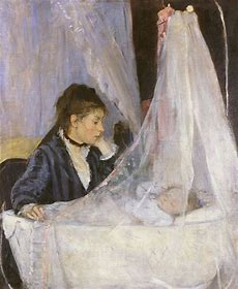
This is the most well-known canvas by Berthe Morisot. It was denounced by some of the journalists as being too self-centred. One even called Morisot a prostitute as a result of exhibiting such a personal event in her life. It is hard to believe that people could have even considered such a subject matter unacceptable. The delicacy in the painting is astounding; the face of the child through the material is especially exquisite.

Morisot as a mature artist in full possession of her talent. Impressionism at its highest.

Morisot seems to have left behind the dark backgrounds she painted when she worked with Edouard Manet and has found her palette of lighter, clearer colours.

Morisot remained a loyal proponent of impressionism for most of her artistic life.
A year after her death, her daughter, Julie Manet, with the help of Mallarmé (the poet) and Durand-Ruel (the art dealer and collector) organised an exhibition of her mother’s paintings. This was a success. Her tableaux are sought after by private and institutional collectors to this day.
Berthe Morisot French Impressionism Paintings History Artist Biography Documentary Lesson And Manet – Bing video. Sorry about the slightly (!) patronising voice and comments. The documentary is OK
Marie Bracquemond (1840-1916)
Nothing short of a miracle introduced Marie Quivoron, later known as Marie Bracquemond (40), to art. She came from a family which never settled very long anywhere, and neither of her parents were artists. However, she ended up being taught by Jean Dominique Ingres and she, in turn, would teach drawing to her future husband, Felix Braquemond. Even though Ingres thought women were good enough to paint still lifes, but not much else, Marie Bracquemond had a fairly successful early career. She was extremely talented, and her paintings were appreciated by critics and public alike. However, things changed a few years into her marriage.
Felix Bracquemond was an artist in his own right: engraver, painter, and sketch artist. Soon after their wedding, Felix seems to have realised that his wife was more talented than he was and he became jealous of the acquaintances who supported her, and envious of a talent that he did not possess. In his biography of his mother, some years later, their son, Pierre, describes the meanness of his father towards Marie. His almost permanent derisory remarks towards her work resulted in Marie Braquemond refusing to show her canvasses to anyone and eventually stopped her from painting. This situation was exacerbated when Marie decided to paint outdoors in the Impressionist style and Felix refused to give her permission to do so because he did not like what these artists produced.
Marie had made friends with the group of the Artistes Indépendants, and her style of painting took a turn in their direction. It is noticeable that in many of Bracquemond’s female portraits the women do not look at the us. They are gazing at the floor in front of them as if they are afraid to hear what the painter has to say. There is even a photograph of Marie Bracquemond which shows this very trend.


It must have taken some courage to face being a woman artist in a misogynistic world AND to have a husband who was doubly so because of his envy and jealousy. Although Marie Bracquemond managed to fight him to go and paint outside in a style which suited her character for a period of time. Eventually, Marie stopped showing her canvasses to the public, and stopped painting altogether.
Henri “Le Douanier “Rousseau 1844-1910
There is little doubt that Henri Rousseau (41) is one of the most confusing, flamboyant, and disarmingly charming characters of an era which had already quite a few of those. Born in the western town of Laval, Henri never formally trained as a painter. He was self-taught. Life did not start as well as it could have as at age 16, he was sent for a short burst of time to prison for the theft of twenty francs from his employer. Following a spell in the army, he gained employment with the tax office in Paris as a lowly clerk. The Douanier (custom officer) name comes from a misunderstanding as to what his job was: he collected taxes on alcohol coming into Paris, and in no way was he a Customs employee.
Le Douanier Rousseau never travelled far from Paris and the jungles he was so fond of depicting came from his visits to the Jardin des Plantes or Le Jardin Zoologique of the capital. The first showing of his canvasses resulted in them being mocked by the critics and ignored by the public. However, later on in his life, his art, often described as naïve art, suddenly became popular. Appreciation of his paintings came from Robert Delaunay (the artist), Alfred Jarry (the father of Ubu Roi), Guillaume Apollinaire (the poet), and none other than Pablo Picasso.
After Le Rêve was displayed Apollinaire wrote « Cette année, personne ne rit. Tous sont unanimes: ils admirent ». (This year, no one is laughing. They all admire)

There is a view that Rousseau was a precursor to what Séraphine Louis was going to produce in terms of art a few years alter. It is extremely improbable that Séraphine Louis ever saw a painting by Le Douanier. She, like him, seems to have been a one off. Both were fortunate to be recognised in their own time. How many more of these “one off” artists, unfortunately, never had that opportunity?

Rousseau was very keen to depict the technological progress taking place in his lifetime.

Although very much on his own as an artist in terms of style, Le Douanier Rousseau seems to have belonged to this group of end of century artists, such as Rimbaud (the poet) and Jarry (the playwright) who, whilst troubled souls, knew very much what they wanted to produce. They opened the doors for many other artists coming after them.
Famous Henri Rousseau Paintings – Bing video. Full screen is best.
Gustave Caillebotte (1848-1894)
Gustave Caillebotte’ s father was a wealthy cloth merchant who left a comfortable sum of money as well as a property which contained a studio for Caillebotte (42) to indulge in his passion. Gustave trained as a lawyer and a naval architect, but his real calling was painting. He never thought himself as talented as some of the other artists he would befriend: Monet, Renoir, Degas, and Pissarro. Throughout his life, he would support them financially or buy their paintings to ensure that they would survive.
Caillebotte’s favourite subjects were everyday life and work. He was the first artist to represent ouvriers and artisans at work in the city. His most famous oeuvre was refused at the official Salon when it was finished. This was a major setback for Caillebotte and impacted on his confidence.
Whilst the other Impressionists gained in fame, Caillebotte remained largely unknown in France, but not in the USA where his art was praised and highly prized. It is only since 1994 that his paintings have come back to the forefront in France and have been accepted as an integral part of the Impressionist movement. In his will, Gustave Caillebotte donated a great number of the tableaux he had acquired during his life to the French state: some were refused as the very conservative management of the Palais Du Luxembourg thought that they could not exhibit such avant-garde art. Fortunately, several of these paintings were accepted and are shown to this day in various museums. The others were bought by foreign institutions or by private collectors.


To the academic men in charge of selecting suitable paintings for the official Salon, these subjects were anathema; crude, rude and vulgar were some of the terms used. To us now, they are objects of beauty as well as social records of times long gone. We should be glad that Gustave Caillebotte’s work is shown all over the world but especially in Paris where he painted for most of his life.
Famous Gustave Caillebotte Paintings – Bing video. Please turn the music off.
Paul Gauguin (1848-1903)
At a glance, Paul Gauguin’s (43) life might appear to be that of the inveterate romantic adventurer. His mother was from an aristocratic family from Spain and his father a well-to-do journalist and investor who died whilst the family were en route to Peru. From then on, Gauguin’s existence is full of unusual experiences which would take most of us several lives to go through. Aged 17, he was sailing as second lieutenant on merchant ships to the Caribbeans. During the 1870 Prussian conflict, he was aboard a French Navy ship which captured a number of German boats. After 1871, and for most of the next decade, he was working as an Exchange Agent and made large sums of money which he spent liberally. He married a Danish woman with whom he had five children but left them once he could not financially look after them. He started to paint in Paris when he encountered the Impressionists. He befriended Pissarro who encouraged him to continue with his art.
Pierre Bonnard, the painter from the Pont Aven school influenced his way of thinking about structure and observation when he moved there. In Brittany, Gauguin seemed to have acquired the technique to produce what his mind and creativity were pushing him to put on his canvas. He worked on the Panama Canal during its construction but ended up in Martinique where he painted scenes of everyday occurrences as the work in Panama turned out to be too hard and dangerous. Back in France, he met the Van Gogh brothers and Vincent invited him to come and paint with in Arles. This resulted in some of the most beautiful art produced by either of them but also in the infamous ear incident.
Finally, Gauguin took himself off to Tahiti and the Iles Marquises. There, he created a large number of paintings of the local women and of the countryside of the islands. He died in the Marquises as a result of an overdose of opium he had taken due to injuries sustained during one of the fights which appear to have been regular occurrences throughout his life.
To say that Paul Gauguin must have been a difficult character to deal with could be an understatement. He appears to have been argumentative, short tempered, aggressive but driven, caring and loving. The people of the Marquise were not entirely won over by Gauguin as they thought that he used them for his own purpose. He certainly had relations with young women who by today’s standards were vastly under aged: Tehura was 13 years old, and so were Pau’ura and Marie-Rose. All three were apparently pregnant by Gauguin before they were 14. Having said all this, it is impossible to deny that Gauguin in his approach to painting and in his influence on Klimt, Van Gogh, Matisse, and Picasso changed the face of art.

Painted during his time with the Pont Aven School. Some critics have said that it is about Paul Gauguin’s interior debate. He himself argued that it was about the simplicity with which women accepted religion in Brittany.

An existential set of questions which must have been on his mind the whole of his life. The answer appears to have been more destructive than creative in his everyday life and the opposite as an artist.

This tableau must have been painted at a time of stability in Gauguin’s life as it does not have the same tension or striking colours of other paintings undertaken at times of stress.
Georges Seurat (1859-1891)
In his short life -31 years- Seurat produced art which had a very strong influence on what was going to happen next to painting and art in general. He attended the Beaux-arts school at the age of eighteen but soon found out that the teaching was not what he was looking for. His interest lay in the perception of light and its reproduction on the canvas. To achieve his aim, he studied the best available physics textbooks on the subjects of colour and optics at the time. This scientific approach to painting resulted in what is now called pointillism and postimpressionism. There is little doubt that most of the Impressionist group objected to this form of art, to such an extent that Monet, Renoir and Sisley refused to have his paintings shown in the same salon as Seurat’s during the last Salon des Indépendants in 1886. The only one of the Impressionists who will attempt to paint in the pointillist style will be Camille Pissarro (see above).
Pointillism means painting in very short strokes with a brush or even using dots of paint to create an ensemble. The only colours which are to be used are the primary colours or the secondary ones: yellow, red, blue, green, orange and purple. The rest is optical illusion created by our brain. The subject matter favoured by Seurat is the city and its people. Whilst his compositions are more classical than impressionist, the people depicted seem to be frozen in time.

This is painted using short stroke, although Seurat will review some of it later on using pointillism.

Again, this is done using short strokes and some areas were changed to be done using the pointillistic technique. This is a long way from Impressionism and getting close to what the next generation of artists will produce.

The dresses the dancers were wearing were shocking for the good people who saw the painting at the time. Furthermore, the dance itself was an object of derision for the same right-minded spectators. Note that the perspective is maybe not what it should have been, preparing for the advent of the next movement in art.
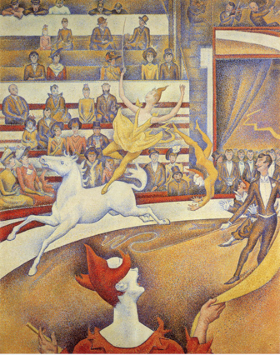
Unfinished painting but already announcing the direction that art was going to take in the next few years. One can only wonder as to where Seurat would have gone next in his search for what his imagination was pushing him to explore. Seurat was a very reserved man who never told his parents of his relationship with the model Madeleine Knobloch, or of the child which was born of that relationship. The child died two weeks after his father.

A final word about Seurat. Not only did he have a short career, but the technique he employed meant that a painting was a long and laborious undertaking. This in part explains the small number of tableaux which exist by him. The mantle of postimpressionism and especially pointillism will be taken over by Paul Signac of which more later in this chapter.
Pointillism With Georges Seurat – Bing video
Eva Gonzales 1849-1883
Eva Gonzales spent most of her short life in the shadow of Edouard Manet who was her mentor (and maybe her lover). From a fairly academic style at the beginning of her career she moved to paint in the Manet style, and towards the end of her life she began to be influenced by the Impressionists. Throughout her life, Gonzales followed Manet in refusing to exhibit her paintings alongside those of the Impressionists at the Salon des Indépendants.

The influence of the teaching of Manet can be felt in this composition. The subject matter, the dark background, and the bouquet of flowers on the left of the picture tell us that Gonzales followed the directions given by Manet to the letter.

The difference between the two tableaux gives us an idea as to what direction Gonzales was going to take before her untimely death put paid to any further development. It is clear that her style was getting closer to that of the Impressionists.
Eva Gonzales gave birth to a little boy in April 1883. Unfortunately, a few days later, as a result of the birth she died of a blood clot on May 6, 1883. Her mentor, Edouard Manet had died at the end of April of the same year. She is now considered as one of the three Grandes Dames of Impressionism alongside Berthe Morisot and Mary Cassatt.
Marie Darrieussecq – “A Box at the Theater des Italiens” by Eva Gonzalès – Bing video
Francis Tattegrain 1852-1915
Francis Tattegrain’s father allowed his son to study art on one condition, that he would study Law at the same time. Francis (44) completed his doctorate in Law before joining the Julian Academy in Paris to improve his skills in drawing and painting. Once his paintings had been exhibited at the official Salon des Peintres Français in1879, Tattegrain never went back to being involved with the judiciary.
Tattegrain’s area of predilection was the Channel coast of the Pas De Calais, especially the stretch between Boulogne sur Mer and Berck Plage. His subjects were mainly taken from the people who were making a living out of the sea: sailors, fishermen, and pilleurs d’épaves (45). His style was that of the Naturalist. Painting the subjects in their daily lives in their own environments. His most well-known piece exemplifies perfectly both his style and the aim of his art.

The story attached to this painting speaks volume as to the conditions in which people lived in the region. The girl in question is one of dozens of young women (this lady is in her mid-teens) whose job it was to collect anything that the sea left on the beach. The debris were then sorted and either recycled or sold to make a few francs. The colours of the sky and of the grasses at her feet tell us that it is almost certainly a winter month. Her posture implies that she is carrying a heavy load. The state of her clothes screams of poverty. Her day will start at first light, trying to be on the sand before the other gatherers. Even in the middle of winter, this young woman will have to enter the water if she sees something away from the shore which is worth getting. In these conditions her life span was extremely limited.

Whilst Eugène Boudin was fascinated in depicting the beauty he observed around him on the beach, Tattegrain was far more interested in the reality of everyday life as he saw it for the people who had to make a living out of it. Tattegrain’s art is grim in its blunt realism, but there is a certain beauty in his paintings. One thing is certain, it is Tattegrain’s courage. On the first of January 1915, he went to paint the aftermath of the battle of Arras. Unbeknownst to him, the Germans were still in town. He was killed whilst painting.
Peinture naturaliste : Françis Tattegrain au Musée de Berck sur mer – Bing video In French but the paintings are there to be admired.
Ship wreckers. Unfortunately, these were as common as the bandits to be found in Cornwall. As if the dangers of the seas were not enough!
Paul Signac 1863-1935
In 1879, aged just sixteen, Signac (46) went to the Salon des Indépendants in Paris. After the visit, he decided to leave school and to become a painter. His recently widowed mother supported him financially in his endeavour and soon, Paul Signac became a member of the “Impressionist “coterie. His friendship with Monet, Morisot, Manet lasted until their deaths, as he survived them all. The two artists who influenced him most were obviously Pissarro and especially Seurat who had researched into representing objects or people through the scientific way of using colour.
Signac exhibited two paintings at the 1884 Salon and was overall quite well received. Well enough at any rate, for him to continue painting and selling his art. His meeting with Seurat determined his artistic direction for the rest of his life.
Six years before his death, in 1929, Signac embarked on a quite extraordinary project: to produce two paintings of each French port. Being a keen sailor and having the means to undertake such a task, he left us with two hundred tableaux of the country’s main harbours.
Paul Signac considered himself a libertarian and an anarchist. Yet, he was always friendly with people who were as far from his political ideology as possible. His attitude towards individuals was very much like that of the great song writer Georges Brassens: gently chiding but warm and friendly (see chapter on music).

Signac is 21 years old and has exhibited two paintings at the Salon des Indépendants. He is exploring the way forward. The influences are many, Pissarro, Monet, and Seurat for the strokes maybe.

A typical example of neo-impressionism. This is beyond Pointillism as the brush strokes are much bigger than simple dots. Looking at the painting closely, the observer can see the gaps between the strokes. But as soon as one moves away from the painting the gaps miraculously disappear to give one the full benefit of the scene.
Paul Signac – Bing video I really do not know why they chose to overlay Albinoni’s music: totally the wrong choice in my opinion. Debussy? Satie? Fauré? Even Saint-Saens at a pinch.
Time for a break from Impressionism and all that. A new drink is called for. The next generation of artists are going to stretch us in various direction. So, let us have some amuse gueule (see picture below) and a Pernod or a Ricard with ice.

Suzanne Valadon 1865-1938

Some people have extraordinary lives thrust upon them by accident, but few make the most of these lives: Suzanne Valadon (47) was most emphatically one of them. Born in an extremely poor area of the Haute Vienne area of France of a single mother who was a blanchisseuse, Valadon, by the age of 15 was an acrobat in a circus. An accident put paid to that career, but her unusual looks and totemic beauty soon made her popular with a clique of Montmartre artists: amongst them one Pierre August Renoir who also became her lover.
Aged eighteen, she gave birth to a boy whom she called Maurice. Maurice would eventually be given the name Utrillo after his putative father. Maurice Utrillo is now a celebrated Montmartre artist whose work ended as postcards of that part of Paris (see further in this chapter). Having observed the way they worked; Suzanne started to imitate the artists for whom she modelled. Soon, she developed her own drawing style. She showed some of her etchings to Toulouse-Lautrec who lived in the same house, and he introduced her to Degas who took her as a pupil. Amongst the people with whom Valadon had a relationship, two stand out. The first one is Erik Satie (1866-1925), the musician. She is reckoned to be the only woman with whom he had a physical relationship. When she left him, he wrote of his mind being empty and his life frozen. The second is with the painter André Utter (1886-1948) who was a friend of her son. Utter and Valadon stayed together for a dozen years during which she produced some of her best work.
Suzanne Valadon died in 1938, surrounded by Georges Kars who drew her on her death bed, Andre Derain, Georges Braque, and Pablo Picasso.
Her art stands as the bridge between neo-impressionism and Cubism. It is obvious that in the last years of her life, when she returned to painting after a break, she was going in the direction of more abstract compositions.


Valadon used strong lines to define the subjects of her paintings. The tendency is not so much the photographic representation as the summing up of modèle’s character and attitude to life which are attempted here. The colours are strong and enhance our perception of the mental frame of mind of both the painter and the poser.
Left behind is the beauty of the nearly idyllic tableaux of Berthe Morisot and child, enter the harshness and the unavoidability of the reality which prevailed in Valadon’s extraordinary existence. This is a different view of what art should be and we should be thankful to Suzanne Valadon for having produced it.
Suzanne Valadon (1865-1938) – A French Post-Impresionist painter – Bing video
Toulouse Lautrec 1864-1901
Henri de Toulouse Lautrec’s (48) physical disabilities were the results of the consanguinity of his parents who were cousins. Both of his legs were broken when he was in his early teens and after that they stopped growing whilst the rest of his boy came to be of normal size. This did not prevent him from following his calling which was the production of art. He turned his hand at painting, drawing, poster designing, illustrating and caricaturing. By the end of his short life, he had produced over one thousand paintings and five thousand drawings.
During his training with Paris based artists, he met Vincent Van Gogh, but his main influence was from Edgar Degas. Lautrec, like Degas, was interested in depicting women in the theatre. The difference between the two residing mainly in the fact that Degas was at the ballet whilst Lautrec was at the cabaret or the bordello.
As his fame grew around Montmartre at the end of the XIX century, most of the well-known places of entertainment, Le Moulin Rouge, Les Folies Bergères, Le Divan Japonais, and many more had a table set for the nightly visits by Monsieur Toulouse Lautrec. His subjects were the women who were on the stage of these famous venues or the femmes de petite vertu with whom he was intimate. Lautrec is not a painter with a political or social message, just a depicter of the life he witnessed around him every night.
The outcome of his time in Paris was that he contracted syphilis and suffered from severe alcoholism. He died paralysed in the castle where he spent his youth in the South of France.
Toulouse Lautrec produced some of the most memorable pieces of art of the period. His posters for the Moulin Rouge or Les Folies Bergères are extremely popular items sold in Montmartre to this day. Very much like Suzanne Valadon who was at one time his model and his lover, Toulouse Lautrec painted life as it was, not a beautified version of it. He is seen as post-impressionist in his technique and his use of colour and, a guiding light in the Art Nouveau production of posters.


La Goulue (Louise Weber) was with Jeanne Avril one of the most celebrated Cancan dancers of the Belle Epoque. Toulouse Lautrec painted her a number of times, but this is the most famous depiction of this artist. In the foreground is Valentin le Désossé (the Boneless). Valentin was a permanent feature at the theatre and although he danced nearly 84 000 times at the Moulin Rouge, he was never paid for his performances. He danced for the love of the art.
It is worth noting that most of the paintings and posters by Henri de Toulouse Lautrec are now housed in a museum in Albi in the southwest of France. A beautiful city with a rich history.
Need To Know About: Toulouse Lautrec – Full Documentary – Bing video
Séraphine Louis 1864-1942
Of all the artists about whom something of their lives is known, there is no doubt that Seraphine Louis (49) is the most extraordinary. It is worth spending a short time describing her youth. She was born in a poor family of in northern France. Her dad was a farm hand, and her mother came from peasant stock. Her mum died when she was one. Her father when she was seven after which, and until she was in her early teens, she went to live with her elder sister. At about twelve, she left school to become a shepherdess. A little later, she was employed as a maidservant in a convent in Senlis. Documents from the school she attended say that she had beautiful handwriting and she was an attentive student (Meaning that she never said a word). Nothing about art. It seems that she started to paint when she became a cleaner for well to do families in Senlis. According to the local museum curator, she began painting because her angel told her to do so. In many ways the reason behind her need to produce art is somewhat irrelevant. To fulfil her need, she made her own paints and brushes from materials she gathered from her job or from nature. Seraphine Louis had no training of any sort in drawing or painting; all her inspiration and technique came from within herself. Her art is often called naïve or primeval. Neither fits the bill entirely. Her art has nothing to do with us: it is to do with her “soul” expressing a need to represent a joy which is embodied in the imaginary plants painted on the canvas. Her state of mind has been equated by psychiatrists to that of being in a state of ecstasy when she was at work.


In either 1912 or 1924, the German art collector Wilhelm Uhde discovered a painting by Louis in a house where he had been invited for dinner in senlis. For a short while in the late twenties and early 30s, Séraphine achieved a modicum of fame and of financial stability. However, after the 1929 Wall Street debacle, art was the last thing people had an interest in. As a result, nobody bought Séraphine’s paintings. Her state of mind took a rapid turn for the worst, and she ended up in an asylum not far from Senlis where she died of starvation and neglect in 1942. (a similar fate to that of the great sculptor Camille Claudel-See the Chapter about the Famous women of France)
Even though she suffered from poverty and neglect for most of her life, Séraphine Louis was fortunate in having been able to express what the famous Ukrainian painter Wassily Kandinsky (1866-1944) described as “this internal necessity” which made her paint. In her case, this urge was incompatible with fame as it pushed her towards mental illness. Once again, the question raises its head as to how many people in the past, the present, and even the future (will be) have been frustrated in their desire to produce art of any sort.
A final point about Séraphine Louis. A biopic was made some years ago about the life of the artist. The acting of Yolande Moreau in the film does bring out the struggle Louis must have experienced throughout her life. A worthwhile film to watch. (The film is simply called Seraphine)
Séraphine De Senlis – Mozart – Lacrimosa – Bing video The video is taken from the film. The addition of Mozart’s music is relevant in as much as Seraphine was a strong believer in Catholicism and her life was a tragedy in more ways than one. Whether her art was inspired by the occult is for each one of us to decide in our own conscience.
Henri Matisse 1869-1954
Matisse (50) was a printmaker, a draughtsman, a sculptor, a collagist, and a painter. The work he produced during his long life is seen as being a turning point in the history of art. From Postimpressionism, he moved into Fauvism (simplified forms, strong line, strong and sometimes violent colours) and finished in producing amazing collages as his health prevented him from painting. He revered Cézanne and said repeatedly that Cézanne was the master who had influenced him most.
Matisse was successful early in his career, especially in the US, which enabled him to be financially and artistically independent. He travelled extensively and was especially sensitive to the light and colour of the regions or countries he visited (Collioure, North Africa, Tahiti amongst others). He met Picasso at the house of Gertrud Stein (the American Art Collector) but Matisse was distant and tongue tied. This would set the tone for the rest of their relationship. Both Matisse’s daughter, Marguerite, and first wife, Amelie, were arrested by the Gestapo in 1944 for activities with the Resistance. His daughter was tortured and as a result disfigured. Once freed Matisse drew her portrait.


A good example of Fauvism


I selected these works of art by Matisse as they are some of the most popular. Just to remind ourselves as to how present his art is in our lives. It is nearly impossible not to like what he was doing. Not that his aim was to please us but he, himself, must have felt secure enough in his own mind to produce such wonderful things. Merci Monsieur Matisse!
This section is rather short because the man is so well known, and his art is so popular that everyone is aware of the extent of his creation.
Henri Matisse Documentary – Bing video. 55 minutes long but really worth it if you are interested in Matisse
Pierre Bonnard 1867-1947
Pierre Bonnard (51) was a painter, graphic artist, designer, sculptor who was very much influenced by the impressionist movement. Bonnard was never attracted to the new trends like Fauvism, Cubism or Surrealism. After his death questions were asked about his status as a painter: Was Bonnard a great artist? He himself probably never asked himself that question as he was modest and gentle. His art was his own and his skills as an artist are to be found in his use of colours and in the beauty of his depictions of nature, natures mortes or nudes. He was very popular with the art critic and with the public during his lifetime but never in fashion with the avant-gardists who saw him as a petit- bourgeois painter.


I do not know how to answer the question about Bonnard being a great artist or not, as this would require comparison with others who were going in totally different directions at the time. One thing is certain his popularity with private and institutional collectors continues to the present day. Is that the measure of greatness, though?
Artist Pierre Bonnard: French painter, illustrator, and printmaker | GOLDMARK.TV – Bing video. Very informative video about Bonnard’s art
Raoul Duffy 1877-1953
Raoul Duffy (52) was born in Le Havre and spent a lot of his early life painting in the area. His skills extended well beyond the canvas: he was a draughtsman, a ceramist, an illustrator, turned his hand as a cloth designer, and a decorator of private houses, public spaces as well as of theatres. From a very early age, Raoul Dufy was successful and praised privately and officially for his skills.
His art went through three main phases.
- The influence of Eugène Boudin and the impressionists. Having been brought up in Le Havre and attending the Beaux-Arts school in that city must have automatically implied him coming across some of the paintings by Boudin and Monet.

The influence of Boudin is obvious. Dufy’s sky is not as good as the master’s, though!
The second phase was that of Matisse and to a certain extent Signac. Strong lines and colours.

Finally in 1907, Duffy attended the exhibition of Cezanne’s paintings and was greatly influenced by him. Progressively his art tended towards Cubism à la Cézanne as it were. Especially when he painted alongside Braque in l’Estaque in Provence.

Having looked at the progression in Dufy’s work, it has to be stressed that the paintings favoured by the public are depicting sea views along the Mediterranean Sea and its beaches.

Raoul Dufy (1877 – 1953) French Fauvist painter – Bing video
Cubism : a style of art that stresses abstract structure at the expense of other pictorial elements especially by displaying several aspects of the same object simultaneously and by fragmenting the form of depicted objects
Fernand Léger 1881-1855

At first sight Fernand Léger (53) looked more like a boxer who had lost its way amongst paintings than an artist with a mal de vivre. He always said that the fact that he had been brought up on a farm by a grumpy father had sculpted his physical features. As a thinker, Fernand Leger was very much influenced by what he had experienced as a stretcher-bearer at Verdun during the First World War. Like a lot of artists and intellectuals of the time, he converted to the Communist credo with which he stayed for the rest of his life. His paintings reflect in many ways his beliefs: in no small measure in the manner he depicts machines, structures, and people in an orphistic and mechanical way.
Léger visited the 1907 Cézanne retrospective, and his drawings and paintings thereafter reflect what he had seen at the Cézanne exhibition. Nus dans la Forêt of 1910 is a prime example of what his form of Cézanne Cubism would be: Orphism or Tubism.

Orphism is the use of curves and circular forms in drawing and painting. Orphism was developed by the Delaunay couple (see later in this chapter). Tubism is what it says on the tin: the use of tubular shapes to depict machines or people.
For the rest of his life, Leger remained true to his beliefs both in politics and in art. He moved away from the forms of Cubism (and beyond) put forward by the likes of Picasso and Braque but moved closer to Francis Picabia and Marcel Duchamp. The interwar years were very productive for Leger who was internationally recognised. Having experienced the horrors of the front in 1916, Léger decided to move to the USA in 1940. He took up several teaching posts and numerous museums exhibited his tableaux. The war over, he returned to Paris and his popularity with the public, the critics and the institutions continued to increase. Although less at the forefront of art than he was in the 1950s and 1960s ,Fernand Léger is still part of the pantheon of painters who played a very important part in the development of culture in France.

An example of Tubism and Orphism within Cubism as interpreted by Léger.

In this painting Tubism and Orphism appear to be less important than the need to depict manual workers doing their work in an enticingly beautiful and colourful surrounding. The link between the togetherness of the work and the political creed of Communism are blatantly obvious and accessible to all (which is what art should be according to the Communist creed).

A far less typical painting by Léger who seems to have gone back to his more profound roots of looking at the physiognomy of human beings and of showing us a more realistic view of their appearance. Few curves, hardly any tubes. Closer to Cézanne than anything else.
Fernand Léger’s Radical Cubist Vision – Bing video
Georges Braque 1882-1963
“What attached me in particular and became the main direction in Cubism, was the materialisation of the new space that I sensed. So, I began concentrating on still life, because still life possesses a tactile space that one might almost describe as “manual”… For me, this corresponded to a wish I had always had to touch a thing rather than simply look at it. This space attracted me a lot because the quest for space was foremost a Cubist quest. Colour played only a minor role. The only aspect of colour that interested us was light. Light and space are closely related, and we dealt with them together.”
Georges Braque (54)Like his father and grandfather before him, Georges Braque trained as a house painter and decorator whilst attending the Académie des Beau-arts in Le Havre. At some point in his early life, he met Henri Matisse and André Derain (1880-1954) and some of his work of that period can be categorized as belonging to late impressionism or post impressionism.

Prior to meeting Picasso in 1907, Braque was painting in the Fauvism style and was influenced by Matisse and Lger. Visiting Cézanne’s exhibition in 1907 and meeting Picasso, changed his way of looking at art.
A visit to the Cézanne 1907 exhibition and his meeting with Picasso in 1909 appears to have made him look at his art in a very different way. Picasso and Braque worked together for a number of years which resulted in the creation of Cubism.

One of the most well-known paintings by Braque. At only 28 years old, he and Picasso were already pushing the boundaries that Cézanne had set. The emphasis is on the definition of space in the cubist style. Colour is of lesser importance. This would be the trend for the rest of Braque’s life.
Braque was seriously wounded during the first World War and thereafter, and for the next 20 years, moved away from still life to paint landscapes and portraits.

In many respects a move away from Cubism. However, during that period of his life, Braque seems to have experimented in many directions. The Cahier de Georges Braque, 1917-1947 (55) clearly explains his position as an artist at the time.

One of the versions of the Cahiers published in 1948. The Cahier describes the thought processes that Braque underwent to produce his art.
During the Second World War, Braque tried as much as possible to hide from the Vichy Regime and from the Germans who were keen to entice him to Paris and Berlin. The artist managed not to be forced to comply with their wishes and became a recluse.

A very dark and serious painting which must have reflected his frame of mind at the time when France was under the grip of the Nazis.

La Sarcleuse is Braque’s last major work. Even in his advanced years, the artist is still trying to explore avenues which so far had eluded him.
Although not as famous as Picasso, Braque remains one of the most influential French painters of the XX century.
Georges Braque and the Cubist Still Life | Living St. Louis – Bing video
Cahiers de Georges Braque 1917-1947 by BRAQUE GEORGES (1882-1963): (1948) | Chloé et Denis Ozanne (abebooks.co.uk) A copy f the Cahier for sale (£418)
Maurice Utrillo 1883-1955
Maurice Utrillo (56) is one of the few famous Montmartre painters who was actually born in that specific quartier of Paris. From a young age, Utrillo was used as a model by his mother, Suzanne Valadon, or was in the presence of many of the famous artists for which she posed, Renoir, Degas, Van Gogh etc… Maurice Utrillo did not start painting until he was 22 years old, but he soon became celebrated as the artist who depicted Montmartre at the beginning of the XX century. In some part of the world (Japan in particular), his popularity is such that fakes have appeared in great numbers and it has become difficult in many instances to distinguish between copies or imitations and genuine tableaux.
Throughout his life, Utrillo suffered from alcoholism, serious mental health problems and a very overbearing mother. He spent long periods of time in hospitals for psychiatric treatment which prevented him from creating art. It is nowadays unavoidable during a visit to the Butte Montmartre to encounter painters who will produce paintings copied from Utrillo.

Utrillo’s paintings could be seen as being postimpressionistic in structure and colour. There is a softness about his art which cannot help but being attractive to the eye and easy to access.

Montmartre before the tourist invasion. It is often referred to as having had the feeling of a village in the middle of the city. Utrillo conveys very well the ordinariness of the scene whilst at the same time creating a sort of myth or an aura about it. There is no harshness or difficulties of perception about his pictures. It is all in the appearance of softness and gentle ordinariness that we see the city.

Even in the coldness of his white painting series there is a softness which detracts from the harshness of life under such conditions.
Utrillo was officially recognised by the French state and given the Légion d’Honneur in 1929 in recognition for his work in the field of the arts. It is possible that part of Utrillo’s success comes from the fact that his paintings made good posters and postcards and that it is easy for fakes or copies to be made. Whatever the reason, looking at his paintings leaves us with a feeling of peace and tranquillity which was a rare occurrence in his troubled life.
Maurice Utrillo V – Bing video a video of his work accompanied by music by Vivaldi. (Hm!)
Alfred Latour 1888-1965
Painter, graphic artist, photographer, poster designer. Alfred Latour never wanted to belong to any school or trend but chose to remain independent. The eldest son of a printer, he showed early signs as a talented draughtsman and artist. His works just before 1914 on the canvas are close to Fauvism. He managed to remain financially independent throughout his life thanks to his advertising work. Latour was seriously wounded during the First World War and spent time in hospital in Rouen recovering, enabling him to reflect upon the direction he wanted to take in his art. In the interwar period he spent a considerable amount of time taking photographs with great success. Soon after the Armistice of 1940, Latour joined the Resistance and played an active part in fighting the Nazis during the conflict.

Latour at a young age was influenced by both the Impressionists and the Postimpressionists. This changed quickly.

Latour at his purest: a convergence of many skills, painting, poster design, and even graphic design. The simpler forms with the pastel colours give an impression of lightness and joy which is recurrent in Latour.


Alfred Latour was undoubtedly more than an artisan in all his endeavours and deserves to be more widely known and appreciated than he is nowadays.
Francis Picabia 1879-1953
Painter, writer, Picabia (57) began life as a very successful Impressionist artist who, when he met Tristan Tzara, Marcel Duchamp, Man Ray turned to abstract art then to Dadaism and Surrealism.

In his early years as a painter, Picabia admired Alfred Sisley’s work. Picabia’s canvases were extremely popular and earned him artistic and financial recognition. Not that he was ever in need of money as he inherited a fortune in his twenties.

Caoutchouc was one of the first deliberately abstract paintings exhibited in France. Abstract art is a departure from reality. It releases the creative energy of people and provides them with the freedom to explore their minds and emotions in a way that was impossible in traditional styles of art. The abstract is an expression connecting the feelings and vibes. It is a different perspective than the usual perception of realism. Abstract art uses visual language of shape, form, colour and line to create a composition which may exist with a degree of independence from visual references in the world. Picabia used the shapes of rubber balls in a still life painting to explore the relationships between objects and space (?).

Dada or Dadaism was an art movement of the European avant-garde in the early 20th century, with early centres in Zürich, Switzerland, at the Cabaret Voltaire. New York Dada began c. 1915, and after 1920 Dada flourished in Paris. Dadaist activities lasted until the mid-1920s. It can be defined as a movement in art, literature, music, and film, repudiating and mocking artistic and social conventions and emphasizing the illogical and absurd. Although Dadaists would refute such an explanation as it is a classification, therefore a convention, the very things they wanted to abolish.
In producing L’Oeil cacodylate, Picabia was emphasising the ridiculous notion that the signature on the work of art gave it (monetary) value. He asked his Dadaist colleagues to write and sign this canvas to demystify such a view. It is now considered a nearly priceless work of art!
Although incredibly talented as an artist and very much in the avant-garde, Picabia was also a dilletante who spent a large proportion of his life with a small circle of similar minded people. He escaped being exposed to the suffering of the First world war by being sent on mission to Cuba and spent the Second World War in France always refusing to take sides. His dismissive attitude towards the Resistance nearly cost him dearly in 1945.
HOW TO SEE | Francis Picabia – Bing video An excellent documentary about Picabia and his art.
Marcel Duchamp 1887-1968
Marcel Duchamp (58) belongs to that rare category of people who have achieved success and renown in more than one field and who have changed the direction of thought in these fields. In his case in art. Duchamp was a painter, creator, cinematographer, conceptual artist, body art exponent and writer. An extremely bright student in all areas as a young man, he was self-taught when it came to drawing and painting. However, two of his brothers, one of his sisters and several other members of the family were artists, so he did not have to go far to find help if he needed it. Marcel Duchamp’s journey through the various art movements of the era began with Impressionism as in the example below of a painting he produced aged fifteen. He tried his hand at Post-impressionism and Fauvism but moved away from Cubism which were all in fashion at the time.


Having tried all genres, Duchamp eventually found his niche. In Nu Descendant l’Escalier number 2, Duchamp takes a path which is far more difficult than the Cubism route. Some art historians call it hermétique as it goes beyond the simplification of objects into their fundamental shapes as seen by the artist and their relationship with and in space. Paradoxically, Duchamp considers himself an “anti-art” artist whilst admiring the paintings of Goya, Velasquez, Hogarth, and many others and using their art to improve his.

This ready-made object is probably the most famous/derided bit of creative art by Duchamp. It was preceded by many others, amongst them an upside- down bottle holder. It soon became the only thing associated with Duchamp in the mind of the wider public. Two things come to mind when looking at the Fontaine of 1917. The first one is that it started a trend which continues to this day: beds, bricks, sharks, aquariums have become objets d’art in their own rights. The second is that, even if they are not from Damien Hirst or Tracey Emin, we still decorate our spaces with objects which are ready made but aesthetically pleasing to us. One nil to you Marcel!

The original title of this work by Duchamp was La mariée mise à nue par ses celibataires, même.
This is made of wood, glass, and various metals. It has a definite visual impact, and it is aesthetically pleasing and not shocking to us in early XXI century. Art historians have put forward the view that it was a modern continuation of one of the greatest paintings of all times Velasquez ‘Ménines. Duchamp’ s influence on art is undoubtedly felt to this day.
Marcel Duchamp: The radical artist who changed the course of art | The Mix – Bing video
Marc Chagall 1887-1985
Chagall (59) was born in the Byelorussian village of Liozna in a very religious Jewish family. His seemingly peaceful and happy childhood amongst similarly minded people will have a great influence on the artist as Chagall will always consider his younger years as having taken place in a sort of paradise. His talents as an artist enabled him to be sent to study at the Academyin Saint Petersburg. There, he met Bella Rosenfeld, and he fell in love with her. Bella would be his muse until her death three decades later.

Marc Chagall and Bella flying over Vitebsk. If this does not represent love and happiness, I do not know what does. In 1910, Chagall was given the chance to travel abroad. In Paris, where he stayed until 1914, he met the poet Blaise Cendrars, the artist Robert Delaunay and his wife (see below), and the poet and art critic Guillaume Apollinaire.

By 1914, as war was beginning, Chagall was back in his native country. After the Bolshevik revolution of 1917, he was given the role of Art Commissar for Vitebsk. However, probably due to his Jewishness and independence of mind, Chagall was soon replaced by a more orthodox artist in the job of Commissar. In 1922, Marc and Bella Chagall managed to come to France and started travelling throughout the world. It goes without saying that his art is in great demand. Fifteen years later, he acquired the French nationality and resided in that country until his death in 1985. The only time he had to flee was in 1941 when the Jewish laws were imposed in France and the couple were fortunate to escape to the USA. Bella, his muse of thirty years, died in 1944.

This painting was exhibited the year after Bella died. There is little doubt that all the elements of their past life together are there: the village in the East, love, marriage, their physical and spiritual life, the loss that he felt and the fact that she remained with him from beyond the pale.
Chagall returned to France in 1945 and settled there with his second wife Vava until his death in 1985.
Although influenced by Surrealism (Its aim was, according to leader André Breton, to “resolve the previously contradictory conditions of dream and reality into an absolute reality, a super-reality”, or surreality) and Neo primitivism (Neo-Primitivism is a style-label employed by the Muscovite avant-garde in the early twentieth century to describe forms of visual art and poetry that were tendentiously crude in style and socially and politically contentious in terms of subject matter), Chagall never fitted into these parameters. The three main influences were his independence of mind, Bella, and his Jewish background. His aim, if there was one, was the reconciliation between the various cultures and beliefs which he had encountered in his life.
We should be glad that most of his output is available in public places for us to have access to as he undoubtedly produced paintings, sculptures, engravings, and poetry which enlighten our days. Thank you, Mr Chagall.
Marc Chagall: The Life of an Artist – Art History School – Bing video. Apologies about the slightly patronising tone at the start of the video. It gets better.
Sonia Delaunay (and Robert) 1885-1979
Sonia Delaunay (60) was a painter, fashion designer, fabric designer, costume designer, set designer and leading artist of the XX century. Born in the Ukraine, then part of the Russian Empire, Sonia was adopted by an uncle who was also an amateur art collector. She studied in Russia, Germany before settling in France with her first husband who happened to be the art dealer Wilhelm Uhde (see Séraphine Louis). The marriage did not last long as she met the man with whom she would live and work for the next 34 years, Robert Delaunay. Robert and Sonia Delaunay’s relationship was such that they worked on the same pieces together and were at the avant-garde of art for the next three decades.
A combination of abstract circular shapes with strong but warm colours usually led Guillaume Apollinaire to call their art Orphism. According to Apollinaire this emanated from his poem Orphée which deals with pure Poetry (?), a sort of luminous language. Even he was not entirely certain what it really meant.

A typical early Sonia Delaunay painting in the form of Orphism: Curved shapes with strong warm colours.

Sonia Delaunay went back to illuminating her or other people’s writings. Here a poem by Blaise Cendrars with a painting by Sonia.
From early on in her career, Delaunay was very involved in fashion design and in painting on cloth. Soon, items of clothing she designed became fashionable and enabled the couple to be financially stable. The design of the clothes continued the trend of shapes and colours which had started on the canvas. It is quite obvious that such designs would have been popular in the 50s and 60s.

In the early thirties, Robert and Sonia became interested in advertising design, whether on cars as in above or made of luminous bars of lights. They were contracted by manufacturers to create unique advertising neon signs for such disparate things as foods, cars, and trucks.

Sonia Delaunay is one of the most important painter and designer of the XX century in France and enabled other artists and designers to move forward. The Centre Pompidou in Paris regularly has exhibitions of her work. She has become a cultural icon for the French.
Sonia Delaunay`s Work Retrospective The Colors of Abstraction Paris – Bing video
We are now entering the last section of Art and French culture: artists born post 1900. To celebrate, I propose that we go east in our choice of wine; a Gewürztraminer from Alsace, fruity and soft, will go well with a fresh baguette and a portion of Munster cheese (the smellier, the better). Enjoy!
Jean Dubuffet 1901-1985
Jean Dubuffet (61) was fortunate to have been born in a wealthy bourgeois family from Le Havre as it enabled him to be financially independent for the whole of his life. He never had to sell a painting to survive and therefore, was never at the mercy of what people thought of his art. Furthermore, whenever he was not happy in his own mind as to the direction his art was going and needed time to reflect, he would return to his commercial activities and give himself the time necessary to move to the next stage of his development.
In art, Jean Dubuffet was a revolutionary (but maybe not in business). He conceived of the idea of L’Art Brut (Art produced by people who were on the fringe of society, dropouts, madmen, and madwomen (his description), self-taught artists, prisoners and outcasts). Throughout his life, Dubuffet said that his inspiration came from them. Not from the well to do, middle of the road, bourgeois artists of the previous eras of French art.
Dubuffet was self-taught inasmuch as he attended the Julian Academy in Paris for a while but decided the constraints imposed were not for him and thereafter did his own thing. Pushing the boundaries in painting, sculpture, and arts plastiques are the norm for Dubuffet but fame (or the reverse in most cases) did not happen to him until he was in his early forties.

Les Gardes du Corps from the early 1940s were mocked by most of the public and the art critics when it was exhibited in 1944 in Paris. This art brut at its barest: simple lines, plain shapes, uncomplicated colours. A child could have just about produced this, it was claimed. Yet it was, for the majority shocking in its bare simplicity.

This is neither Cubism nor Naive Art. Dubuffet is pushing the boundaries once again. This is what the imagination enables one to do: it may be described as “cartoonesque” in conception but at the same time making us accept that art can be about other things than an intellectual exercise which Cubism is.

Matériologies et Texturologies were experiments in Papier Maché and other materials mainly on canvas. Whilst Matisse was trying to make things beautiful and accessible, the irascible Dubuffet made it plain and fairly unattractive. Should art always be pretty? Was the question he was asking.

Dubuffet experimented also in large three-dimensional creations. This was going to influence younger artists such as Nikki de Saint Phalle who would develop the art.
(See below)

This recently renovated and rejuvenated tower by Dubuffet is accessible to all in a park in the suburbs of Paris. Red, white, and blue became the dominant colours used by Dubuffet later on in his life.
Although derided at first, Jean Dubuffet soon became the symbol of a France which was at the avant-garde of art. He himself never cared very much for the official recognition such accolade gave him. All he seemed to have cared about was the development of his art.
Jean Dubuffet: Brutal Beauty – Curator Tour – Bing video A most informative video.
Bernard Buffet 1928-1999
Bernard Buffet (62) is one of those artists who will achieve success and recognition from a very young age. Having been accepted at the Ecole des Beaux-Arts of Paris at 15 years old, his career took off very quickly afterwards. Many a prize came in his direction. His output just after the end of the Second World War was enormous and most of it was acquired by two art dealers who had signed a contract with him. Furthermore, Buffet was considered by the art connoisseurs as being in the top ten French artists of the post-war era. Buffet did not approve of abstract or impressionist art and was not impressed by many past painters: maybe Manet had his vote. He saw himself as an Expressionist: Expressionistic art is amodernist art movement and its most iconic trait is presenting the world solely from a subjective perspective, distorting it for emotional effect with the aim to evoke moods or ideas.
Buffet’s art is easily recognisable as it bears his autograph in a highly familiar font and because of the strong black lines used to define his figures and the particular shape he depicts human beings.

Bernard Buffet met Annabel at a time when he had left his lover of ten years, Pierre Bergé. It was according to Buffet, le coup de foudre. He painted Annabel dozens (if not hundreds) of times. The portrait above became the cover of a book about his paintings as well as the artwork for a record sleeve.

This is a prime example of the terrible loneliness of the human being as seen and experienced by Buffet. In this case, this human uses the bottle as a prop in both senses of the world. Inevitably, it seems, such depth of despair can only lead to one thing…

There is a pathology called “La pathologie du clown.” It describes a human being who behind the appearance of a humourist and a joker, experiences deep despair. Buffet was one of those people. He ended up taking his own life.
In the period immediately after the war, Buffet was one of the most adulated French artists of the time. He received many official awards, was elected to the académie des beaux-arts at a very young age and was made a Chevalier de la Légion d’Honneur. Despite these accolades, Buffet’s world was very bleak, and this is reflected in a lot of his art.
Bernard Buffet – long version – Bing video
Yves Klein 1928-1962
Yves Klein (63) can be said to have lived to the full before dying of a heart attack at the young age of 34. Both his parents were artists who were recognised internationally and for a short time in Japan Yves Klein organised exhibitions for them. Most of the travels that Klein undertook early on in his life were due to judo which was then seen more as an intellectual and spiritual experience than a physical one. Art also played a very prominent role in the development of Klein as a thinker. His aim in art was “a quest to find immateriality and the infinite.” To achieve this Klein found that monochrome paintings were the best vehicle. He tried a variety of colours until he created “International Klein Blue” (IKB) which, he claimed, was the colour of the sky and the sea. The other colours, he argued, tend to create images in the mind as IKB seemed to liberate the mind from any associations with material or intellectual thoughts.
Yves Klein, like many XX century artists, did not wish to confine himself to one artistic medium, Klein was a painter, conceptual artist, sculptor, photographer, and film maker. He also introduced the notion of “living brushes” where the artist paints on living and moving things (usually female models).
At the time, most of the art critics were either vociferous in their derision or ignored him entirely. Was Klein “ahead of his time” as the cliché goes? The amount of ink and/or of radio and television time which have been spent discussing and dissecting his output ever since his untimely death seems to answer the question in the positive.


Included below are a video about Yves Klein’s life and an example of a “Living Brush” film (64).
MAMAC – Yves Klein, the master of blue – Bing video. In French but with translation.
Yves Klein Video – Bing video. Prepare yourself for some nudity!
Catherine Marie Agnès de Saint Phalle(1930-2002)
Niki de Saint Phalle (65) was an autodidact when it came to art. She tried her hand at painting, sculpting, film making and at creating objects from various materials. Her fame reached its zenith when she filmed herself shooting at balloons of paints hanging over a canvas in order to create a tableau. This was repeated a number of times in France and in the USA.
Niki de Saint Phalle was politically and socially militating in the feminist and the racial equality movements and her art at times reflected her involvement. Saint Phalle was extremely good at using her attractiveness and her risk taking to acquire a reputation as an avant-garde artist and to become successful. In 1994, she published her autobiography in which she described being sexually abused by her father when she was eleven years old.
There is little doubt that Saint Phalle was influenced by the Art Brut of Jean Dubuffet and by the Nouveaux Réalistes such as Yves Klein. Her large and colourful statues are present in such disparate environments as Zurich Train Station and The Monster Park in Israel (Both commissioned by the respective states).
Through her regular presence in the eye of the public in the 1960s especially, Niki de Saint Phalle helped the causes to which she was committed. She is now considered a major artist in France.

Les Nanas (The Girlies) (66) was both a Feminist statement and an attack on Racism.

De Saint Phalle produced several more monsters which are still in use and are disseminated throughout the world.

“Tirs” tableaux were famous as Niki de Saint Phalle was filmed undertaking the work and the documentaries were shown throughout the world (See video below)
What is there not to like in Niki de Saint Phalle’s work?
“Niki de Saint Phalle in the 1960s” at the Menil Collection – Bing video
Niki de Saint Phalle – Black Beauty (Nana series) 1968 – Bing video
Les Tirs de Niki de Saint Phalle (english subtitles) – Bing video
Having decided at the onset that this chapter would be about sixty artists, I now realise how foolish it was to restrict myself to any number (68 artists are actually covered). I have to apologise to the memories of those I have left behind.
As I was researching, it soon became obvious that I would have to restrict myself to the bare minimum in terms of the information provided if I did not want to spend the rest of my days writing everything known about each one or discussing the relative merits of their output. My aim is to introduce the artist and leave to the readers to do further exploration if they are interested.
What about the people who have produced art since Niki de Saint Phalle, I hear you say? Here is a short list and an example of the art of a few people who are or have been in the forefront in France since 1970.
Gérard Fromanger 1939-2021

Karen Joubert 1954-
Elsa Dax1972-

stuckism – Bing video. This is not about Dax herself but about Stuckism

Hom Nguyen | 300 years Lefranc Bourgeois (English subtitles) – Bing video
There must be even younger artists who are now making a name for themselves in France. All we can do is update this website as time goes by.
Read about the Art of France in Chapter Three (PDF) or Chapter Three (Word download).