

(Work in Progress)
In the mid-1990s, I was in a small village’s school grounds in a country in the Balkans which had recently opened its borders to the world, to talk to a woman who had a story to tell. The lady was waiting for us in front of the broom cupboard where she lived with her mother and two of her children. The woman was dressed in black from head to toe and she could have been between 30 and 60 years of age. Our translator had some difficulties understanding and therefore telling us what she was saying. As far as the interpreter could make out, this is what she recounted in a flat and expressionless voice.
“I lived in a village in the heart of the province of K…. That night we could hear the sound of gunfire which seemed to us to be far away. It was getting dark, and we were watching television. In the living room of my house, there was my mother and my father, my husband and our three children. A short while later, our neighbours knocked at the door and joined us. We were now fourteen people in the room. My husband got up and switched the television off. My dad turned the light off and we should have been in complete darkness. Instead, there was a glow in the room which was a reflection of the red and yellow light coming from outside. My dad said that there must be a fire in the village. The neighbours were just about to go home when our front door was smashed open. Three men came in with guns and shot at the ceiling.
“Get out!” one of them screamed.
We were so scared that none of us moved. So, he shouted again and this time, he pointed his gun at us. Slowly, we got up from our chairs and moved towards the door. One of the men told us to hurry and started pushing and shoving us forward. I picked up my youngest. (The woman was not crying but her eyes were expressionless as if they were lifeless). My husband picked up the middle one and held on to the eldest by the hand.
In the street there were many other men with weapons herding the villagers. They were all going in the same direction, towards the east. People were too scared to speak to each other. All that could be heard were the soldiers giving rough orders and the noise of fires. They had set the village alight.
In the main square, they had blocked three of the roads leading out, leaving only one direction open towards the east. We followed everyone. Suddenly there was a noise like a gun going off or a bottle of gas exploding far away. The soldiers went mad, and they started shooting. I saw one or two people fall in front of me. I closed my eyes for an instant and when I opened them again my husband, my eldest daughter, and my dad had disappeared. The middle child was now with my mother. People started running forward and I was carried by the crowd and could not stop to see what had happened to them. I still don’t know.”
Needless to say, when the woman returned home months later, her house had been burnt to the ground and none of the family members who had disappeared on that fateful night had come back.
This could have happened at anytime in history. All that needs to change are the weapons used (bow and arrows, swords, clubs, stone axes instead of guns) and the domestic scene (sitting in front of a fire instead of the TV or a computer). And there is no doubt that it will happen in the future. Whether it is called fratricide, genocide, ethnic cleansing, expansionism, imperialism, or colonialism is to a certain extent irrelevant. What matters is what it does: The practice of dominion, which involves the subjugation or destruction by one people of another. Nowadays, it is hiding under the term neo-colonialism. As defined by the dictionary it appears quite benign but, to my understanding, it is very much the same thing, the exertion of influence or control over other nations, especially former dependencies, without direct military or political control.
In any of its forms, subjugating one people to the will of another is nothing new. It is probable but not on record that the homo sapiens did it to the many other upright versions of early man which existed. The Celts were at it, the Greeks, the Romans, the Malians, the Zhang Dynasty, The Mongols, the Franks, the Vikings, the Anglo-Saxons, the Persians and more; all had a turn at putting down or getting rid of peoples whom they had taken over. Human history is littered with such happenings. The reasons: Land, Power, Wealth. Not necessarily in that order every time.
What about the French? Before looking at the chronicle of France as colonialist nation, it might be useful to consider the history behind it.
Going West
It is documented that the Norsemen (Vikings) were one of the first tribes to journey west from Europe and land on the North American continent. Anthropologists have placed them in Canada and north United States. Some have even gone as far as putting forward the view that these intrepid adventurers had travelled to the very southern states of the United States of America. There is good reason to think that French and Anglo-Saxon fishermen had caught their fish, landed their catch, and bartered it with tribes from Newfoundland for pelts which were then brought back to be sold for great profit in European ports.

1492 is a year which is imprinted in the minds of the people living in the Iberic peninsula. After ten years of war, Isabella of Castille and Ferdinand of Aragon, the reigning monarchs of Spain, pushed the Moors out of the last regions of Granada they still occupied. It is also the year Isabella agreed to support and sustain financially the expedition of a Genoese sailor and adventurer named Christopher Columbus to go west. The aim is to discover the fable passage to Cathay (China) and Nippon (Japan). So far, the goods coming from these two “countries” have either travelled via the Silk Road or through various other means but still coming from the east or the south. Goods took months, sometimes years to arrive from their starting point and the Silk Road was not very secure.
Columbus’s first voyage from August to November 1492 was stressful for the crew of the three ships under his command. But they landed in Hispaniola, (present day Haiti and Dominican Republic) and began a Golden Age for Spain’s rulers and centuries of misery for most of the peoples native of Central and South America. Because Columbus wanted to develop the slave trade and Isabella was against it and to punish him for going against her wishes, she opened the exploration of the western lands to Columbus ‘s competitors.
To name but a few: Amerigo Vespucci, he who might have been at the origin of the name America. Magellan who went on an epic voyage round the world (most scientists and some sailors at the time had a notion that the Earth was spherical, even if the Catholic Church was not entirely in agreement). Vasco de Gama who sailed south around Africa and then east to reach India. Pedro Alvares Cabral whose Portuguese expedition reached Brazil first, hence the language spoken there. Vasco Nunez de Balboa, the first explorer to reach the Pacific Ocean by crossing the isthmus of Panama (Panama is apparently the natives’ name for one of their tree species). As Governor of the region of Hispaniola, he was more than ruthless and can be named as one of the first Conquistadores (the name implied glory and callousness). Hernando Cortes, who as Conquistador employed by the Spanish crown, “freed” the Aztecs of all the gold, silver, and other treasures they did not need any more! Overthrowing the local empires, killing many of the natives, converting the populations to a religion which made absolutely no sense to them, or in the case of Balboa, setting your dogs to maim and kill tribes which openly practised homosexuality, were the order of the day for most of the men who were of those expeditions.
It must be remembered that the Very Catholic Isabella had decreed that the Jews of the Kingdom of Spain must either convert or leave without any of their possessions and that she was the Queen who established the Inquisition under Thomas de Torquemada to ensure that Jews and Muslims who converted did so in good faith- occasionally by torturing them. Inquisitions were set up in Mexico., Peru, Columbia, Brazil, and Goa to safeguard the integrity of the Catholic faith.
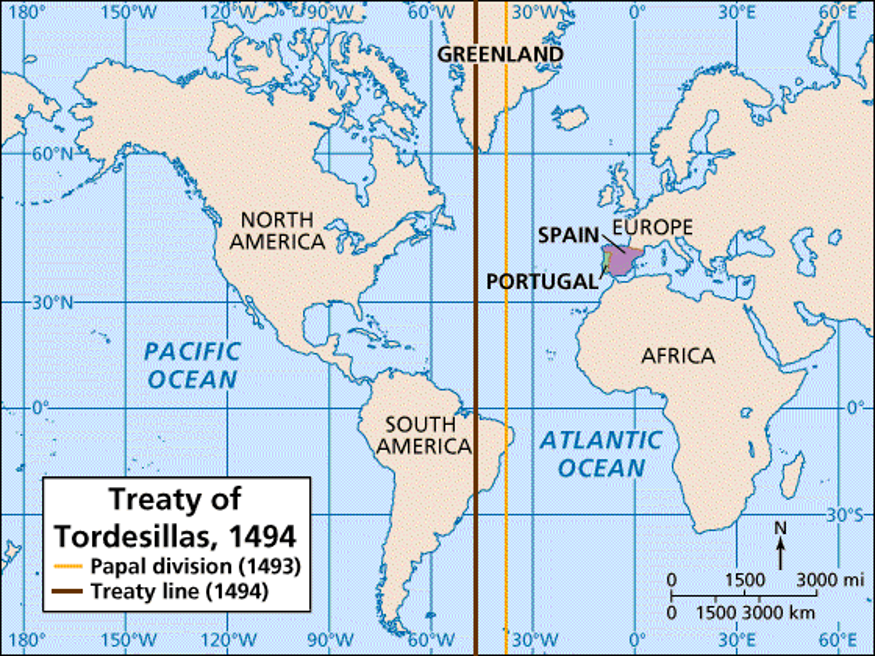
On the 7th June 1493 (barely a year after Columbus’s first journey) the treaty of Tordesillas was agreed between the Pope, Spain and Portugal. The Treaty stipulated that all the lands east of a line 370 leagues off the Cape Verde Islands would belong to Portugal. New discoveries in the west would fall to Spain. Hence colonies in Africa (Mozambique, Angola, Guinea-Bissau, Sao Tome and Principe) spoke Portuguese and South and Central America (apart from Brazil) speak Spanish to this day.
The dominant figures in Europe at the time of the advent of François I to the throne of France in 1515 were more southern based than they are nowadays. First and foremost, in the league was Ferdinand of Aragon who had lost his wife Isabella of Castille ten years previously, but who was still on the throne of Spain as well as having acquired possessions all over Europe (Sardinia, Sicily, Naples and Navarre amongst others). Upon his demise Ferdinand’s successor, Joanna (La Loca (the Mad)- who wasn’t that deranged apparently, just wilful!) must have given birth to the highest number of monarchs ever known; Eleanor, Queen of France, Charles V, Holy Roman Emperor, Isabella, Queen of Denmark, Ferdinand I, Holy Roman Emperor, Mary, Queen of Hungary and Catherine, Queen of Portugal. Not even Queen Victoria managed that many kings or queens! The Pope, Leo X was from the house of Medici. His reign over the Catholic Church started in 1513, when Spain had appropriated a lot of gold, silver, and other useful things from the New World. Being a Medici, he knew where the bread, the butter and the jam came from. Hence his favourite son came from the Iberic Peninsula. He also had to deal, sternly at times, with Francois I who would not accept that the Spaniards were richer and therefore stronger than him, and Henry VIII who wanted to be recognised as a big player on the scene. Does that not sound familiar: The EU, Brexit, Wars, strong dislike between the leaders of France and the UK?
France in Europe early 1500s

The Wars of Italy were in many ways a proxy war. By that is meant that it enabled the main players in Europe to fight each other but not so directly that it would have irreversible consequences. Through multiple marriage alliances, invasions and ability to buy the loyalty of minor figures, Hapsburg Spain was encircling France (See map above showing France surrounded by the lands under the sway of Spain in beige). To try and relieve the pressure on the country, Louis XII (1462-1515) invaded Italy. At first some of the regions welcomed the French. However, the invaders were soon seen for what they were: a pillaging, thieving and violent army. Defeated, Louis XII went home to his knew wife who happened to be none other than the beautiful Mary Tudor (1496-1533), sister of Henry VIII (1491-1547) of England. Louis XII was so enamoured with his wife that a few weeks after his wedding, he died of exhaustion. (Louis XII did not do any favours to the reputation of Frenchmen as lovers!)
The next King of France was François 1 (1494-1547). This king is famous for winning a battle at Marignan in 1515, changing the face of the Loire Valley, by bringing new ideas about architecture from Italy, by taking back with him a vast number of “borrowed” artifacts from the Italian wars, and by enticing Leonardo da Vinci to come and work in France. What is not so well known about this king is that he realised France was far behind in terms of exploration of the world. If France wanted to be as strong as Spain, it needed to be rich. To be wealthy it had to invest in a navy which would be able to cross the seas and bring back goods which could be sold.
The first explorer to be sponsored by Francois 1 was the Florentine sailor and soldier Giovanni Da Verrazzano (Pocket Bio’s E15: Giovanni da Verrazzano (1485-1528) – Bing video). He left Dieppe in Northern France in 1524 with the mission of finding a passage west towards China and Japan. Failing that, he could bring back news of unchartered lands and any amount of gold, silver, or goods to be sold for a hefty profit.
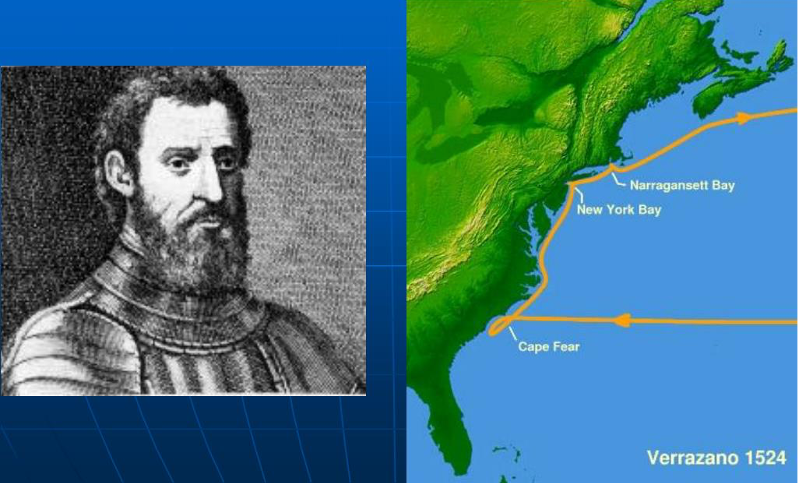
Giovanni Da Verrazzano was the first to chart the East Coast of the United States and to enter the bay which would become New York Harbour centuries later. Da Verrazzano made three more crossings of the Atlantic. His last journey ended in his death at the hands of a tribe on what mistakenly appeared to be a deserted island south of Jamaica. The cannibalistic natives promptly made a meal of him.
Dieppe was one of the two main ports in France from where expeditions started – the other being Saint Malo. The king would sponsor expeditions but never in advance. Thus, explorers had to find a banker who would risk his own money knowing full well of the hazards of either the expedition failing or the king forgetting that he had agreed to pay for it. Jean Ango (1480-1551) (Jean Ango – Bing video) sailor, poet, and humanist of the town of Dieppe was a man who had experienced life at sea with various expeditions under Spanish and Portuguese captains. Later in his life, he had received a large share of the treasure stolen from Hernan Cortes which had enabled him to buy his own fleet and sponsor further voyages. Ango had become a force to be reckoned with, and by 1531, he was able to block the port of Lisbon in Portugal to retaliate against the increasing number of his ships being sunk by the Portuguese navy.
One of the first captains Ango sponsored was Giovanni da Verrazzano. He also financed the doomed expedition commanded by Jean Parmentier and seconded by his brother Raoul. Jean Parmentier, cartographer, sailor, renowned poet, and humanist undertook to travel east at the bidding of Jean Ango in 1529. His ships were one of the first from France to navigate the Cape of Good Hope in South Africa. However, scurvy, a deadly disease common to those at sea, struck a vast number of the sailors amongst them Jean and Raoul who died a few days from each other in November 1529. The expedition eventually returned to Dieppe with a meagre 312 kilogrammes of pepper corns. (For readers interested in discovering more about Parmentier and his time, see The Voyage of Thought : Michael Wintroub : 9781107188235 : Blackwell’s (blackwells.co.uk)).
Whilst Dieppe dominated the exploration scene early in the XVI century, Saint Malo developed a taste for going west. Immediately after Da Verrazzano, Jacques Cartier (1491-1557) (Jacques Cartier – Bing video) sailed towards the setting sun. Cartier did not discover many places in the new lands; however, he is renowned for several things. He sailed across the North Atlantic in twenty or twenty-one days, a record for the times. He was one of the first Europeans to approach the various tribes along the newly named Saint Lawrence River and negotiate with them. Finally, he named the land he explored after the local word for village, Kanata which eventually became Canada. All the expeditions led by Cartier were financed by the king of France who wanted treasure, lands, and spices.
France, being embroiled in the first years of a religious upheaval (Protestantism and Calvinism against Catholicism), the religious authorities of the pope decided to send clerics who would ensure that the right religion was imparted to the local tribes. Who best send than the Jesuits? From then on, Jesuits would be arriving en force to convert the Savages. The capital S in Savages is not mine; it belongs to the era: it gave respect to the people involved at the same time as intrinsically considering them inferior as human beings. After all, they were not French, Spanish, Portuguese, English or Dutch and, therefore, could not therefore be civilised. Nothing new here. If one people wants to subjugate another, the best way to start is to call them savages. The manner in which they are treated thereafter flows from there.
The first European to stay in Quebec over the harsh winters was the apothecary, Louis Hébert (c.1575-1627). He and his wife, Marie Rollet (?-1649) have become something of a myth in the province of Quebec. Their quasi-mythical-and probably over-romanticised- love story has inspired many writers and poets. The humanist Hébert was the first to cultivate various foods which would enable him and eventually his family to survive from October to June. Their first winter in Quebec was a near disaster as they were running out of food and firewood and dying of cold and/or of scurvy. That Hébert and Rollet managed to survive is a miracle. Still, they created a line of Hébert’s which is several thousand strong to this day in the Province of Quebec. Louis and Marie are also known to have treated the natives for various illnesses and to have taught them the rudiments of medicine and apothecary which the couple possessed. Louis Hébert – Bing video

During the voyage of 1603, Hébert met Samuel Champlain (born between 1567and 1574-1635). Champlain’s first voyages across the Atlantic was in the pay of the Spanish and Portuguese crowns. From these two and half years of expeditions he wrote a report, Brief Discours, which impressed the king of France, Henri IV. The report not only described in some detail the way the natives led their lives, but also, and to his disgust, the savage punishment the Conquistadores imposed on the locals if they did not fulfil the expectations set by the Inquisitors. From now on, Champlain would attempt to treat the natives in a more civilised way, but still in accordance with the mores of the times.

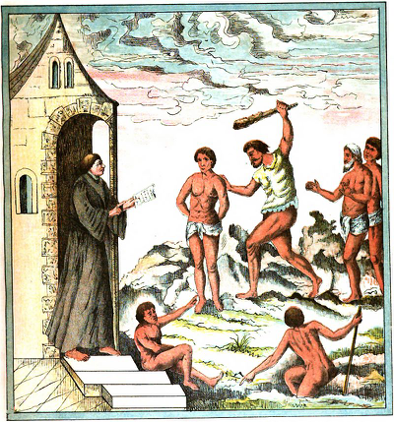
Having acquired the confidence of the king, Champlain undertook a series of journeys across the “Big Pond” either at his behest or with his agreement but on behalf of companies of merchants- some created by himself. Twelve times he crossed the Atlantic from 1603 till 1633 when he was probably too ill to travel. Some of the crossings were incredibly quick for the times (11 days from East to West), and some were laborious: he set off on the first of March one year and encountered all kinds of hazards, including banks of fog so thick you could not sea anything, and enormous icebergs which slowed them down – no one in the 17th century knew about iceberg southward migration in the spring or of iceberg alley in the North Atlantic. On that occasion it took the ships 74 days to reach the other side of the ocean.
At first, Chaplain’s job as to make a map of the river Saint Lawrence and of the area around it. As he gained experience he became a leader, until he was appointed Commander of the Province but never Governor as his low aristocratic heritage did not permit him to gain such elevated position. Champlain achieved many firsts in Canada. He was the founder of Quebec City when he built an” abitation” on the site of the present city. The same applies to Trois-Rivières and to a certain extent to Montreal. He went on exploring lands which had not been walked on by any Frenchman before him and visited places that Jacques Cartier had not set foot upon in the last century. He managed to populate some of these places with Frenchmen and a few women who became the original Acadians (Canadians).
The first known trial of a European took place at his behest when it was discovered that a group of men were going to assassinate him as they were in the pay of the Spanish crown. The prosecution ended with one of the men being condemned to be hung until death took place. The earliest recorded trial and execution on Canadian records.

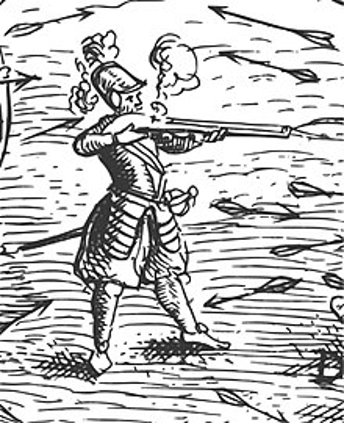
Champlain’s relationship with some of the tribes, Montagnais, Micmacs, Hurons led him to get involved in wars against the Iroquois, who were in alliance with the English. The defeat of the Iroquois started the uneasy- and more often than not- downright hostile relations between the two European powers. During the opening clash between the two tribes in the presence of a European, Champlain fired his harquebus, killed outright one of the chiefs of the Iroquois which led to their hurried retreat. There is a drawing of the battle, and it is the only accredited physical representation of Champlain.
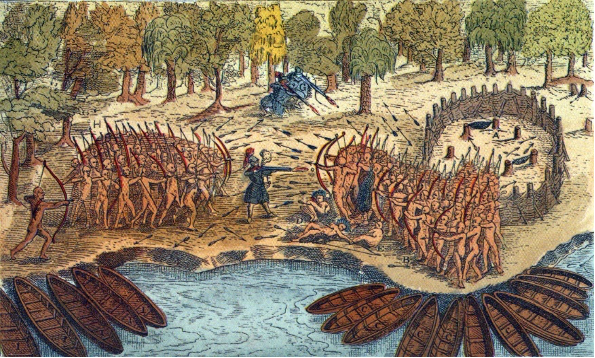
Some of the actions attributed or undertaken by Champlain give a clue as to his character. One of the Huron women had been taken prisoner by the Montagnais tribe and was going to be killed and eaten by them. To save her from death and being eaten, it is said that Champlain asked for her and he took her back to France where her fate is thereafter unknown. In his forties (?) he married a young girl of twelve who brought him a dowry of several thousand livres. The money would help finance future expeditions.
Like all European explorers, Champlain renamed local rivers or hills after saints, kings, or queens of their country. The one place escaping this rule is the lake he discovered and promptly named after himself. The name is still in use to this day.
Finally, Samuel Champlain never went native. Many of the lesser-known characters who sought adventure in the new lands, eventually found it easier and healthier to adopt some of the ways of the local tribes. Often this included wearing clothes suitable for the weather conditions instead of the heavy and constricting but not very warm items worn in Europe. Many a hunter also took wives and settled to a life amongst her kin. It is the view that although Champlain had local mistresses, he never considered giving up being European (therefore superior?). Samuel de Champlain (Québec 1603) – Bing video

In order to communicate with the natives, Champlain relied on a Truchement (an interpreter), usually a European who had learnt the local languages. The most well-known was Jean Nicolet (1598-1642). Nicolet had spent seven years living with various tribes to learn not only their language but also their customs to discover if they knew anything about a passage west to China. One of his journeys lead him to be the first Frenchman/European to set eyes on lake Michigan. Nicolet married late in life, but his descendants are counted in their thousands in modern day Canada. Unsurprisingly for a man who spent most of his life in a canoe, he died when his boat overturned, and he was not able to save himself. Heritage Minutes: Jean Nicollet – Bing video
The names Marquette and Jolliet sound like a well to do firm of solicitors from London, New York or Toronto with Huguenot ancestry. This assumption could not be any further from the reality of their lives. Jacques Marquette (1637-1675) was born in the French northern city of Laon and attended the local Jesuit College before taking up orders and becoming a Jesuit himself. In the year of the Great Fire of London (1666) he was sent to Canada to help in the Christianisation of the Savages and in building new Missions along the rivers which had been discovered so far on the continent. Louis Jolliet (1643-1700) was one of the new breed of Europeans as his birth happened to take place in Quebec city itself. He was sent to study at the Jesuit College there and was destined for the priesthood when a change of heart made him wish to become an explorer.


Jolliet and Marquette met in the fall of 1672 to prepare for an expedition which was supposed to take them west towards the sea to sail to Cathay and Nippon. Their journey was an epic one. Along with only another six Europeans, they canoed down several lakes and rivers until they reached the fable Mississippi. Hoping that, eventually, it would turn west they continued south until they were only about 6 to 700 kilometres from the Gulf of Mexico. Realising that they were not going to discover the passage west, they turned back. It is also possible that encounters with native tribes allied to the Spanish crown forced them to take such a decision.
On the way home, they split up. Jacques Marquette decided to take the shorter route east but died of illness whilst still some distance from Quebec City. Louis Jolliet took a longer path along rivers and lakes barely explored so far. It has to be speculated as to what their state of mind would have been, had they gone as far as the Gulf of Mexico. Obviously, disappointment at being in the wrong place to sail to Japan and China. But a degree of elation at the discovery they had made about the Mississippi and its outlet. Neither Marquette nor Jolliet would ever know.

This map clearly shows how far south the two explorers had gone
René-Robert Cavelier (1643-1687) had two aims in life: Fame and Fortune. To achieve this goal, he set off with determination and some support from the king of France to explore the vastness of the north American Continent. Fame, he reckoned would be attained the day he was made a noble by Louis XIV. Fortune would flow from the treasures and lands he would discover, acquire, and exploit in the name of the Sun King. Strangely enough, Louis XIV complained that explorers should “from now on, refrain from discovering such vast territories” (sic). Eventually, he was allowed to join the aristocracy and became René-Robert Cavelier de la Salle under which he is still known nowadays. De la Salle was frustrated in some of his ambitions: he never found the enormous pot of gold he was looking for nor did he find the Passage west to Nippon and Cathay. He certainly went further south and west than anyone else at the time. As far as south as the Gulf of Mexico and inadvertently 600 kilometres further west than the mouth of the Mississippi river. During his last voyage, he landed in Texas and aimed to go back north and east to find the Mississippi. Along the way there was a mutiny by the crew, and he was murdered. The Adventures of Rene-Robert Cavelier, Sieur de La Salle – Part V: A French Colony in Texas – Bing video

If the French were the leading explorers of North America, why aren’t the French language and its culture as widespread as it ought to be? The first census of “Canada” undertaken in the winter of 1665/6 gives several clues. There are only 3571 colonialists registered that winter. Compared to the probable million and a half natives (not counted in the census), this is minute. The professions declared give us another pointer. 400 plus are servants and only 75 are gentlemen (probably officers of the crown and official explorers) who are allowed to go wherever they wish and own land. The rest are traders, artisans and hunters and they were not allowed to settle without permission from the governor who resided most of the time in France. Alongside these people there are soldiers, priests, and nuns. All in all, very few families were given the go ahead to colonise the place on behalf of the Kingdom of France.
As a result, the proportion of male to female is 98% male and 2% female. An attempt to remedy this imbalance was made under Louis XIV when poor “orphaned” girls of lower nobility were dispatched to the colony to find husbands and populate the country with French people. A century later, the numbers had grown to 35 000. However, most of these people will stay in the cities (Montreal, Québec, Trois Rivières) and few will venture further afield.
Despite the local battles with the English which regularly took place in that part of the world, and which were lost and won in turn, France in 1763 occupied a large section of Canada and the middle states of what would become the USA. Most of it was sold to the Americans by Napoleon to pay for his conquests or lost to the British by Louis XV after the disaster of the Seven Year War (1756-1763).
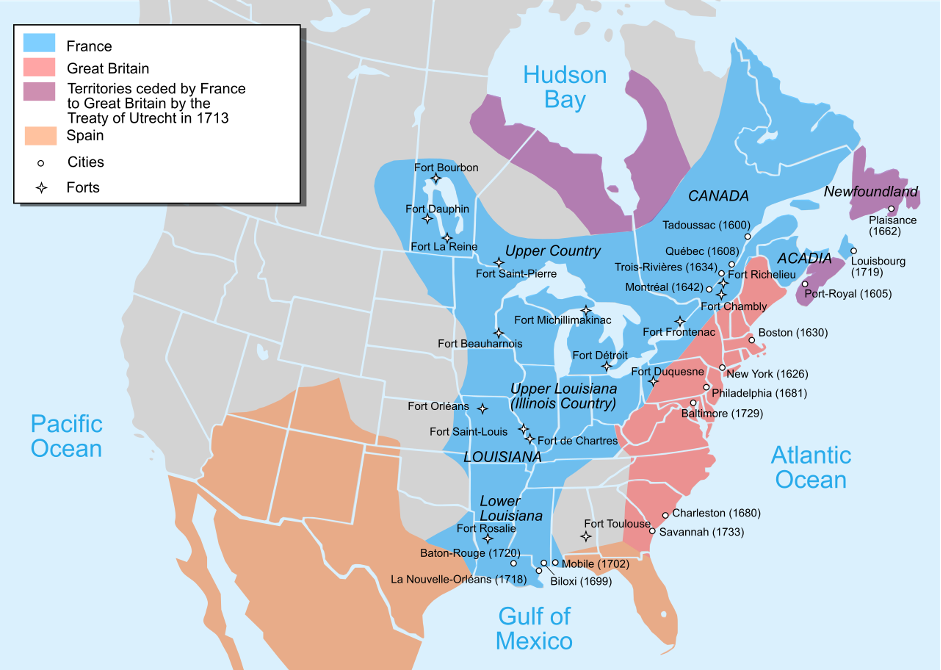
Going South
The next section is about Africa in relation to the Caribbean Sea, Central and South America. In comparison, the French occupation of Acadia and Canada seemed to have been less traumatic than in these other regions of the world. Indeed, there were slaves in northern America but very few. It must be remarked (and this is no excuse for the behaviour of Europeans in Africa) that the natives of all these areas made slaves out of those they had defeated in battle and of their families. The reason behind the apparent ability of Europeans in Canada and northern America to live next to the natives without wanting to destroy or own them, could reside in the fact that the explorers were there originally to find the Passage to the West and not to colonize.
It is difficult to explain the behaviour of human beings at times. The historical context occasionally provides a glimmer of understanding but even that does not help us to comprehend Pogroms, the Holocaust, or any form of Slavery. Some of the words and pictures in the next few pages are shocking. However blasé people have become due to the incessant violent images to which they are subjected by the media, I hope there is still room for a reaction of disgust at the conduct of some of our ancestors who went to Africa for the purpose of the exploitation of people.
Once again, I have chosen a date to mark the beginning of this deplorable story which has, as yet no ending: 1364.
In 1364 there is a written record of two ships landing in Dieppe with goods- Ivory and cloth- coming from what is nowadays Sierra-Leone in West Africa. Trade has always existed between Europe and Africa in one way or another, but 1364 is as good a place to start as any. Sailors from the Iberic Peninsula are very keen to develop trading arrangements with local tribes in Western Africa, but they are not the only ones as the record of 1364 shows. Eighty years later, in 1444, the Portuguese – who are already implanted in the newly colonised Canary Islands – created permanent Comptoirs in Lagos. Comptoirs are places (usually a fortified settlement) where exchange of goods take place.
The first real need for cheap workers on a large scale occurs when Ferdinand and Isabella chase the Moors and the Jews out of Granada in 1492. Raids along the coast of Mauritania soon provide the necessary earth tillers in substantial numbers to replace them. 1492 is also the year Christopher Columbus landed in Hispaniola. Soon after the first colons arrived form Spain and Portugal. A cheap workforce would soon be needed to till the fields. Having decimated the local population ether by killing them with weapons or illnesses, slaves were imported from Africa.

Roughly at the same time as the plantations were sprouting up in the Caribbean, Ahmad al-Mansur (1549-1603), king of Morocco took it upon himself to invade the Mali Empire. The destruction of this highly centralised empire will play in the hands of the European slavers. As the Mali Empire disintegrates, new and much smaller kingdoms emerge. These new entities wish to expand. In order to do so they need money to acquire weapons. Fortunes can be made by hunting for unarmed tribesman, women and children who are promptly taken to the coast in their thousands to be sold to the European traders as slaves.
The Triangular Slave Trade is born.
As usual, the French will play catch up with the Spaniards, the Portuguese and even the Dutch. Between 1614 and 1635, expeditions setting off from Nantes, Bordeaux and Saint Malo will explore the Antilles, The south coast of the United States and La Guyane on the north-eastern side of South America. Many of the islands of the Caribbeans are declared French territory and farmers are enticed there from Provence, Brittany, and Auvergne regions by the prospect of free land. Settlers who arrive from France realise soon after setting foot on the islands that it would be impossible for one man to clear the land and cultivate crops. No one has told them about the very aggressive local tribes either. All the natives want is to get rid of the new arrivals either by chasing them back to their boats or by killing them, and in most cases eating them.
However, managing to survive in the Caribbeans is nothing in contrast to what awaits the Colons in Guyana. The whole area is covered by a very lush flora made up mainly of enormous trees and of very deep routed and persistent bushes growing rapidly in a very hot and humid climate. Farmers were competing against the rain forest with hand tools. This ordeal was nothing compared with the diseases striking all on arrival from continental Europe. It was thought that African slaves would fare better as they came from hot climes. Hundreds were sailed across the Atlantic to be set to work in Guyana plantations. More than 40% were killed by either malaria or exhaustion only a few weeks after having landed.
The first known contract between two Frenchmen for the delivery of slaves, dates from 1638 when Daniel Trézel signed a contract with Daniel Rozée for the supply of 100 slaves to his plantation in the Antilles. Four years later, Louis XIII and his Principal Minister, Cardinal Armand du Plessis de Richelieu endorsed a decree allowing for the slave trade to take place. Furthermore, a payment of 13 livres was to be made for each slave captured and transported to wherever it was needed. As Comptoirs are set up in Madagascar from 1643, they will become one of the main providers of slaves for the Atlantic trade. It was during the reign of Louis XIV, his Principal Minister Jean-Baptiste Colbert and his son also, Jean-Baptiste Colbert that the Code Noir is published (1685) The Code Noir (1685) | Learning for Justice. The Code Noir is a piece of legislation which codifies the life and death of the slave. Whilst, on the one hand, accepting that the black slave might be human, he/she was denied any and every civil right. Or if some rights are allowed, marrying, or having children, they must be with the permission of the slave owner. It is argued in some quarters that the Code Noir made an attempt at codifying in law the responsibilities of the slaver towards his human stock (cheptel). For one thing, the slavers never took a blind bit of notice of it. For another, all it does is make obvious what was already happening; slaves had no rights, were nonpersons and the masters were the law.
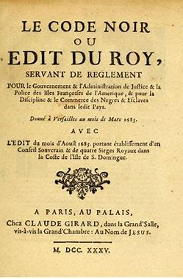
A few examples of pronouncements contained in the Code Noir:
Article XXXIII. The slave who has struck his master in the face or has drawn blood, or has similarly struck the wife of his master, his mistress, or their children, shall be punished by death…
Article XXXVIII. The fugitive slave who has been on the run for one month from the day his master reported him to the police, shall have his ears cut off and shall be branded with a Fleur de Lys on one shoulder. If he commits the same infraction for another month, again counting from the day he is reported, he shall have his hamstring cut and be branded with a Fleur de Lys on the other shoulder. The third time, he shall be put to death.
Article XLII. The masters may also, when they believe that their slaves so deserve, chain them and have them beaten with rods or straps.
The justification for the acceptation of slavery and of the Black Code by the Catholic Church is both puzzling and astounding.
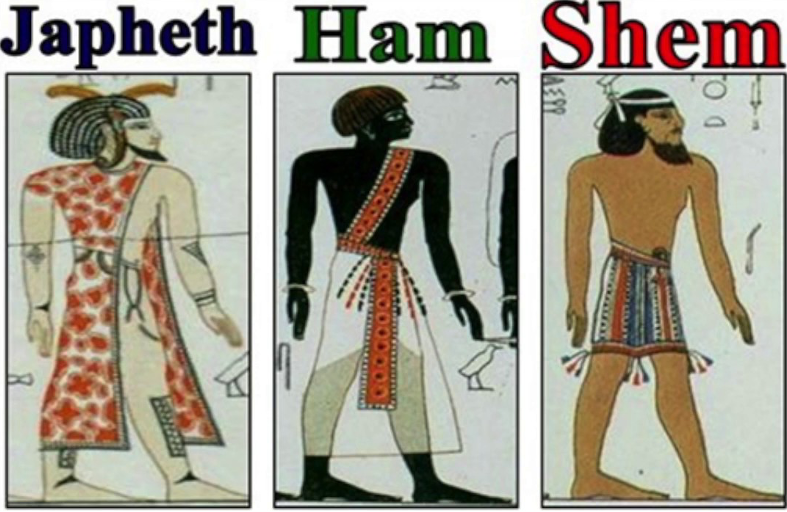
According to Genesis (the first book of the Old Testament), every human being descends from (at least) Noah or one of his three sons and their respective wives: Shem is the ancestor of the Semites; Japheth is the ancestor of the Europeans and Ham the ancestor of the Africans (but also and confusingly of some Semite tribes). Ham had three sons, one of whom was Canaan – also a Semite according to Genesis 10:15-19- who was deemed to be of a different colour (?). The two other sons, named Egypt and Put, are the only ones with any connections with Africa. But for some reason Canaan was cursed and was wrongly associated with Africa.
The rationale behind the curse of Canaan was because he was the son of Ham and nothing else. The fault (sin if there was any) was his father’s, not his. Was he black? No one can tell. The result of the curse was the justification for the enslavement of hundreds of thousands of black people by white people.
What was the sin meriting such banishment? The story goes like this. One evening Noah had finished work in his vines and was having a drink. He seemed to have liked his wine, so he had several cups and became inebriated. After a while, he went to his couch for a lie down. He did not cover himself and exposed his naked body for all to see. Shem and Japheth went into Noah’s tent backwards so as not to look directly at his nakedness and threw a cover over him. (At this point a question arises: how did the brothers know that their father was in the nude and visible without them looking in the first place?). The following day when Noah woke up, bad tempered because of a hangover, I would imagine, he went into a rage when he discovered that someone had been into his tent, seen him in his birth suit, and had placed a goat skin over him. Shem and Japheth, terrified at their father’s temper pointed the finger at Ham- the youngest of the family who stood no chance against his two older siblings. Noah cursed not Ham himself but his descendants for the sin he had committed: looking at his father in the nude! Canaan, Ham’s son, being the ancestor of Africans, Africa was cursed. Not by God but by Noah.
Where does the bit about slavery fit in because so far there is no question of slavery, I hear you ponder? When Noah woke up in a foul mood and on finding out what had happened, he is supposed to have shouted: “Curse the Canaan! The lowest of slaves will he be to his brothers.” Why did Canaan and not Ham receive the curse, is a problem that theologians are still trying to resolve ever since.
Here lies the (more than tenuous) religious justification for African people being enslaved.
One the fundamental principles of making a profit in shipping, whether in the 17th century or nowadays, is for the boats never to travel empty on any of their journeys. The Triangular Trade, as it became known, aimed to achieve this goal as ships sailed from Europe to Africa then west to the Americas and back to Europe. On the way south from Nantes, the captain of a galleon would have loaded firearms, gun powder and all the necessary materials for war manufactured in France as well as cloth, alcohol and maybe some trinket to please the chief’s many wives.
In the time it took the vessel to reach the Congo River, the local chiefs had gone to war with other tribes and taken prisoner dozens if not hundreds of men, women and children and had kept them securely in a compound. As soon as the ship had dropped anchor in the approaches to the mouth of the river, negotiations started about the price for each individual. Instead of paying with money or gold, weapons were exchanged for the human beings detained in the compound.
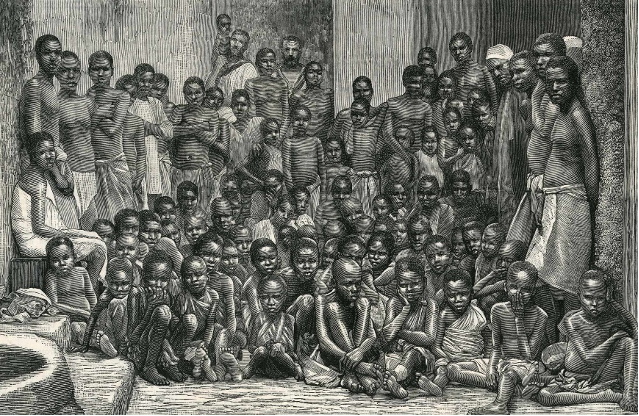
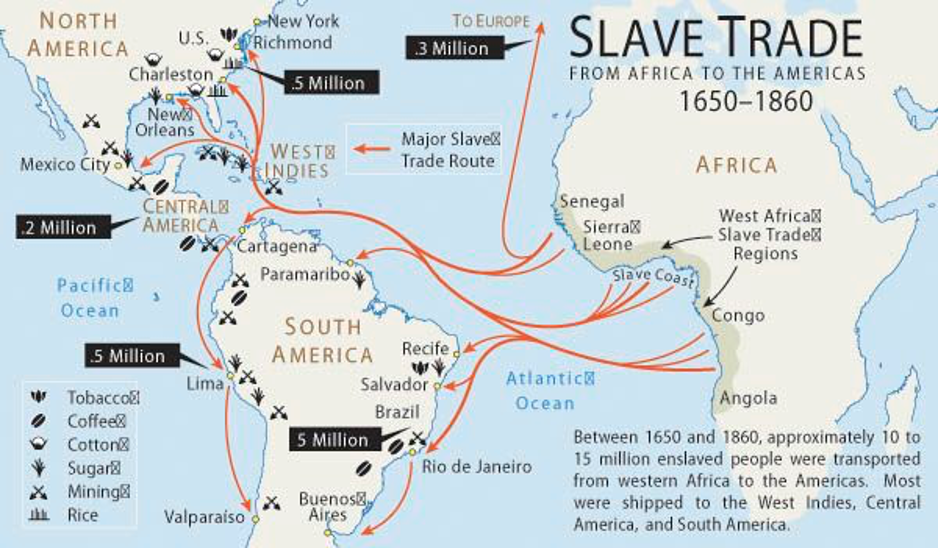
Once loaded on board, the vessel would leave for the Americas where an auction would take place and the slaves were exchanged for sugar, tobacco, exotic spices, or fruit which would arrive on the markets of Europe to be sold at great profit for the shipowner. The Triangular Trade plied the waters of the Atlantic between 1650 and 1860 and in that period alone 10 to 15 million people were enslaved to be sent west to Brazil, the Antilles, Central America as well as North America. The taking of people from the West Coast of Africa had started in 1441 but the records are patchy as to numbers. In the XV and XVI century, Spain and Portugal were the two nations most heavily involved in the buying and selling of slaves. However, very soon, British, Dutch, French and Danish flags could be seen floating on-board ships loading their human cargo off the west coast of Africa.
At some point in the XVII, the coast was so busy with traders that the French decided to go further south and started a Triangle from Madagascar. The crossing from the Congo River could take from two to three weeks to sometimes two or three months depending on the weather. From Madagascar this should multiplied by at least three as the captain had to sail around the Cape of Good Hope and along the western parts of Namibia and Angola before making his Atlantic crossing. The map below shows clearly that by 1650 Europeans had created plantations in most parts of the Americas. French colons were especially involved in planting sugar cane, tobacco and coffee in the Antilles, Guyana, and the southern part of present-day United States of America. Manpower was needed to undertake the laborious work of clearing fields of trees and bushes, planting new crops, and gathering the coffee or sugar at the end of the growing cycle.
The master was at the top of the tree in terms of hierarchy. He gave orders, dealt with traders and slavers, and was the judge and jury in instances of disobedience by the slaves. His word was the law, regardless of what legislation had been published in his country of origin. The sole sentence from the Code Noir which was of interest to the master was the one which enabled him to punish any slave under just about any circumstance.
Just below the master in the pecking order, was the master’s family. It was not unknown for the mistress to have to take over from her husband if he was sick or if he died. Rare, unfortunately, are the cases where, on her husband’s death, the mistress became more compassionate towards her “stock”. In many ways, she had no choice if she wanted to endure.
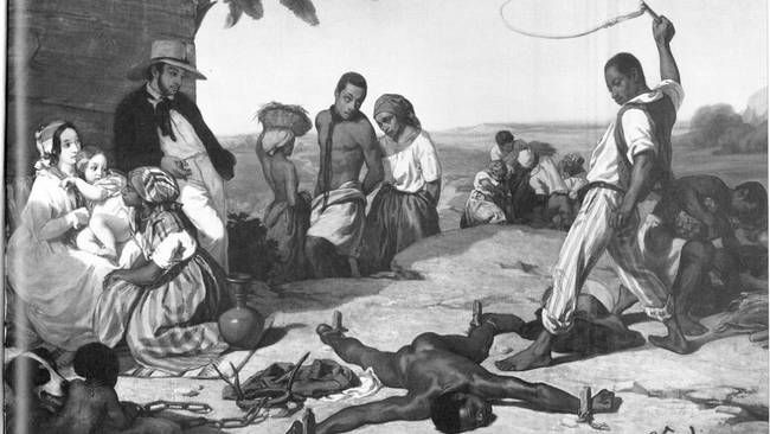
No plantation would have survived without creating another rung between the masters and the slaves. Slaves could be made freemen. Some were and remained with their master and were put in charge of certain aspects of the work on the plantation. The picture above depicting a Black man flogging a slave was not an unusual event. The overseer is dressed in European clothes and does not appear to have any compunction about lashing the slave. This was his job. However, he belonged to neither clan, master, or slave, but would be hated by the latter and not always trusted by the former.
.
At the bottom of the pile came the slave.
Slaves were no more than a commodity in the eye of the white slavers. A “cheptel” (human stock)was acquired by trading armaments or sought-after goods with local natives who had no problems of conscience selling some of their prisoners of war to white men. It also occurred that some poor families would sell one of their members into slavery to avoid dying of hunger.
Three European countries stand out in the league of slavers in the years 1650 to 1750: Britain accounted for the largest percentage in the ownership of slaves (41%), Portugal (29%) and France (20%). Nantes, Bordeaux, Saint Malo, and La Rochelle were the main points of departure of the slave ships in France. La Rochelle – this much-admired touristic town on the Atlantic coast- has the dubious honour of having had in the region of 70 ship owners who traded 130 000 slaves between 1717 and 1763 aboard 427 boats.
Amongst this elite of the maritime trade in La Rochelle was Le Sieur Jacques Rasteau (1680-1756) who held a flotilla of 25 vessels both for the local trade but also for the Triangular route. Rasteau’s sailing ships were involved in 67 voyages across the Atlantic from Western Africa. The exact number of slaves transported by Rasteau is not entirely certain but can be counted in thousands.
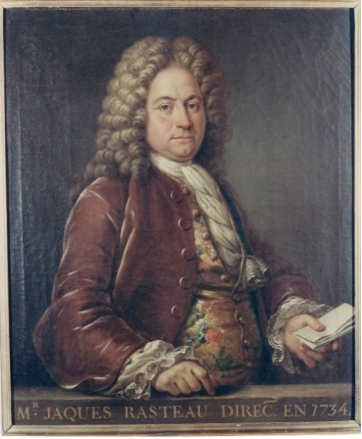
Over the years, Monsieur Rasteau had been involved in bringing slaves to Guyana, Saint Domingue, The Antilles, and La Nouvelle Orleans. To maximise profits, businessman Rasteau had acquired land and shops in these three places. The slaves he transported were not only used as barter for products to be shipped back to France, but also employed by him in his plantations and Comptoirs. With 19 children to his credit- all of whom would eventually be involved in the trade – Rasteau needed a lot of money to feed them. In La Rochelle, Le Sieur Rasteau was a rich and respected bourgeois whose standing in the community was only second to that of Théodore de la Croix, the owner of 90 sea going vessels. To ensure their positions in the eye of the king, Rasteau and his colleagues were also the proud bearers of shares in both “La Compagnie du Sénégal” and “La Compagnie de Guinée” whose major share holder was Louis XIV himself.
On the way from La Rochelle to Africa, Monsieur Rasteau’s ships carried guns, gun powder, fighting knives, pipes, iron bars and alcohol. These goods would be exchanged for slaves. Between 340 and 470 black people would be loaded for the journey across the ocean. After a passage of 30 to 90 days depending on whether conditions, they would be very quickly sold in Cayenne, New Orleans or set to work either on his plantations or in his shops. At the time (1680-1750), France was the leading importer of sugar in Europe. La Rochelle had a good share of the market and Monsieur Rasteau was not left behind in the race to sell his refined products to the Germans or the Dutch who craved for this sweetener to mix in their coffee. Europe was addicted to sugar.
The slave trade would not have existed without the realisation that the profit margins could be eye-watering: the margins of gain could be as low as 4% of the original money invested in the venture, especially in times of war when the certainty of crossing the ocean safely was small and therefore the cost of insurance and of finding ships and crews a lot more expensive. However, a return of 450% on the initial investment could be gained when the market was buoyant. Incidentally, this could also be in times of war (if it did not involve the nation of the slaver) when goods were needed to be found to sustain the conflict.
How much did Le Sieur Rasteau pay for his slaves? First of all, the price paid for a slave at source depended on the age, the gender, and the health of the person involved. The records show that Rasteau would have disbursed between 100 and 200 livres Tournois for each individual according to the factors described above. The most expensive would be a strong, young male in excellent health who was known to be pliable to the will of his master. A young female who had the same attributes would be slightly less expensive. Children were nearly half the price of an adult slave. It was not uncommon for families to be auctioned singly and therefore be acquired by separate owners.
Rasteau, if he was clever, would only pay taxes on the sugar or other goods which were refined in France. The profits he made abroad were not taxed. The shipowner would therefore invest more of his gains buying plantations or commodities which would be transported to other places than France without paying any dues in La Rochelle. Slavers in the XVII century were some of the richest men in the Hexagone and investors were keen to buy shares in their businesses. It seems that it is only in this century (21st) that people have come to realise the extent to which France – amongst other European countries- was involved in the process of this appalling trade.

(Apologies for the language used in the poster above)
Having been bought in Ghana and sailed across the Atlantic to Cayenne, a slave costing 200 livres Tournois in Ada or Prampram, in present day Ghana, could be sold for 5 to 10 times his original value. The price clearly reflecting the needs of the market. Hence, our young healthy and well-behaved male could end up bringing between 1000 and 2000 livres Tournois to Monsieur Rasteau. Economists reckon that the Livre Tournois of the 1680s would be the equivalent of €2.10 ($2.15) (£1.80) nowadays.
Before attempting to write the next section, I conducted a small experiment during which my dog looked at me as if I had gone mad. The desk on which I write is about a century old. Made of solid dark oak and a legacy from my parents. It is over a metre long, half a meter wide and the same distance (50cms) from the floor to the lowest bottom draws.
All the lights were switched off in the house, curtains drawn. No sound except that of the wind and rain which prevailed outside on that moonless night. After some contortions, I slid myself between the four legs and under the desk. I stayed there for as long as I could. The floor underneath my back is wood and after a while I wanted to move but was hardly able to do so due to the small space between the legs of the desk. Even though it was very dark, I could somehow feel the bottom of the draws above my head. I only managed to stay in that position for twenty minutes. All in all, it was a most claustrophobic and unsettling moment that I don’t wish to repeat soon.
Whilst half a million slaves were exported to Europe between 1650 and 1850, Monsieur Rasteau does not seem to have been in the business of bringing back black people to be sold in La Rochelle. The dozen or so merchant ships involved in the Triangular Trade on his behalf, appear to have been taking their cargo to the other side of the Atlantic.
The boats involved could not be too big as, otherwise, they would not be able to sail upriver to collect the slaves in West Africa. To make the journey profitable, the captain and his crew had to pack as many people as possible in the holds. On average the voiliers were 80 to 90 feet long, 25 to 30 feet wide and the cargo bays were 12 to 14 feet in height. The latter was often divided so that more people could be carried.
To best appreciate how things were for the slaves, I thought that pictures might be better than just words.

The barrels in the lower hold contained food and water which were deemed sufficient to feed the crew and the slaves: usually rice, a few vegetables, and the indispensable water. After a few days at see it was not uncommon for the water to be swimming with unwanted insects which made it undrinkable, and the food would be crawling with vermin. One of the few slaves who could write and who survived the journey wrote:
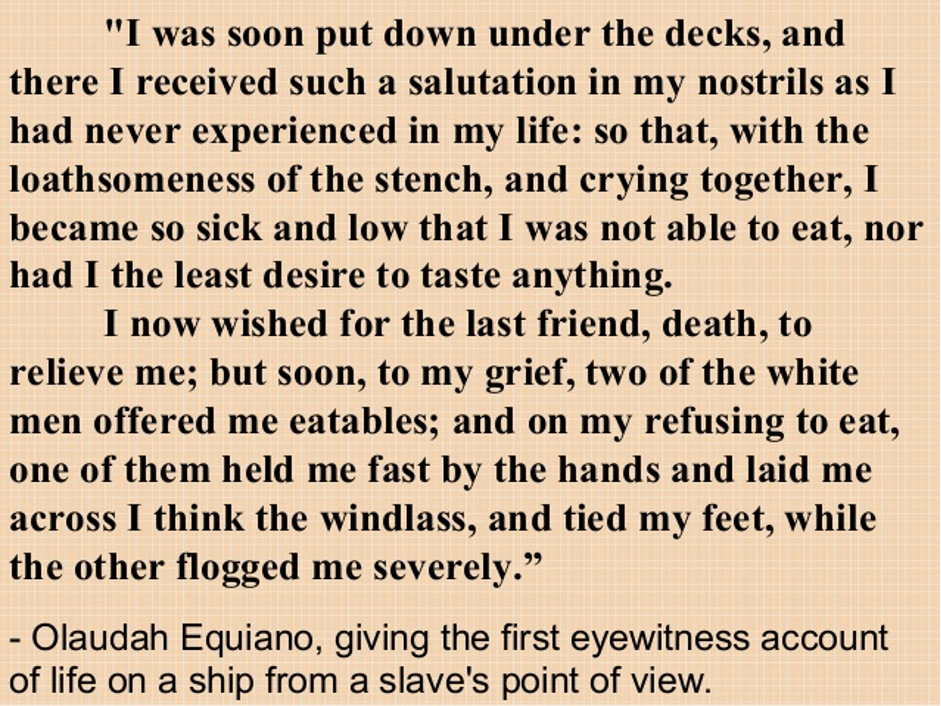
If the slaves were fortunate, the transport would only have 420 slaves on board and each person would have 60 centimetres or so between himself and the next man, and maybe 80 centimetres above his head so that he could sit instead of being permanently forced to lie down.
However, some owners wanted to be rich as quickly as was possible. To that aim they ordered their captains to load over 700 people in the same space as for 420. The result looked like the picture below.

Drawing of the hold of a British slaver which carried 720 people from Africa to America
It goes without saying that the men, women, and children were chained for 23 hours out of 24 in good weather- the missing hour was given to forced exercise on deck for each chain of slaves. In bad weather, there could be no exercise for days on end. Fresh air circulating in the hold was only possible in calm seas as otherwise incoming water would risk drowning people or even sink the ship.
Olaudah Equiano who wrote about the stink which hit him when he was first chained in the hold never described in any detail where this smell came from. The floors of the decks could only be washed if the weather was good enough not to threaten to overwhelm the boat. Otherwise, urine, vomit and excrement in large quantities would slush as the vessel rocked in time with the waves and the wind. His account is reminiscent of the conditions which would prevail in the Concentration Camps of Hitler, Stalin, Pol Pot or Mao.
Slave ships had a crew which was roughly twice the size of the normal complement. The officers and the sailors made up half and the added personnel was there to look after the cargo of human beings. These men were usually people who could not find any other employment or had left the military. They were supposedly under the captain’ s orders but it does not seem that many tried to restrain their enthusiasm for violence. Woe befell whoever did not follow their orders to the absolute letter. The cat with nine tails was the best way, these jailers thought, to keep the people below decks amenable. And if one accidently died there were plenty of others and no one would ask too many questions.
The fate of girls and women was as precarious as that of their male companions. The vast majority were used as sex objects once on board. The picture below is an extract taken from the official log of the captain sailing to New Orleans.

At the top of page in the diary, the captain tells us that the weather is beautiful. Then, as if he was happily describing the sea or the sky, he writes that he had a black woman brought to his cabin and had sex with her twice. (The notion of rape never entered his mind). He adds that it is the first woman he has had since leaving France. The last line returns to the beautiful weather. Many females had children and were forced to keep them, even though they were the results of unwanted sexual relationships.
There are no official statistics as to the number of people who died on the transports from Africa to America, but it is obvious that the conditions in which they were kept meant that any form of viral illness would quickly go through a whole chain or hold. Malnutrition, thirst, and sea sickness also took their toll. Gratuitous violence towards the slaves was endemic and any form of rebellion ended with the perpetrators being thrown overboard.
Remarkably, those who refused to eat were force-fed as there was money to be made at then end of the journey. The number of slaves who attempted suicide (and succeeded) during the voyage is unknown. However, there are numerous references in later accounts of the journey by slaves who witnessed such events. Olaudah Equiano is correct when he writes that death was the slave’s only (and ultimate) friend. Life Aboard a Slave Ship | History – Bing video
The Jesuits were the first to bring slaves to Cayenne in the early 17century. As many as 400 men, women and children were “employed “by the Good Fathers to cultivate the land the monks had been granted by the king. Before the slaves arrived, France had enticed poor peasants from Brittany and Auvergne to come and clear the jungle in order to plant tobacco, sugar cane and other exotic products, with visions of gold and an easy life in the sun. Very soon rumours went back with ships of the appalling death rate amongst the French workers. Within a few weeks, nearly a quarter was either sick or dead of exhaustion, malaria or of other illnesses. The same ratio applied to the first colons who had bought land whilst in France and soon discovered that hard work under extremely hot and very humid conditions was needed before a profit could be made.
By the mid-1750s , it was accepted that of the slaves who had been squeezed in the hold of a ship coming from Africa, just short of 10% would die on the way, a quarter would die soon after arrival of exhaustion or sickness, and another but much smaller percentage would either commit suicide or tried their luck by disappearing into the jungle- an act amounting to the same thing as the chances of survival in the jungle were small.
Monsieur Rasteau had 600 slaves working for him in Cayenne by the early 18 century and roughly the same numbers in the Antilles and in New Orleans. Sugar was transported back to France as molasses where the Rasteau manufactories in La Rochelle would refine them to be forwarded to other parts of Europe in his ships and maybe sold in his shops in Paris. His fortune made, Rasteau bought himself a big town house in the town and a manor in the countryside. Space was needed for his score of children. Whilst the family continued to enjoy “the Good Life” of the wealthy for the next hundred years, more than a million people died in the transports across the Atlantic.

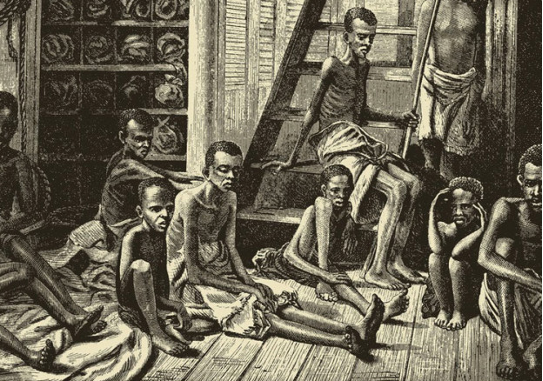
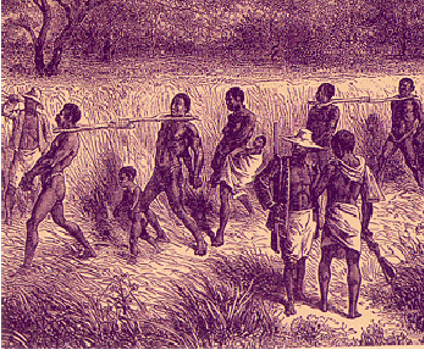

Even though on the 28th of August 1833, the Anti-Slavery act was signed by the king, and therefore making illegal in the United Kingdom, it has continued to exist. It is reckoned that in Britain today there are between 8 000 (Government) and 130 000 slaves (Anti-Slavery Campaign) of some description in the UK in 2022. The numbers are very similar in France. Globally, the estimate ranges from 36 to 40 million people who are in forced situations (work, servitude, sexual slavery, etc…) in the world today.
Colonisation
From 1442 till the early 19th century, there had been little exploration of the interior of the African continent by Europeans. Most of the adventurers had gone west in search of the passage to China and Japan. The Middle Leg of the African Triangular Trade relied on African tribesmen bringing slaves to the coastal area where they would be picked up by slavers.
As a colonial power, France had lost vast tracks of territory in the North of America after its defeat in the real First World War now known as the Seven Year War. From 1756 till 1763, Europe was ravaged by a conflict which involved all the big entities of the continent. Seven Years’ War – Summary on a Map – Bing video

The Participants in the Seven Year War (1756-1763)
In Blue: Great Britain, Prussia, Portugal, and other Allies
In Green: France, Austria, Russia, Spain, and other Allies
As the map demonstrates, the belligerents fought not only in Europe but also in the Americas, in Africa and in Asia. Hence the war is global and not restricted to the battlefields of Europe as has been the case so far. The Treaty of Paris saw France losing a large part of its possessions in Canada and present-day USA. (For readers interested in the conflict and its consequences see Pélagie La Charette, a novel by Antonine Maillet 1979). The Seven Year War resulted in France reassessing its army and navy and by 1789, it was ready to take on the rest of Europe and, for a time, prevail under Napoléon Bonaparte (1769-1821). In 1803, the military dictator – soon the crown himself emperor- sold what was left of the French possessions in the newly formed United States of America, to the then President Thomas Jefferson (1743-1826) in order to fuel his conquest of Europe.
By 1800, a number of European countries were making aggressive moves to colonise in Africa: The Dutch were invading from Cape Town and going north, the Portuguese had footholds in Angola and Mozambique, and the English were exploring East Africa from the west coast following bed of the Congo River. In many ways, the reason behind the French involvement in the region has initially little to do with a wish for an Empire. Charles X (1757-1836) was a very unpopular king. His line of thinking in 1830 was that if he began the process of creating an empire of which he would be head, the French at home might look at him far more favourably. The invasion of Algeria started under his kingship, but a few weeks later, he was thrown out during the 1830 Revolution. From then on, the process of colonisation increased in pace and in scope.
Even when France had become a Republic (1871) – and despite its Liberté, Egalité, Fraternité moto- it still yearned to acquire more lands and peoples to subjugate into its will. By the time Georges Clémenceau signed the Treaty of Versailles on 28 June 1919, France had swallowed more than 20 countries and territories in west and central Africa.
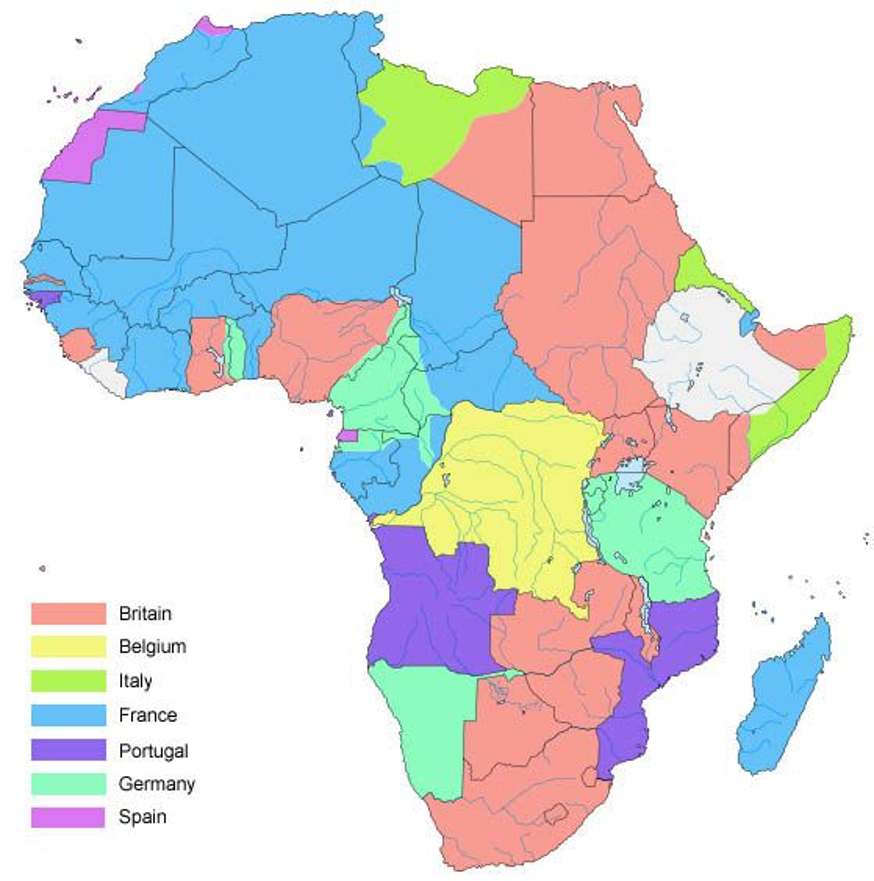
Most of the following modern countries or territories of the continent gained their independence from France in the middle part of the twentieth century:
Algeria, Benin, Burkina Faso, Cameroon (a German, then British, then French colony), Republic of Congo, Ivory Coast, Djibouti, Gabon, Ghana, Equatorial Guinea, Madagascar, Mauritania, Mali, Morocco, Niger, Central African Republic, Senegal, Tchad, Togo (a former German Colony) and Tunisia.
At different periods of their colonial history, the inhabitants of these countries might have been French citizens in name but very rarely in fact. They could not obtain a passport to travel to the “Mother Country”, nor could they claim to be fully fledged citizens of the Hexagone, most were not eligible to vote in elections. Even fewer managed to go to the Lycée. After all, they were of a different colour and came from the blackest, darkest regions of Africa. However, they had their use: young men could be enrolled into Zouave Regiments of the French army to either fight for France or to quell one of the many rebellions which took place between the occupation and the independence of a colonised country.
Algeria
One of the earliest countries to be colonised, and probably the thorniest when it came to gaining independence, was Algeria. Prior to the French army arriving, Algeria was ruled for the most part by the Pasha of Algiers, nominally on behalf of the Ottoman Empire, as was the case for most of the Maghreb. The Maghreb includes the four countries which border the Mediterranean coast: Morocco, Algeria, Tunisia, and Libya plus Mauritania. It was argued in French government circles of 1830 that the fact that Pirates from Barbary (Kabyle) were landing on the south coast of France and kidnapping men, women, and children to take them into slavery, as a sufficient excuse to launch a full-scale invasion of the region. If this was the reason- and indeed this kind of event had been happening quite regularly for the last five hundred years- why now?
In the spring of 1830, and after a two-month siege of Algiers, the Pasha, Hussein Dey (1765-1838) was defeated, and the city was occupied by French troops. The next 132 years will be a long and protracted conflict between the occupying forces and those who would like to see Algeria independent of a colonial power.
The most renowned leader of the struggle against the French of the era was Abd el Kader (Abd-al-Qadir ibn Muhyi al-Djn ibn Mustafa al-Hasanj al-Jaza’irj) (1808-1883). In 1832, Abd el Kader took over from his father as Amir of Oran. His aim for the next 16 years was to see the French Army return to where it came from on the other side of the Mediterranean. He avoided direct confrontation on a large scale wherever possible- a strategy which would be employed by generations of Algerians who fought the French.

Although mainly confined to the region of Oran in the far west of the country, Abd el Kader instilled in the local populations a pride in being Algerian, a nation with its own culture, language, and religious traditions. He himself was never one for riches or glory. Taken prisoner in 1846, he was freed a few years later by Napoleon III and returned to the Maghreb. He died in Damascus in 1883, revered in Algeria as the father of the Liberation Movement, but also respected for his integrity by followers and opponents alike. Léon Roches (1809-1901), a French diplomat, translator, and businessman, was Abd el Kader’ s loyal secretary for a period of ten years. Roches wrote a rather fanciful book about his time with the Algerian Amir. Called Ten Years Across Islam, the pamphlet reinforces the view that our freedom fighter was a man of integrity and great humanity.
Whilst Abd el Kader was leading the small Algerian force in a guerrilla campaign, General Bugeaud (1784-1849) was installed as Governor General of Algeria. Bugeaud employed the controversial tactic of the “Terre Brulée” (burned earth) in the pursuit of his enemy. The famine which was the consequence of this policy seemed to increase the will of the local population to be rid of the invading army. Despite both Bugeaud and Abd el Kader having left Algeria by 1847, the conflict continued. The next stage was euphemistically called The Pacification of Algeria. It involved the army killing as many rebels as possible whether they were men, women, or children. An action repeated in many other countries in French occupied Africa (see Madagascar in the section on decolonisation).
The episodic armed conflict in Algeria would not stop until the country’s independence was signed at Vichy in 1962. It is reckoned that between half a million and a million Algerians died in the first thirty years of occupation by France out of a population of three million at any one time. Overall, the 132 years of occupation might have resulted in 5.6 million deaths directly related to the conflict. WHO WAS EMIR ABD EL KADER? – Bing video

West Africa
Several reasons prevented, Europeans from penetrating deeper than the mouths of rivers in West Africa from the 14th century to the early part of the 19th century. Even though the sailors were armed, it would not have taken long for the natives to have overwhelmed them through sheer numbers. Invasion would not have meant better trade, after all, slaves were brought to the coast before being taken to their final destinations. This was the extent to which the sailors were prepared to work. There had been no accounts of fabled treasures from the interior- as had been the case in south and central America. Finally, the tribal chiefs had reported the presence of what to Europeans appeared to be monster beasts. Few were brave enough to go and verify the veracity of such stories. Mythological animals from Africa – Search (bing.com)

In the first half of the 19 century explorers were less inclined to take such mythical beasts at face value and were better prepared in terms of expeditionary necessities for the time. Groups of well-armed and determined Dutch, Portuguese, and British men entered the interior at various points. Portuguese near Luanda, and Pemba, the Dutch near Cape Town, and the British at various points in the west of the continent (Nigeria, Cameroon, Congo). Not to be left behind in the race to build itself an empire, France -whether under king or republic- sponsored adventurers or military men to go and find out what could be take in the name of France. Three men stand out for their endeavours to explore the region.
Edouard Bouët-Willaumez (1808-1871) was a member of the navy who led a foray up the river Senegal in 1834. Five years later, he is found in command of a steamer off the coast of modern-day Gabon. His orders are to sail up the river Ogooué. Along the way, he did free slaves who were on board a “Négrier” (a slave ship), built the first houses of a village which will eventually become the capital of Gabon, Libreville -named for the slaves he freed- and signed significant treaties with two local kings: King Denis and King Louis (sometimes history cannot but make you smile and wonder!). The treaties were important as they gave France legal ownership of large tracks of African territory in the country.

Of the three explorers, Pierre Savorgnan de Brazza (1852-1905) is probably the most well-known. Or, to put it differently, the least unknown and in many ways the most controversial. Born in an Italian family with French connections, Pierre Savorgnan de Brazza (Italian name Pietro di Brazzà) did not become a French citizen until later in his life. Even when he had finished at the Ecole Navale and he had fought in the 1870 war as foreign officer on a French steamer in the North Sea, his application to become French had not become a reality.
As a newly appointed but lowly naval officer, he is sent to Algeria to help quell the many uprisings happening there in the 1870s. Savorgnan de Brazza is horrified at the degree of violence used by the French military towards the indigenous population. Witnessing such incidents will influence his later behaviour towards the inhabitants of the Ogooué and the Congo regions of West Africa.
The first expedition he undertakes on behalf of the French Government is aimed at finding out if the rivers Ogooué and Congo are one and the same river. In this he will be successful as it is plain to him that they are different bodies of water. Savorgnan de Brazza is a very charming and open man, and this will serve him well in his relationships with many of the tribes he meets on his expedition. An incident which happened during this first foray into Gabon and Congo best describes his approach to the local population.
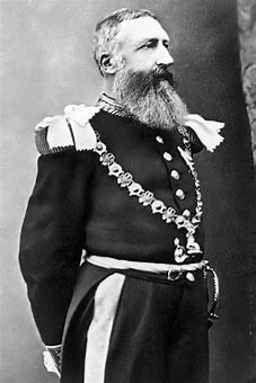
An armed phalange of Osyenas were escorting a group of slaves to be sold on the coast of Gabon. After much circumspect talk, Brazza managed to acquire the slaves and then free them. Amongst them is a family of three: Otulu, Aniassa and Antini. Instead of trying to make their way home, the family decided to remain with the expedition. Along the way, Otulu, the father, is crushed to death by an angry male gorilla and Aniassa, the mother, dies as a result of being bitten by a snake. Brazza promises to look after Antini who will return to France with him and who will be become his adopted daughter. Discovering the source of great rivers was a popular hobby for explorers of the Victorian era and the fashion had caught the imagination of the public in France. Savorgnan de Brazza’s fame resulted in the publications of books and newspaper articles describing his accidental discovery of the source of the Ogooué. By then, he had also witnessed the way the Belgians, next door in the Congo Kinshasa, treated the Congolese population on behalf of their king. Leopold II of Belgium (1835-1904) used the territory as his own property and treated the locals in extremely violent ways to gain as much reward as possible from the land, with as little rebellion as possible. To this end he sponsored a certain Henry Morton Stanley (1841-1904) to colonise the Congo on his behalf. Stanley (of “Doctor Livingstone, I presume” fame) was one of the most profit driven and therefore aggressive explorers of the continent at the time. A very different character from Savorgnan de Brazza. Leopold II of Belgium: The Biggest Coverup In European History – Bing video
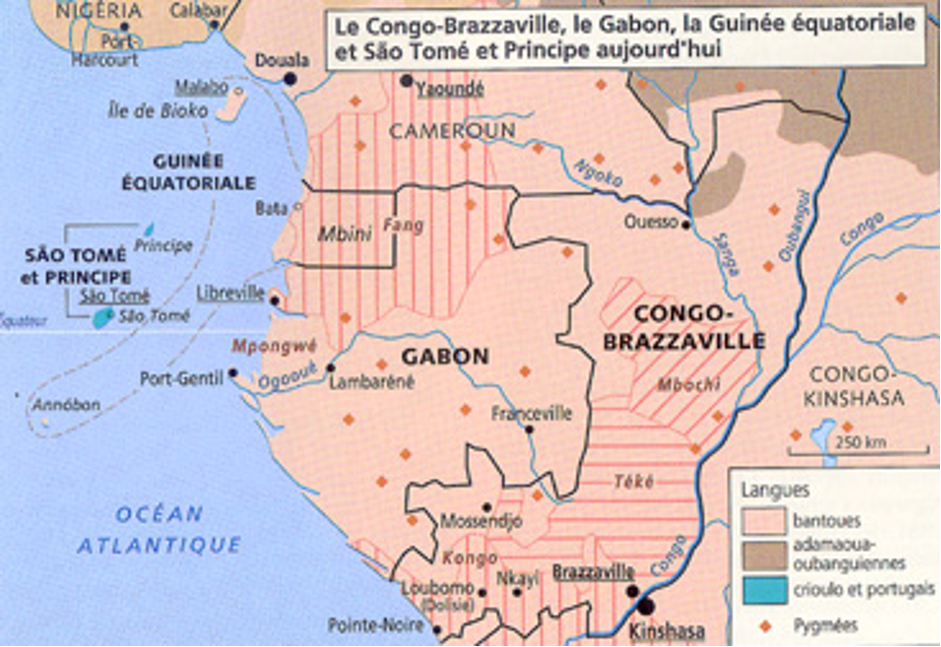
In some quarters of the Foreign Ministry in Paris, the rather laid-back and native friendly attitude of Brazza was seen as being a weakness when compared to the very energetic ways in which the Congo Kinshasa was being exploited. Soon enough, newspapers, which recently had published accounts of the adventures of Brazza, turned against him. Yes, he was a dilletante. Yes, he was lazy. Yes, he was disorganised. But at least he treated the people around him as human beings and not as slaves. He died of illness trying to find the source of the Congo in 1905. Savorgnan de Brazza et le Congo – Bing video (the video is in French, but the pictures tell the story)

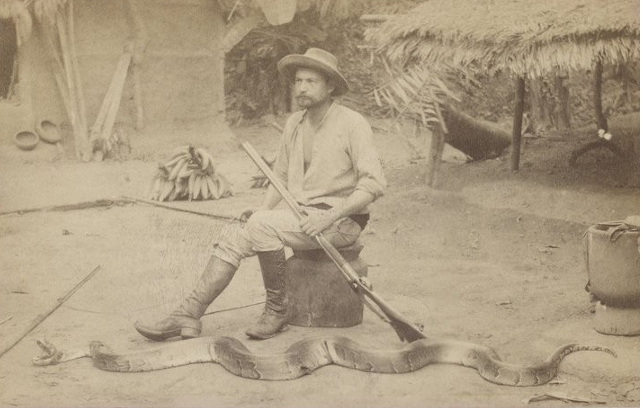
Marcel Trech-Laplène (1860-1890) is almost unknown in France. Yet, he is the first French administrator of the Ivory Coast and a man who would not spare himself in what he considered to be the duties of his work. Trech-Laplène came from a provincial middle-class family emanating from the south of France. From the age of 17 he was sent to the Ivory Coast, first to help in the administration of a plantation and eventually as an official explorer charged with diplomatic missions to the country’s interior.
His most important assignment was to prevent the British from succeeding in their aim of colonising all the lands from Ghana to Senegal. By signing treaties with various kings, his work was accomplished. His final expedition saw him walk from the south coast of the Côte d’Ivoire in a northern direction to meet with Louis-Gustave Binger (1856-1936) who was hiking from Senegal directly east. The rendez-vous happened in Kong, a city situated north of the Kong mountains in Northeast Côte d’Ivoire.
Both men were exhausted and suffered from malaria and other diseases when they met. Binger had to be transported back to Abidjan in a hammock where he recovered. Some weeks later Trech-Laplène died probably from having taken too much quinine to combat malaria. Trech-Laplène’s skills as a negotiator had prevented the British from becoming the masters of the region. For the French this was a massive success. Later administrators followed in his footsteps and West Africa became the centre of colonial France and of Francophonie.
Madagascar and the Hero of the Marne
The only news which ever comes from the magnificent island of Madagascar is about its fast-disappearing forests and its rare population of lemur. Regardless of its size and of the natural beauty which exist there, the island remains for most people a place they would never consider as a possible tourist destination.
The French, in the early days of the Triangular Trade, had created a Comptoir on the coast. Slaves from various tribes were captured by locals, sold to ship owners, and transported to the other side of the world. But so far, few Europeans had dared explore the interior of the island which is mountainous and heavily wooded.

Let us forward to 1895. The island is ruled by a queen called Ranavalona III (1861-1917). She came to the throne in 1883 and by all accounts she was neither better nor worse than any other African monarch of that era. At least she was not from some distant country no one had heard of before they arrived on the scene, neither would she despoil her country as he knew people would rebel against her, nor was she trying to send slaves in vast numbers abroad. Praise must be given for the efforts she made throughout her reign to stave off the colonial advances France was making. This policy continued until 23 April 1896 when the future Hero of Paris and the Marne arrived on the island.
The future Hero of Paris and the Marne was sent to Madagascar by a prime minister who had recently (1885) declared that:
“Les races supérieures … ont le devoir de civiliser les races inférieures »
(Superior races have the duty… to civilise inferior races)
Jules Ferry, that was the prime minister’s name, was to become one of the most respected politicians in France as he was instrumental in putting together the 1904 act of separation of church and state. The act would enable the laicisation of education in France. A idea which is enshrined in the constitution to this day. However, his policies towards Africa gave administrators or military men the freedom to act as they wished in their colonies.
Gallieni – the future hero of the Taxis de la Marne who saved Paris in September/October 1914- landed in Madagascar in 1896. Joseph Gallieni (1849-1916) was a military man through and through. His first acts were to depose the queen and to massacre (les Menalbamba) the Mérinas tribe who were the aristocrats who had ruled the island for generations. The Pacification of Madagascar continued for some time and by the end it is reckoned that between 15 000 and 700 000 locals had disappeared. The reason behind the wide disparity between the two estimates comes from the fact that no one counted the dead or if they did, they never reported it. Once again, Gallieni employed African troops to do the dirty work.

To ensure no tribe had the possibility to dominate politics in Madagascar, Gallieni practised what he called “la politique des races”. Basically, divide and rule. Gallieni wrote that he enjoyed the power games he played and that he felt like Louis XIV. His policies were made official when “Le Code de L’Indigénat” was made into law in 1897. The code (very similar to the Code Noir in effect) described the restrictions imposed on those governed by French administrators:
- Restrictions on travel within the colony (needing a permit)
- Needing permission from the local administrator to move house
- Limits in terms of ability to apply for jobs
- Servitude of 30 days a year
- No right of appeal once decision made
These are only a few examples of the impositions made on the local people. For the next six- or seven-decades Madagascar will be a thorn in the side of France as it will rebel time and time again. The rebellion of 1947 is one which is especially bloody even if it was kept quiet by various administrations of the colonial power. Particularly as it involved decisions made by one man (amongst many others) who was to reach the highest rank in politics later in the century.

The process of rebellion followed by decolonisation will be looked a little later on in this chapter. First, we will travel further east.
The Far East
Prior to the occupation by the official military of large areas of the Southeast of Asia, French sailors had taken over some of the larger islands in the west of the Indian Ocean. La Réunion, The Seychelles but especially l’Ile de France (Mauritius) were centres of activities and trade in the region. These islands would be used as steppingstones in the conquest of Laos, parts of Cambodia and China, and Vietnam.
L’Ile de France was also used as the centre for Corsairs expeditions in the seas between Africa and Asia. The most well-known of French pirates was undoubtedly Robert Surcouf.
In my early teens, I remember going to the cinema to watch Robert Surcouf, Le Tigre des Sept Mers . A romantic biopic of the man made by a Franco-Italian outfit in 1966. I watched it again recently and was not entirely impressed by the movie. But in the 1960s, historical accuracy was not exactly the order of the day. In no way is it comparable to Andrei Tarkovsky’s Andrei Rublev or Gillo Pontecorvo’s The Battle of Algiers which came out the same year. This is the link to Surcouf’s biopic (just in case a reader would like to spend 90 minutes at sea) Surcouf, le tigre des sept mers 1966 – Bing video.
Robert Surcouf (1773-1827) remains to this day in the communal imagination of French people as something of a hero. As a child he was a gang leader. His unruly behaviour reached such a peak that he was sent to sea by his well-to-do parents aged 13/14. There he found his vocation. By the age of 21 he was given command of his own ship and he took to the Triangular Trade like a duck to water.

However, his fame comes from being a pirate in the Indian Ocean where he harassed vessels belonging mainly to the East Indian Company and even the Royal Navy. His most renowned coup was to capture of a voilier called Kent three or four times larger than the one he commanded. Kent was heavily armed but not as manoeuvrable as Surcouf ‘s own brigantine. Over the years, Surcouf seized dozens of boats from the Dutch, the Danish but primarily from the English whom Surcouf disliked due to his Irish ancestry. Many an expedition was organised by the Royal Navy to stop such piracy but to no avail. Having retired unscathed from pirating, he became a respected and decorated ship owner in his native Saint Malo and died in his bed. A fate accorded to very few sailors or slaves who happened to be transported on his vessels. Napoleonic Wars : Robert Surcouf – King of the Corsairs – Bing video (this video reinforces the romantic view that most French people have of the man).
Surcouf navigated the waters of the Indian Ocean as if it was his second home. However, it is not known whether he went further east as some lesser-known French sailors did. Their goal was first and foremost one of trade in spices, rice, tea, coffee, and silk. These adventurers were not interested in changing the people they met. This was left to the religious men and women whose vocation was to convert these poor unhappy souls to the right religion (!).
Before looking at the practicalities of colonisation in South-East Asia, it might be useful to put forward a couple of ideas for consideration.
There was an article recently in a well-respected French daily newspaper about a North Korean woman who had managed to escape from the country. She described her life under the totalitarian regime of Kim Jong-Il (1941-2011) as a place where individuals had no right to decide about anything. From birth, people were told what to do, what to think every minute of the day. All day long the only thing at the forefront of her mind was food as everyone apart from the elite was starving. She cannot remember ever thinking about fighting for her freedom because it was not a concept known to her. The other issue that mattered, apart from food, was her adoration of the leader. Even when food was so scarce that she had to search the bins for rotten morsels, she did not blame the leader but those people who did not follow the directives of the party and profited from other people’s misery. She did not know anything about other countries of the world or events that had happened there except that most Americans were starving. It was permanently repeated ion the radio and TV that North Koreans were the luckiest people on Earth and the richest. And she never questioned it until she managed to move to the United Kingdom where she discovered another version of history.
I encountered a similar situation in 1992 in Albania where the people we met had been told by Enver Hoxha (1908-1985) and his successor that other countries wanted to invade Albania because it was so rich. And Albanians believed it as they had no other information to compare it with.
The notion of inferior and superior culture prevailed in the explorations of the late 19 century. Added to this was the presence of religious orders who came to look after the souls of these unfortunate pagans. Modern day tourism in search of the exotic is the newest version of this concept. The visitor has come to the country to experience something different which is going to reinforce the visitor’s view of his own superiority.
The second point flows from the one above. All societies have structures. Structures imply culture. Culture is language, traditions, agreed intrinsic beliefs, arts, political structures, and many more aspects of daily life. These aspects of civilisation make the people who live within the culture, whether they agree with all their aspects or not. Hence tribes in Africa, the queen of Madagascar or the king of Siam had culture. Probably different from the French approach to the idea but these people did not live in a vacuum. According to their own mores, they were civilised and anyone not fitting in was a Savage. As the intruders (the French) wanted to impose their own culture, the locals faced a choice: either accept and embrace this new culture or…
The first Comptoirs east of l’Ile de France are mainly in the regions of Pondicherry (Puducherry) and Chandernagore (Chandannagar) in western India. Further east, a small number of Jesuits had been sent to either make contact with local dignitaries or/and to try and spread the word of their god. Reports were sent back to Versailles, but it was of very little interest to the authorities there until it became obvious that Perfide Albion (the English) was making moves to impose its law in Siam and Laos. To stop the advance of the East India Company, contact was made with local rulers who would accept the presence of foreigners in the midst of their kingdom.
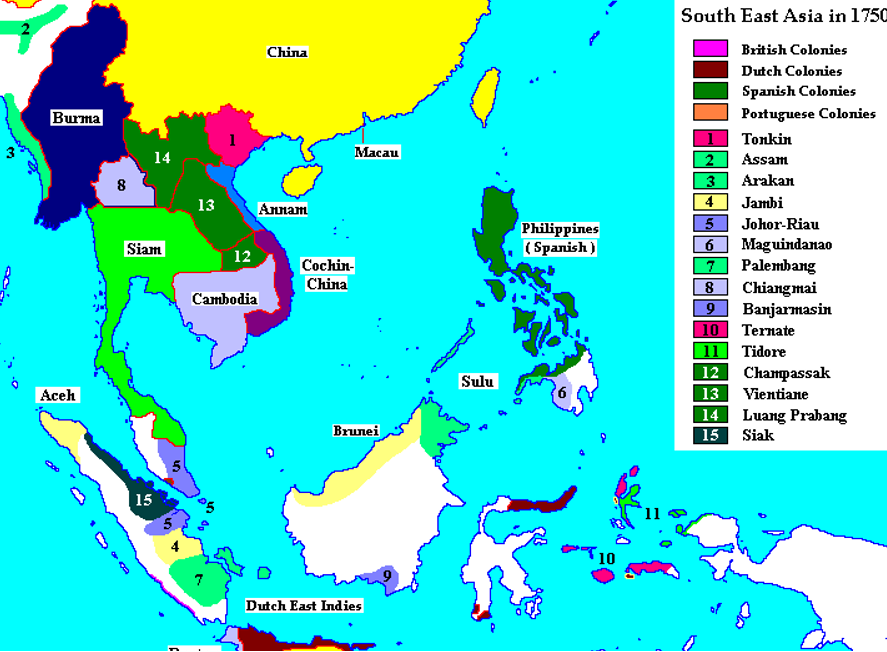
Fresh from having finished his studies at the Jesuit seminary of Laon (another one!), Pierre Pigneau de Behaine (1741-1799) is sent to India then to Vietnam by the Missions Etrangères de Paris with the double aim of making contact with the king of Cochinchine and of converting the locals to Catholicism. The king is having to fight the armies of the Khmer from Cambodia and the interest of the King of Siam who is supported by the British. The lack of interest in Versailles for the difficulties of the Cochinchine king, meant that Pigneau de Behaine had to find the funds to pay for a private expedition of 350 soldiers, a score of officers and two ships to undertake a military campaign to help the Annam army.
The success of the expedition is due in no small part to two officers of the small French army: Olivier de Puynamel (1768-1799) and Jean-Marie Dayot (1759-1809). The former trained the Annam army to use modern techniques and technologies. He also designed and built fortresses to defend the country. The latter, a navy officer, manoeuvred his two ships to gain ascendency both along the coast but also in the Mekong Delta. Once enthroned king of Annam and Cochinchine, Nguyen Anh (1762-1820) barred foreigners from his kingdom with the exception of Pigneau de Behaine and his acolytes. This first presence of a French military force in Vietnam will be followed by many more but most on a much larger scale and with a different purpose.
In 1848, on the pretence of the “humanitarian rescue” of the Christians who had not been massacred by the locals, the French Army invaded Cochinchine and by 1887, Cochinchine (Saigon), Annam (Hue), and Tonkin (Hanoi) were integrated into the Indochina French Administration. Six years later, 1893, Laos became a protectorate of France to “save it from the claws” of Imperial Britain. Cambodia will follow in 1897. By the turn of the century the whole of the region id under French sway and will remain so until after the end of the Second World War whether the peoples concerned like it or not.
In short, this was the occupation of South-East Asia. A lot more will be said later about the painful process of decolonisation of the region. For now…
Allons En Chine!
When the price of cotton dropped after the Napoleonic Wars and Britain’s continued involvement in India made the country nearly bankrupt, the East India Company was charged with finding new ways to increase revenues for the tax office in London. The Indian humid but hot climate was ideal for growing poppies. From the flowers, opium could be extracted. A market had to be found. China was the most populated country of the region and Imperial England officially became the largest drug dealer on the planet. There were only very few ports which were open to foreigners in China. Britain wanted access to more harbours to import its merchandise from India and when the Chinese emperor objected as money was flowing out of the country to pay for the opium, a war began: The First Opium War (1839-1842).
The army of the Qin emperor was no match technologically or strategically for the British force. Even when the latter was 10 times smaller than the former. The result was that Britain had an enormous market to sell its stock. The humiliation of the emperor was total. In 1842, he had to agree to open cities like Canton and Beijing to foreigners for the first time in the history of the country.
In 1842 Shanghai acquired a British then an American concession. Two years later the French and the Russians had also been granted -albeit reluctantly- concessions in the city. Initially, the French settlement was mainly made up of Jesuits who opened a collège in 1847. Compared to the British and the American settlements, the French concession was small verging on the insignificant. Not to be left behind, France made attempts to move opium from the Tonkin region of Indochina through southern China to the big cities of the coast. This led to the Second Opium War (1856-1860) fought by the British, the Americans, the Russians, and the French against an already depleted and harassed Chinese fighting force. By 1886 in the region of 10 000 tonnes of opium was reaching China on a yearly basis. In 1906 this had risen to 34 000 metric tonnes. It is reckoned that roughly a third of its 450 million population was either occasional users or completely addicted to the stuff.

Hong Kong became the financial centre of the banking system which oiled the wheels of the trade. Large money institutions governed by such men as William Jardine (1784-1843) of Jardine-Matheson, Sir Thomas Sutherland (1834-1922) of Hong Kong and Shanghai Banking Corporation, or James Wilson (1808-1860) of Standard Chartered benefitted from the opium market. Emperor Xian Feng (1831-1862) had to contend with foreigners invading his land, opium turning his people into zombies or even destroying them and a rebellion which was going to kill countless numbers of his people. No wonder he died young.
The Taiping Rebellion (1850-1864)
In the 19th century, France had experienced three important upheavals 1830, 1848 and 1871. All had resulted in a change of personnel at the top of the political tree by getting rid of the previous incumbent in the post of top dog. Most of the action leading to these alterations had taken place primarily-but not exclusively- in or around Paris. The numbers involved had been relatively small compared to the total population and the casualties even smaller. None had resulted in famine or mass slaughter (the Paris Commune resulted in the region of 25 000 deaths out of a French population of 38 million people) to the extent of the Taiping Rebellion.

The man who started the movement is Hong Xiuquan (1814-1864). Hong was a very bright student who came from the provinces of China. He was thought to be so brilliant that he was encouraged to take the Civil Service entry exam. Only 1% of those who tried ever succeeded. Hong tried three times and failed three times. He was humiliated and in a depressing state of mind. A friend of his noticed that amongst his library he had a bible. Hong was persuaded by his friend to read it and his life changed. As a result of his reading and of his low mood, Hong had night visions (!). He became adamant that he was the second son of God and Jesus’ younger brother. Hong decided to bring The Message to the people (In a few words: Get rid of the present set up and put me in instead because I know better!). China at the time was plagued with famine, wars against foreigners , the coming of opium on a large scale, financial difficulties, and other rebellions in various parts of the country.
Hong’ s movement took off in a big way very rapidly. His creed was a mixture of Christianity, Taoism, Confucianism and Millenarianism. Added to these were new policies (at least at the beginning):
- End of feet binding (stayed on the menu till the end of the rebellion)
- End of separation of the sexes (took a very quick dive as over a short period of time it was even more strict)
- Land socialisation (War and its train of destruction put paid to that)
- No more private trade (Except for the masters)
- Prostitution is outlawed (The Rebellion became so prudish that even encounters between married couples were frowned upon. Except for the bosses of course!)
- No gambling, alcohol, or opium
At its optimum the Taiping army reached two million soldiers battling on several fronts. After some vicious fighting, one of the armies was defeated at the gates of Shanghai by a very small but well-armed European private band of mercenaries. Hong became less and less interested in the Rebellion and shut himself in the luxury and pleasures of his palace in Nanjing where he eventually died as the Qin army entered its gates.
It is reckoned that during its years if existence the Rebellion of the Taiping conquered 600 cities which it promptly destroyed. The people captured by the Taiping were either dispatched or forcibly enrolled in the army. The famines which accompanied such destruction and the fighting itself resulted in 20 to 25 million deaths. If we add to the Taiping, The Nian Revolt (1853-1868, The Panthay Rebellion (1855-1873), The Dungan Revolt (1862-1877) and The Red Turban Upheaval (1854-1866), it becomes obvious that the Qin Dynasty was in trouble. But even after the 20 to 30 + million dead as a result of these events, the dynasty survived (some historians argue that the numbers were as high as a hundred million). Unfortunately for the Chinese people the 20th century would be no relief on what had happened in the hundred years before. The End of the Qing Dynasty, Part 2, Section B, The Taiping Rebellion – Bing video