


“The textbooks used in the Hexagone were also the ones which students in the colonies were reading. Whether Berbere, Arab or Senegalese. There was a boy in my school in the 1950s whose name was Okoulov. His dad had been left behind after the end of the Second World War and forgotten by Stalin who liked to repatriate all his people to butcher them. He too, along with Meichman, Pietrovski and Mendes, had to accept that his ancestors were Gaulois.“
What to Drink Whilst Reading This Chapter
A small glass of Chiroubles.
Chiroubles is a Commune in the Beaujolais region of France that gives its name to red wines made from the grapes grown there. As with all Beaujolais reds, the grape variety is Gamay.
Chiroubles vineyards are on the hills that rise to 450m above sea level. This means that the harvest is often quite late comapred with other nearby appellations, and the cool nights translate into fresh-tasting wines.
French history is made up of stories. When French children are introduced to it, it is often put together of a bit here and a bit there but rarely as a continuum. It took me a long time to understand the relationships between the different sections which I had been presented with at school. Even now, I have to think carefully about when things happened in relation to other events or people. In this section about the history of France, I have taken people and events, which are important in the Culture of the country in chronological order, and which are of significance in the development of who the French are intellectually, socially and also as myths.
In the beginning…. There was a beginning and presumably some kind of Eve who had children with some kind of Adam; that was such a long time ago that no one knows anymore, and we haven’t yet found any proof that this was the case in the first place. Do we descend from primates? Again, it is more than probable but there are too many gaps in our knowledge to put forward this statement with any kind of certainty. Have we all got African ancestors? The answer is a resounding yes. However, recent DNA testing appears to indicate that many people have also got other hominids’ genes i.e., Neanderthal. Before Homo Sapiens Sapiens took over, there were a number of other hominids (Denisovans, Homo Erectus…) also roaming the Earth. Collections of bones have been discovered in various parts of the world which prove that Sapiens were not alone and certainly not the largest population for a long time. Eventually, through producing more offspring than the other groups, by breeding with them and/or by violently disposing of the other hominids, Sapiens became the top dog.
Remains of a group of Neanderthal people were found in caves situated above the port of Gibraltar in southern Spain. Archaeologists and anthropologists involved in the discovery and study of the cave have put forward the idea that these were probably some of the last Neanderthal people on Earth, and that they were fleeing from the Sapiens but could not run any further as the sea was too high for them to cross into Africa. They either died of starvation as they could not hunt or gather any further or were killed by local Sapiens. Somehow, I always see this story as a portent for the rest of our history as human beings, hence the title of this chapter. (1)
The demise of the Neanderthals and other hominids happened during the last ice age (from 115 000 to 11 700 years ago). It is also at that time that Sapiens left his kingdom somewhere in Central or Southern Africa to start traveling North. As the seas were between 24 and 130 metres lower than they are today, Sapiens were able to cross from Africa probably into Iran (For more information see: Professor Alice Roberts’ book, Evolution, the Human Story). From there, the group spread out. Some archaeologists argue that the party had left their hunting ground due to the desertification of their environment. It was by no means a large group: hundreds, maybe a couple of thousands at the most, certainly not tens of thousands as was first thought some years back.
From there, they set on foot to conquer the world. It is extremely unlikely that they consciously decided to overrun the planet. Their aim was to survive and to thrive. Like all the other hominids they were hunter-gatherers, lived in small tribes and found safe shelter in caves. The ability to use fire for their own purpose was probably the greatest skill tribal chiefs could demonstrate. It protected the tribe from wild animals, gave light and warmth during the dark hours or in winter and enabled cooked food to be more easily digested.
Sapiens arrived in France at a time when a good half of the country was covered in the thickest amount of ice and snow imaginable- 43 000 to 24 000 years ago. We are not talking here of thin ice and flurries of the white stuff. Hundreds of meters of hard ice crust covered by layer upon layer of snow. South of this nearly impenetrable white world lived a megafauna of Mammoths, giant Aurochs, and many other oversized animals -archaeologists have argued that some beavers weighed as much as 60 kilograms, 110lbs (2). Hunters had a field day. It is said that Sapiens and other hominids destroyed more species during that time than we probably have so far in the last two thousand years. The last Aurochs (very large cows) in Gaul were reported to have been seen by Julius Caesar when he invaded the country in 56-51 BCE.
8000 years ago, a profound transformation in the life of Sapiens took place: they became farmers. The discovery of grain as a means of feeding the tribe came to be fashionable. Forests were burnt and replaced by fields of wheat or maize. Sapiens turned sedentary. Shelters were built. They grew into hamlets. Trade began between hamlets. Paths and fords were created to enable the trade to take place. Farmers turned into traders. The wealthy ones developed as tribal chiefs. A hierarchy was established amongst the tribe: modern society was born (3). From an average height of 1meter 85 for a male hunter gatherer, Sapiens shrunk by 12cms when he settled as a farmer. There is also a strong possibility that sedentary life and the proximity of newly domesticated animals made farmers more prone to diseases than when they were running in the tundra after wild animals (4).
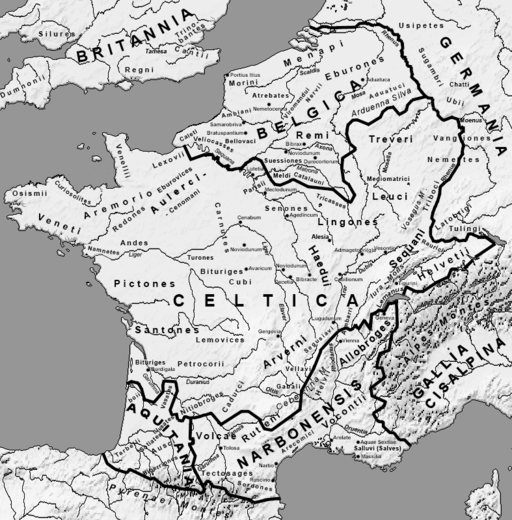
There are few written records of the peoples who lived in France from about 600 BCE until the Romans arrived on the scene, as none of the Celtic tribes believed in keeping written accounts of their history. Greeks, Phoceans and Romans who had either trading posts in Gaul or had created cities on the Mediterranean coast, have left some descriptions of their stature; Gaulois (Celts)were tall either red-haired or blond and broad in the chest. Belgians (Celts) were smaller but faster in their movements, Ligurians (Mountain people) were small, darker of skin and very nimble.
The Belgian tribes had most of the lands between the Sain (Seine) and the Rhine (Rhin) and were a very resilient people who gave the Romans a lot of trouble from the time of Julius Caesar onwards. The Gaulois, whose name is a collective noun for many tribes, lived between the Loire and the mountains of the South. The east and the Alps were the areas in which the Ligurians had their homes. All Roman generals agreed that the Gauls (the three peoples of Gallia) were ferocious fighters who appeared on the battle ground often naked but painted in various hues.
From the time of the separation of the Church from The State of 1904/05, the history taught in schools has referred to the Gauls as being everyone’s ancestors in France (Nos Ancêtres, Les Gaulois). The textbooks used in the Hexagone were also the ones which students in the colonies were reading. Whether Berbere, Arab or Senegalese. There was a boy in my school in the 1950s whose name was Okoulov. His dad had been left behind after the end of the Second World War and forgotten by Stalin who liked to repatriate all his people to butcher them. He too, along with Meichman, Pietrovski and Mendes, had to accept that his ancestors were Gaulois. The other remarkable thing which happened after the Act of Separation of 1904, was that the history of France was only of interest to young people AFTER 14th July 1789. Before was a black hole. The victors always write history.
Old Julius Caesar was a shrewd operator and an extremely ambitious man. Aristocratic of birth, he was not against plunging into the less well-off sections of Roman society to find the support he needed. At times, in his younger days, he had to put as much distance as possible between himself and the city of his birth in order to survive. His rise to fame and power came when he was governor of Spain.
Germanic tribes had been forced to cross the Rhine into Gaul. This was the result of other peoples further east deciding that they needed to Go West (Young Man). The Germans crossed Gaul and headed towards Spain. JC’s Legions were not large enough to cope with the invasion. Our general hired Gaul horse soldiers to fight alongside his Roman Legions. On his way to push back the invaders, JC decided that it would serve him well if he declared the land that he was crossing part of the Roman Dominion. Amongst the leaders of the Gauls who had fought to defeat the Germans was a young aristocrat called Vercingetorix. He objected to the rule that JC wanted to impose on the Gaulois. Here starts the myth of Vercingetorix.
Vercingetorix the First King of France (sic)

Let’s continue with the belle histoire.
Vercingetorix is not his real name. Gaulois kept their birth names secret. The word we use to name him means first king of the Gauls or something close to it. He was from the Arverni tribe in the south of the Massif Central. His father was a tribal chief of some importance and Vercingetorix followed in his footsteps when his father died (probably assassinated by his entourage). Vercingetorix is always described as being tall, strong, and blond with a large moustache. After the defeat of the German tribes, he rejected JC’s assertion that the land he had walked on was now Roman. Confrontation was inevitable. In the first year (?) of the war, JC had to return to Spain and Rome. One of his acolytes, General Labienus was put in charge. Vercingetorix’s tactics were those of guerrilla warfare: attack where you know you can outnumber the enemy and disrupt its supply lines. This worked for a time until JC came back. Even the Gaulois ‘victory at Gergovia over the Roman Legions could not prevent the end.
The end took place at Alesia somewhere in Central France. The Romans laid siege to the town which was heavily defended. JC built a barricade to encircle the town. At some point the besieged ran out of food. Vercingetorix decided to send the women and children out of the city hoping that the Romans would let them go back to their homes. No such luck. From the walls of Alesia, the Gaulois could see their women and children slowly die of thirst and hunger. Some weeks later, Vercingetorix finally realised that the situation was catastrophic and gave himself up. He supposedly rode on his white horse and surprised JC by arriving whilst the latter was presiding over a tribunal. He was immediately put in chains and sent to prison in Rome. The rest of the population of Alesia was either massacred or enslaved. After his triumph in Rome, JC probably had Vercingetorix executed (5). Gaul was now a province of Rome and Caesar the Big Cheese.
Several myths have been created around the persona of Vercingetorix.
- The leader of men who sought freedom from subjugation. There is a little truth in there somewhere in as much as he did not want his tribe to become a client of Rome. Like every leader, he had to walk a narrow plank: on the one hand he needed to trade with the Romans. On the other he wanted his tribe to be independent of them BUT under his rule. This was not democracy in any way.
- It is true to say that once he had won at Gergovia, his fame stimulated the other tribes into action. Some joined the battle against JC. But many stayed at home. His call to arms seems to have resonated mainly with the family.
- Gaul was not France. It will be another 4 to 500 years before the Franks’ arrival, therefore he was never the king of France.
- Vercingetorix is described as tall, long blond hair and moustachioed. In fact, direct witnesses seem to talk about a hairless man with piercing eyes but rather thin.
- His final moments are described as martyrdom for a notion of freedom which might not have appealed to those who claim him as their idol (Basically, you do as you are told, or I will dismantle you!). Furthermore, no one knows how he died but it cannot have been of natural causes.
Vercingetorix has become a national hero, the creation of the anti-clerical movement of the 19th century. The symbol of something which might not really exist. If his remains could be found, they would be sent to the Pantheon with all the pomp accorded to resistance fighters. That he wanted is tribe to remain free of external influences is almost certain. Some historians have argued that, like Attila the Hun, he was first and foremost a traitor who had fought for the Romans but had turned his coat when the wind had changed direction. I will leave it up to you to decide what your opinion is of the man. One thing is sure, he was a brave soldier, even by the standards of the day and he deserves to be used as an example of bravery in the face of overwhelming opposition. After his death, Gaul became a region of the Empire and remained so until the end of the Roman Dominion even though there were rebellions and armed revolts against the centralized power. Many Gaulois became Roman Citizens. Some sat in the Senate in Rome. At least three Emperors were born in Gallia or came from Gaulois families (Claudius, Caracalla and Antonius Pius).
A final word about Vercingetorix and culture. Uderzo and Goscinny, the celebrated creator of Asterix and Obelix, continued the myth by drawing a tall, strong in arms, long blond hair Gaulois whose only proper appearance in the cartoons is when he throws his weapons on JC’s feet. JC, however, plays a quasi-permanent role in all their adventures: always on the losing side despite the fact that the Romans occupied the whole of Gaul except the little village where our heroes live. At least two generations of readers of Asterix and Obelix are now convinced that this was the case, and that JC was in awe of the Gaulois who rebelled. I am sorry to say that history shows that most rebellions were put down in a rather violent way by the occupying force (6).
Clovis (ᚺᛚᛟᛞᛟᚹᛁᚷ) c.466-511 (And Clotilde)
The term Dark Ages evokes a period in the history of Western Europe when the days were without sunshine or warmth and when violence prevailed permanently. The expression was used to contrast it with the previous era of Pax Romana, during which, supposedly, the days were peaceful, bright and serene. To a large extent, the end of the Roman domination of Gaul (395) and the mass invasions of the Germanic tribes (405-410) saw the destruction of many of the institutions and buildings which the Latins had imposed on the locals. For those who had to live it, if they were lucky enough to survive, it must have been a perilous age to witness. The invaders were in two minds: on the one hand, they wanted the life that the Gallo-Romans had and which up to then had been mainly unattainable because the Legions had managed to keep them out. On the other, their urge to possess what they sought pushed them to destroy it. This contradiction repeats itself throughout history.
Amongst the numerous tribes which descended on Northern Gaul were the Franks. Like many other clans there were subdivisions amongst them – saliens and ripuaires in this case. The Frank saliens eventually settled in a small region in and around the town of Tournai in what is nowadays Belgium. At the age of fifteen, Clovis, succeeded his father as leader of the tribe of the Frank saliens. As soon as he ascended the throne, one of his first jobs was to dispatch any close relative who could be a threat to his authority. Whilst shocking as an event, recent times show us that this trend has continued to this day- Hitler and the Brown Shirts, Mao and the Reformers of the 1960s, Kim Jong un and his uncle, etc…. . From then on, Clovis was able to defeat more and more tribes. His ambition was to become a sort of Emperor in the West.
Two episodes of his life have become part of the culture of France. They are recounted by the Bishop of Tours, Gregoire (7) 75 years after Clovis’ death and have acquired the ring of truth on which myths are based. During the battle of Tolbiac (496AD) (8) against the Alemanni, Clovis found himself on the verge of defeat. Before the battle, as he always did, he had prayed and sacrificed the odd chicken or two to his Gods. But to no avail. Defeat was staring him in the face. Gregoire, Bishop of Tour then writes:
“O Jesus Christ, you who as Clotilde (Clovis ‘ second wife) tells me are the son of the Living God, you who give succour to those who are in danger, and victory to those accorded who hope in Thee, I seek the glory of devotion with your assistance: If you give me victory over these enemies, and if I experience the miracles that the people committed to your name say they have had, I believe in you, and I will be baptized in your name. Indeed, I invoked my gods, and, as I am experiencing, they failed to help me, which makes me believe that they are endowed with no powers, that they do not come to the aid of those who serve. It’s to you I cry now, I want to believe in you if only I may be saved from my opponents.”

And by some miracle, the chief of the Alemanni was killed (in single combat some later historians would have it!) and Clovis was baptised to the delight of his wife Clotilde who had been bugging him for years to become a Christian. He was the first Christian king of the lands of the Franks and his descendants would continue to be of that religion.
The` second episode which has attained the status of myth in France relates to the Vase de Soissons. Once again it is related in Historia Francorum by Gregoire de Tours. After the Battle of Soissons and the victory of the Frank saliens over the ripuaires, the loot resulting from the sack of the town was divided between the soldiers as was customary amongst the Franks. Remi, The Bishop of Reims (later a Saint) noticed that amongst the treasures was a vase (probably a chalice) of great beauty which he fancied. He asked Clovis if he could have it. The king agreed to give it to Remi, a gesture which went against the tradition of the tribe. One of the soldiers also wanted it and claimed it by hitting it with his axe, even though Clovis had made his request on behalf of Remi public. Clovis let the soldier have the vase in order not to have a confrontation on the day of victory.
A year later, Gregoire tells us, Clovis called for a review of the army to make sure the equipment was spic and span. The soldier who had taken the vase was part of the review. When he came to face him, Clovis took the soldier’s axe and threw it on the floor. The soldier bent down to collect it and Clovis smashed his head with his own axe and took the broken vase back to give it to Remi. For some reason, this episode resonated with the Republican and anti-clerical movement of the late 19th century and became taught in school with the motto:
“Souviens-toi du Vase de Soissons “
Remember the Vase of Soissons
It must be said that Gregoire de Tours was not a historian but an apologist for the Franks being one himself, and that these two episodes are given an emphasis which is there to show the kings of the Franks in a positive light according to the conventions of the time i.e. a man who will convert because the new God is more powerful than the old ones and a king who does not forgive or forget but keeps tight reins on things.
Charles Martel (Charles the Hammer) 688-741

Charles ‘s father, Pepin of Herstal, was the Mayor of the Palace under the last real Merovingian king, the infamous Dagobert the First (the one whose trousers were back to front as in the song). When Pepin died, and after a short hiatus, Charles took over. His ambition was to unify the Frankish kingdom which had become divided under the lazy Merovingian kings (so the victors say!). But and there is a big but, in this case, Charles faced the powerful incursions of the Moslems (Moors, Berber, Arabs) from the south. Iberia (Spain) had been conquered by the Moors in fifteen years, from 711 to 726 and it is quite clear that their intention was to move across the Pyrenees and take as much land as possible in the name of their God.
The Franks, who were overwhelmingly baptised wanted to stop them. For two obvious reasons: they wanted to keep hold of the land they had conquered over the last two hundred and fifty years and they meant to keep it in Christians’ hands. The battle of Poitiers in 732 at which Abd-El Rahman (The leader of the Moors) was defeated, has become a mythical date in the mind of the French. On that day 26th October 732, Martel, stopped the Arab invasion. For some, he is the hero who saved Christianity. There is no doubt that over the next seven years, he defeated the Moors on a number of occasions and forced them back over the mountains. Yet, the inhabitants of Provence preferred the political regime under the Moors (less violent, more tolerant, and less given to pillaging) than that of the Franks. There are still extreme sections of French society which take Charles Martel’s name to mean anti-Moslem and therefore act accordingly. The phrase: Charles Martel a battu les Arabes à Poitiers (Charles Martel defeated the Arabs at Poitiers) learnt when I was a small child, still resonates in my head and does not go well with what I hope is a more open-minded approach to relations with my Moslem friends. (9)
Maybe, Martel did save Christianity, at Poitiers. However, and more to the point he also happened to be the grandfather of Carolus Magnus, aka Charlemagne.
Charlemagne 742-814

Charlemagne was king of the Franks from 768 and Holy Roman Emperor from 800 till his death in 814. His Latin name Carolus Magnus comes from the fact that he was very tall for the age (1m90 in today’s money) and not, as is often thought, because he was a great king. The conception of the myth of Charlemagne rests principally on two factors which happened during his reign. The first one is the creation of numerous free schools and the second is to be found in the Chanson de Roland. (10)
Schools of some sort existed in the kingdom of the Franks before Charlemagne. Carolus’ aim was to increase the number of students who attended them in order to train future administrators. To his eternal regret, the king who could read, never managed to acquire the skill of writing. As a strong defender of the Catholic Church, Carolus was appalled at the inability of most of the clergy to be able to read or write. He hoped the schools would prepare a less inadequate and better educated curia for their evangelising missions. The great Alcuin (735-804) as a close advisor to the king, was instrumental in improving and reforming the schools. The anti-clerical movement of the Third Republic (1870-1940) was keen to develop and succeeded in creating the idea that Charlemagne invented free schools for all to prepare children for non-religious professions.
On the 15th of August 778, in a small Pyrenean valley called Roncevaux, an event took place which became a heroic song and which troubadours, and minstrels would sing and act for centuries as a chanson de gestes. By the 13th century the song had become a poem and the main character a legend which is recognised by all French people to this day. Charlemagne had been fighting with the Moors on both sides of the Pyrenees and had been successful in front of Pamplona but defeated in front of Saragossa. He was returning to Aachen, the capital of the kingdom. The army was going through the valley when the Gascons (Basques) attacked the rear guard hoping to find some loot. The leader in charge of the rear guard was Roland, a “nephew “of the king. The Franks were outnumbered and according to the song, the traitorous Gascons cut the throat of all the soldiers. Before being killed, Roland blew his horn loud and clear- before it was split asunder- but did not live to see the king return to massacre some of the Gascons. The troubadours tell us that the king was distraught and asked his minstrels to put Roland’s valiant defence of the rest of the Grande Armée into poems and chansons de gestes which was promptly done. It can be said that Roland has secured a similar status to that of King Arthur in the mythology of France.For a long time, Charlemagne was one of my heroes. Wise, intellectually aware despite his difficulties in writing, and a good and fair king. However, the image was somewhat tarnished when the research showed me that he was also brutal and no better than most of the warlords of the era on occasions. He showed very little compassion towards his defeated enemies and would destroy whole regions if they incurred his wrath. The Saxon tribes seem to have been the repeated targets of his anger. The fact that most of the history taught in schools tells us that he united the Frankish Kingdom, integrated the Saxons into the Empire, and was crowned Holy Roman Emperor in 800 but ignored his occasional massacres might indicate to us once again that the victors write their and our own history.
Philippe II Augustus 1165-1223
Philippe II came to the throne when he was 15 years old. He was anointed as King of the Franks, and it is only later (1190) that he declared himself King of France. His patronym, Augustus was given to him by the very sycophantic chronicler Ribord in Gesta Philippi Augusti (11) of 1206. Most of his life was spent trying to undo the stronghold the Anjou (Plantagenet) family had on large territories Philippe wanted to acquire to be part of France.

To say that Philippe was a thorn in the side of at least three kings of England (heads of the Plantagenet Clan) would be an understatement. He spent his early years on the throne of France pushing Henry the Second’s sons, Richard and John, to rebel against him. In the case of the hotblooded Richard this was not difficult. Like a lot of children of royal blood of the time, Richard wanted to get rid of his ailing father to take his place. Had the Anjou/ Aquitaine/Plantagenet dynasty not had lands surrounding or bordering the Kingdom of France, it is possible to speculate that Phillippe would have been happy to leave his English neighbours alone. But this was no the case and Philippe was not only devious (second only to Louis XI in the league of deviousness) but also extremely ambitious.
Barely a year or so after his father’s death Richard I (The Lion Heart) undertook a Crusade in the company of Philippe Augustus and Frederic Barbarossa. This was not a success. The enterprise was rife with disagreements, dissention, and plain bad faith, mainly but not only on Augustus’ part. At some point, Philippe decided to go home whilst Richard as usual was in the middle of a bloodbath somewhere in the desert. Phillippe hoped that his rival would be stuck in the Middle East for a while so that he could attack and take the duchy of Normandy. This despite the sworn agreement witnessed by the Pope that it was not legal to do so. But hey! What’s an oath between friends! And when Richard was taken prisoner by Leopold of Austria and ransomed, Philippe tried to persuade John not to pay the money but to take his brother’s place on the throne of England.
On the death of Richard I, Philippe manoeuvred his war machine to ensure that John would lose as much of the land adjacent to the Kingdom of France as possible. And to a large extent, Philippe was successful. John’s mother, Alienor of Aquitaine (12) who at one time had been queen of France as well as Duchess of Aquitaine, must have had nightmares. The complexity of the situation was not going to be resolved until the early part of the XVth century and the conclusion of the Hundred Years War.
By the end of Philippe’s reign in 1223, the Kingdom of France was looking a little more like what the Hexagone is today but still bereft of Brittany, part of Normandy and a good section of Gascony in the south-west
The Hundred Years War 1337-1453
If the dates above are to be accepted as the start and the end of the War, then it is obvious that it lasted more than a hundred years. As to the accuracy of the dates, no two historians will agree but this is what we were taught in schools, and it will do for the purpose of this descriptive.
The name given to that period is also a misnomer: the war was never a continuous battle between two sides like in the First or Second World Wars in Europe. There were long breaks. Sometimes lasting a few years. There were lots of treaties signed by both opponents, however these were often broken by one party or the other. It is frequently thought that this was a conflict between England and France and no one else was involved. It will soon become obvious that this was not the case. The battles of Poitiers, Agincourt, Crecy are often mentioned in children’s history books and are now part of the folk lore of either France or England depending on who is teaching it. These are important markers, but they do not give an overall picture of the era. The battles themselves killed mainly nobles who went on a mad charge like at Agincourt as described by Shakespeare in Henry V. However, as usual, most of the deaths occurred amongst the peasants and the innocent village and town dwellers as a result of pillaging which inevitably led to famines.
In 1337, Edward III was on the throne of England. He was a Plantagenet, and his grandfather was Philippe Le Bel who was king of France. The king of France, Philippe VI at the time, was also a Plantagenet. Edward felt he had as many rights to the throne of France as Philippe. Understandably, French nobles did not want a “foreign king” to be their master. Furthermore -and this economic argument is probably the most important on for the English King- Edward wanted to make sure the export of the wool which was sold to great profit (taxes) in Flanders and Hainaut for transformation into items of clothing was safe and would be getting there without difficulties. The French had designs on that part of the world. War began. It ebbed and flowed for a long time as we know. The war will involve at some point at least a dozen kings and/or national entities ranging from The Holy Roman Emperors to the denizens of Hainaut who will rebel against the French. The conflict will also lead to internal strife: Bourguignons against Armagnac in France and Lancastrians against Yorkies in England. In the early 1400s, it looked like the English were going to overcome the French and France only to be unmanned by the sudden death of Henry V and the apparition of a most unlikely character on the field of battle. This character did not win the war for the French but managed to create a reinvigorated national self-belief which had all but disappeared after Agincourt.
Joan of Arc (The myth) 1412(?)-1431
Since we are talking about people who played an important role during that war, it might be useful to have a look at the myth of Joan of Arc, because it is her who stirred the French into action. Joan as human being appears in the Chapter which deals with some of the Most Important Women of France. Here, we will deal with the myth as it shows the possible extent to which she was influential at the time and beyond.
There is a myth (and it is far from the actual events) which describes Joan (13) at arriving at court at Chinon to be received by the king and his courtiers who are all either prepared to laugh at her or are so cynical about her claims that only a few are supporting her assertions that she is sent by God to save France. Soon enough, she demonstrates her total commitment to the cause of the king and of France, and her absolute disregard for glory, social advancement, or financial gain. One of captains of the army, Gilles de Retz (Rais), is especially taken up with her. Joan encourages the soldiers during the siege of Orleans, which is the first victory the French have achieved for a long time. She leads Charles to be crowned in Reims, a city in the middle of enemy territory she has helped to liberate. Gilles is overawed by this small peasant girl whom he comes to firmly believe was sent by God and is a saint. He follows her everywhere. And when she leads an army (small by all accounts) of mercenaries to free Paris of the presence of Anglo-Bourguignons soldiers, she is wounded and taken prisoner.
At her trial, Joan is condemned to be burnt at the stake for being a woman disguised as a soldier, for leading men into battle and for not being womanly. On the day of the execution, de Retz with two companions, enters Rouen in the guise of a peasant and goes to the Place du Vieux Marché, where the pyre is being prepared. Gilles is certain that God will not allow the burning of Joan, otherwise her death would not make sense to him. The outcome is gruesome. She is burnt three times until her body is only ashes and these are thrown in the river Seine. For the rest of his life Gilles de Retz will do everything possible to provoke God into a reaction: he will kidnap, rape, and kill young women, he will abduct children and torture them to death, he will deal in alchemy and undertake black masses. But to no avail. God remains silent. The justice of men will eventually catch up with him and he will be hung for his deeds.
To many, Joan remains an enigma and few questions find an answer when discussing her case. A more accurate, yet still sketchy, description will be given in a later chapter. (Famous Women of France)
Bertrand Du Guesclin 1320-1380 (14)
Du Guesclin is a hero of the resistance against the English domination of France. He spent the whole of his adult life fighting them. In the mind of the schoolboy that I was, he was on an equal footing with the Chevalier Bayard (le Chevalier sans peur et sans reproche) who fought in the Italian Wars a hundred years later. Bertrand Du Guesclin was a small but powerfully built Breton who, according to contemporary sources, was the ugliest man ever to grace the earth. He, like many of his brothers in arms, came from a long line of small provincial estates which provided the armies of France with their leaders. His rapid rise through the ranks was due to his unfailing courage on the battlefield. Even when the madness of the charge by noble horsemen facing the longbows of the English (the name English was given to any enemy of France whether Breton, Bourguignons, Swiss mercenaries or German soldiers), he never failed in his duty.
The heavy defeat at Poitiers (19 September 1356) changed many things for the French army and in particular for Du Guesclin. Far less inclined was he to send his troops in a mad rush towards certain death under a storm of arrows. His tactics became very much akin to guerrilla warfare. He would only attack when the likelihood of victory seemed higher than not. He would lay siege to a logistically important castle only if he knew that the rest of the English army was too far to turn around and come back to raise the siege. He would also be more likely to negotiate the surrender of the castle than waste lives attacking it. His speciality if it can be called that were supply lines. Preventing an enemy from having access to food stuff. Bertrand Du Guesclin is the anti-hero per se. Later Hollywood film makers would not have looked at his exploits for one second. Yet, in terms of success he was an excellent army leader with many shortcomings; rude, foulmouthed, with no compassion for either the enemy or his soldiers, who, sources tell us, loved him dearly. But competent, brave, and always at the head of the action. Surprisingly perhaps, he died of illness during the siege of a small castle in central France. He is one of the few non-crowned men to have been buried alongside kings and queens in the Cathedral at Saint Denis.

By the time Louis XI comes to the throne in the mid-1400s, France is nearly free of English troops with only Calais as their stronghold in the north of the country. The year 1453 is significant in both Western and Eastern Europe: in France it is the year of the final battle of the Hundred Years War and the “liberation” of France from the occupation by the Anglo-Bourguignon forces. In the East, it is the year when the Eastern Roman Empire finally falls with Mehmet II taking Constantinople. Both events still have profound repercussions in the political lives of Europeans nowadays.
The Loire King
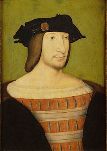
Louis XII (1498-1515) died for loving Marie Tudor (Sister to Henry VIII) far too much for his own good. Already given to some physical weaknesses, his marriage to the beautiful and energetic young Mary finished him off. To a certain extent, he reinforced the reputation gained by Frenchmen as lovers, however, he failed to produce an heir to the throne. The baton was passed on to the House of Angouleme and to Francis I.
France was, during his reign, embroiled in the Italian Wars with the main contenders being, Charles Quint of Spain (who was not Spanish but a Habsburg of Austria) and Henry VIII of England who wanted nothing more than recover what his predecessors had lost in terms of French territory and to marry as many wives as possible. Francis was surrounded by lands which Charles had acquired through marriage or through wars. Spain, some German lands, Austria, Holland, and Flanders were in the hands of the King of Spain. Francis tried to create an alliance with Henry VIII at the Field of Gold meeting but failed as Charles Quint could afford to pay Henry handsomely with the gold he had stolen from South and Central America to keep him on his side.
The Italian Wars were an indirect confrontation between the two main camps (France and Spain) and very nearly bankrupted the economy of France. They also produced an unexpected outcome: the French Renaissance. From his time in Italy, Francis discovered the beauty of Italian architecture, art, and literature of the past and of the present and brought this love of the arts back to France. He began a series of modifications to castles on the Loire in the style of Italy. Francis, like all the War Lords was also a thief and he stole statues, rugs, and wall hangings as well as paintings (The Mona Lisa) which he had captured from the cities he had conquered in Lombardy. He even managed to persuade, the aged and nearly infirm Leonardo Da Vinci to come and live, and as it happens finish his days, in a castle in the Loire Valley.
To name a date at which the Renaissance started is an impossible task. It is often said that Petrarch (1304-1374) was the one who praised the study of ancient texts written by Greeks and Latins in order to appreciate what we, as human beings, really are. Petrarch was the first recorded person to have climbed the Mont Ventoux in France for fun (15). The story goes on to say that when asked by a shepherd whose flock was on the mountain why he had done so, Petrarch is reported to have replied: Because it is there. Petrarch was keen to see the world and in his contacts with other “intellectuals” he probably enticed them to take up learning about Ovid or Plato in his enthusiasm for things ancient.
The legacy of Francis the First and of his followers can be visited along the Loire River. A whole chapter is given over to some of these marvels. Le Louvre also has numerous sculptures and paintings which were pilferage during the Italian Wars.
Contemporaneous with Francis I is a man who is going to set Europe on fire. Martin Luther (1483-1546) was angry with the Catholic Church to which he belonged as a monk. He saw it as losing its way and at being more interested in worldly goods than in spirituality. He was not the first one to have accused the Church of hypocrisy in its approach to its way of behaving in relation to its doctrine (Catechism). Many had preached similar views in the past, but for some reason, this time the mud had stuck (16).
The teachings put forward by Martin Luther, Jean Calvin and their followers had a profound effect on the people living during that time. The Catholic Church was under siege and, if it were to survive, it had to fight back.
The Three Kings (Charles Valois, Henri Valois and Henri Bourbon)



The question is: What have these three got in common? Possible answers: They are not the three kings who, supposedly, brought presents after the birth of Jesus. No. Neither are all three directly related, even though the first two are brothers, the third one is a distant cousin of the first two. The answer is that they were all present in Paris on the night of the 22nd to 23rd of August 1572 (16). The date marks the day of the massacre of the Saint Bartholomew in Paris and in other towns and cities in the country when Catholics killed as many men, women and child of the other faith as possible. Charles IX and Henri III were probably active participants, whilst Henri IV was hiding in fear for his life. Eventually, all three will be kings of France.
The kingdom had been in the throes of a war of religion involving Catholics and Protestants for some years and both sides had taken parts in dismal acts of violence against each other. Catholic priests had been tortured and nailed to their churches by one side and Protestants had been burnt alive in their temples by the other side. Normal, everyday things for a religion (Christianity) which advocates love and tolerance in its preaching!
Charles IX died a couple of years later (1574) probably of tuberculosis and not too clear a conscience as some historians placed him on the balcony of a palace in Paris with an “Harquebuses” shooting at fleeing Calvinists on the night of the Saint Bartholomew. His mother, Catherine De Medici, and the most Catholic Henri de Guise, financially supported by the very religious Phillip the Second of Spain, ensured that Charles IX allowed the massacre to take place. His participation in the event is thought to have been a gesture of goodwill on his part.
Henri III was king of Poland when his brother died in 1574. He had to flee the country surreptitiously at night to return to France and take up his new role as King of the French. His fifteen years on the throne have left behind a very confusing trail of markers. He had “minions”, androgynous young men who were exceedingly good with their swords and their cod pieces. To compensate for his debauchery with these young men, Henri would take part in processions through the streets of the capital during which he would indulge in a little self-flagellation. Eventually, Jacques Clément, an arch-catholic, got fed up with Henri’s idiosyncratic behaviour and tolerance towards the Huguenots and took a knife to him. Having escaped death in 1572 during the Saint Bartholomew, Henri IV, was also knifed by a catholic (François Ravaillac) in 1610. In between, he was permanently at war. To such an extent that it is said that he did not take off his armour for ten years and that he slept in it. Henri IV was much loved by the people once he had been assassinated! Contemporaneous reports state that he never washed and that you could smell his breath when he was two rooms away which must have made him very popular with the ladies. However, he left behind a country which was economically sound and just about at peace with itself which was a good platform to start from for the next lot.

Louis, Louis, Louis!


Louis XIII
Louis XIII’s mother, Marie de Medici, had very little interest in her son. She was far more involved in plots and counterplots led by two Italians she had brought with her when she first got married to Henri IV. Eventually, the two Italians (Conchino Concini and his wife the very ugly Leonora Dori Galigaï) were assassinated. Louis XIII took a long time to think about bringing the demise of these two swindlers and this is typical of Louis XIII’s speed of decision-making process: slow to very, very slow. The intellectually powerful Armand du Plessis de Richelieu, Cardinal of France, who became the king’s confident as well as his acting arm, on the other hand, had no such reluctance when it came to making important decisions. To that end, he had created for himself a guard of mousquetaires which was really his private army. There is little doubt that Richelieu, in state affairs, had better judgement than Louis. It is also obvious that Richelieu never questioned the pre-eminence of the king over himself. Thus, for some years, the monarchy had two heads: Louis’ and Richelieu’s. Both died relatively young: the cardinal first in December 1642 aged 57, Louis in May of the following year of TB, aged 41. Louis, with Richelieu’s help, prepared the scene for the coming of the Sun and of the Absolute Monarchy (18).
Louis XIV
Louis XIV is the longest serving monarch in the history of France. He sat on the throne from 1643 to 1715. 72 years. Even Queen Victoria did not manage to beat that one! The first few years were a bit of a mess: there was a rebellion by some of the aristocrats who wanted to regain their autonomy after Richelieu had seriously curtailed it during the reign of Louis XIII. The regent, Marie de Medici, had hoped to be able to have a hold on her son and to remain in charge of the kingdom. But at the tender age of 14, he sent her packing. From then on, the lad knew what he wanted: Power, power, and even more power. Anyone who did not bend to his will or who appeared to have too much of the thing he wanted, Louis would get rid of.
This happened to Nicolas Fouquet, Louis’ first Superintendent of Finance (the equivalent of Minister of Finance, Treasury Minister and Governor of the Banque de France rolled into one). Fouquet, who was Marquis de Belle Ile and Vicomte de Melun et Vaux, was a rich man. Comparable in fortune to some of the richest men in France like the Arnault family (Vuitton etc…) or the Dassault crew (fighter planes and armaments). He commissioned an architect to build him a castle and its gardens at Vaux le Vicomte (19) in less than three years. The money was no problem. After all, the Superintendent took his share of the taxes collected before handing the rest to the state coffers. And it appears that Fouquet was quite generous when it came to his slice of the cake.
Once the castle was finished, Fouquet invited all and sundry to the opening. Louis was there. It was a magnificent event. The best party anyone had been to. On leaving, the king appeared delighted and congratulated Fouquet on his achievement. Louis was seething inside though. Not so much about the money, as it has always been the case that the person in the post would be very rich, but because of the power Fouquet had shown to hold over all those at the party. His clientèle. Louis was envious and when that happened it did not bode well for the target. Fouquet was promptly arrested and despite his attempts to prove his innocence, he disappeared from the scene and died in prison in the south of France. Forgotten by all.
The story goes that he was the man in the Iron Mask. An assertion which has been shown to be a fallacy by many historians. He was kept in secret and was moved prisons several times but never in an Iron Mask (20).
The dye was set. If a man as powerful as Fouquet could be brought down to his knees, what hope of rebelling had the other nobles. The answer was simple: Obey or Disappear. In a clever move, and copying Vaux le Vicomte, Louis had Versailles built. Versailles served two purposes: on the one hand it was a demonstration of the near god nature of the king who lived in such magnificence (for those who like that kind of thing). The other, was purely political terrorism. All the aristocrats were in one place. Under the king’s nose and would therefore be unlikely to rebel against him without Louis knowing. And if they did consider doing so, he would either threaten them with banishment (a small death for an aristocrat), or they would be imprisoned or executed for high treason. When Louis XIV said “L’Etat, c’est moi” if he ever uttered the words, he meant it. He ruled as a dictator. He chose some very able administrators who came from the lower nobility or even the bourgeois class and were no threat to him. Jean-Baptiste Colbert (21) and his son were rich and powerful men but always within their subservience to the king. Like all stars, Louis went through several phases: Birth, Young Age, Zenith, Maturity, Decline and Death. Throughout his life the Sun King loved war. His last reportedly words of wisdom to his successor were that he had loved war too much and entreated Louis XV not to follow his path. Some years before his demise Louis XIV had married his mistress, Madame de Montpensier, who had become a religious bigot. Instead of the splendours of the beginning of his reign, in the end, Versailles had become a place of dreariness and of boredom. The death of the Sun King set off a counter movement which was about unrestrained hedonism. This would set the tone for the levity permeating the start of Louis XV ‘s reign and would play a part in the creation of the conditions needed to start a revolt by those who could not afford to take part in the parties and gallant meetings of the 1750s and 60s.


The aftermath of the death of Louis XIV in two pictures. Boucher and his gallant in the Vert Gallant and Watteau’s celebrated Gilles also known as Pierrot. Both will be discussed in the chapter on paintings and artists.
Louis XVI (1754-1793)

No one should only be their death. In many ways, Louis XVI is only remembered for the fateful cold and grey day of 21st January 1793 during which he met Madame Guillotine. What happened after that event will be told in the next section. Here, the life of a Bourbon king will be looked at to see how he came to such a sticky end.
Louis was unlikely to ever be king. He was the grandson of Louis XV, the son of the Dauphin Louis who should have succeeded his father but died in 1765. He had an older brother, Louis of Bourgogne, who should have been on the throne after his grandfather passed away, but he also died before 1774. All these Louis are confusing and not very original when it comes to names as if the Bourbons were afraid of using any other patronyms. Understandably, as the last two Henries (III and IV) had been assassinated and the last Charles (IX) was still associated with the Saint Bartholomew Massacre.
His parents were not interested in the younger boy. All their efforts had been given to his older sibling who was said to be good looking, energetic and charismatic. Louis XVI’s education had been quite thorough for a royal: mathematics, Latin, religious studies, morals, languages and of course, military matters. Alongside these, Louis was pushed towards acquiring skills in a practical field, in his case locksmithing. Louis was an extremely shy and gauche boy who was told by his preceptors (both priests) that he should never trust anyone or show his emotions. Although intellectually capable and interested in his studies, Louis, above all, loved hunting, like all Bourbons, and was never happier than chasing a deer on horseback.
He was married to Maria Antonia of Hapsburg when he was 15 and she was 14. It took Louis seven years to finally consummate the marriage. Their relationship, never very close, had been frosty at first, only to warm up a little when the first child was born. Louis had two main goals as a king: he wanted to be loved by his people and he wished to be his own man. His marriage to Maria Antonia went against both these aspirations: the House of Austria was blamed by the people for the state of the kingdom’s finances which were the result of an alliance with the Hapsburg during the Seven Year War (22). Furthermore, Maria Antonia was the daughter of Maria Theresa of Austria who was well-known for her hands-on attitude to governing her country and it was feared that Marie Antoinette, to give her French name, would also attempt to steer France’s destiny. Despite some efforts by the king to remedy both these obstacles, his lack of determination and his shyness prevented him from achieving either popularity or the ability to be independent in his judgements.
Louis XVI never overcame his own inherent contradiction: to continue in the absolutist tradition of his forebears and be popular with the populace. The emergence of a larger, better educated and increasingly demanding middle-class with its yearning for more power, meant that Louis was never going to be able to achieve either of his goals. One of his Principal Ministers, Turgot, tried to manoeuvre the king towards a more representative form of government by creating bodies which included the rich bourgeois of society and by a more liberal way of running the economy, but his attempts failed, and he was dismissed. Every “reform” met with the refusal of either the nobility or the clergy to accept them. And without the support of these two classes, Absolutism would not be able to survive, hence the king’s stubborn rejection to implement wide ranging reforms. The small concessions made towards the abolition of serfdom, the taxing of the aristocracy and the end of the religious tax were not enough and/or maybe too late to prevent the events which were to send Louis XVI and some of his associates to meet “La Grande Veuve”.

1789 and All That!

It might be advisable to drink a full-bodied red wine here: Minervois from La Livinière. A very red and heavy wine.
“What is the Third Estate? – Everything
What has it been until now? – Nothing “
Sieyès January 1789
The two questions posed by the journalist Sieyès (23) in January 1789 – six months before the fall of the Bastille- show the gap which existed between the aspirations of the middle and lower classes and the policies of the king. Louis was desperate to be loved by his people but did not want to relinquish his absolute powers. In theory, the king was in favour of reforms, in practice neither the aristocracy – the First Estate, nor the church -the Second Estate- allowed him any kind of space to manoeuvre towards a less authoritarian regime.
Yet most, if not all, the wealth came from taxes levied on the Third Estate. And France was almost bankrupt. The Seven Years Wars (The Real First World War as discussed in the chapter on Colonialism) of the mid-century had been ruinous for the nation. France’s involvement in the American Wars of Independence had also cost most of what was left in the coffers of the Treasury. To put a final nail in the coffin of the Monarchy, the harvests of the last two or three years had been disastrous due to adverse weather conditions. In other words, the perfect storm.
By April 1789, Louis was left with no choice but to call “Les Etats Généraux”, the meeting of the Three Estates to try and find solutions to the problem of the Finances of France which were acceptable to all. Not liking the demands made by the Third Estates for their acceptance of more taxes, the king dismissed the meeting and forbade them to gather. The delegates from the bourgeois class found a place to congregate at the Tennis Courts and refused to budge until a constitution to their liking was agreed. Mirabeau’s message to the king was clear: “the people of France have sent us here and we will only leave if bayonets are used against us” (24). Confrontation was inevitable.
In the streets of the capital, young middle-class men, most of them lawyers, would harangue the populace beseeching them to rebel against the present regime. On the 14th of July, the people of Paris rose. They broke into the arsenal, took 30 000 guns and 20 canons, and went on to the Bastille- a most obvious emblem of the Old Regime- due to its enormous size and usage as a prison. After a short but bloody pitch battle, the seven prisoners- four thieves, two “lunatics” and one pervert- were liberated. The date of the storming of the Bastille- demolished four days later- became the symbol of future Republics.
In his personal diary the Louis XVI wrote: Tuesday 14th July- Nothing to report.
Over the centuries since the Revolution of 1789, historians have concentrated on the events in and around the capital. The provinces also played their part in the events. Eight days after the Storming of the Bastille, the people of Strasbourg were ransacking their Town Hall, castles were taken by peasants in the countryside after the local lord had either fled or been assassinated, and well-to-do women armed with canons and spears had left their stalls and shops to march on to Versailles to claim their rights. France was in turmoil.
A number of events and people then happened to converge which hastened the demise of the Bourbon family.
- La Fuite vers Varennes en Argonne: Mirabeau, who had become (always been?) a secret adviser to Louis XVI whilst keeping the appearance of a moderate revolutionary, had advised the king to flee Paris if the revolution was going too far. On June 22nd, 1791, in the middle of the night, the king, Marie-Antoinette and their children took off in a carriage disguised as Bourgeois travelling to north-eastern France. The burghers of Varennes en Argonne stopped the carriage from going any further. The king returned to Paris where he was greeted by a totally silent crowd. The remnant of trust which existed between the monarchy and the revolutionary government disappeared, and the king was now under palace arrest and was no longer in charge of anything.
- Declaration of Pillnitz: in August 1791, shortly after the frosty return of Louis to Paris, The House of Austria, and the king of Prussia issued a declaration stating the interest the two countries have in “the wellbeing of the king and queen of France”. As near as can be made to a declaration of war without going to war.
- The Brunswick Manifesto: in August 1792, the Manifesto written by a French aristocrat stated that “the allies wish to see the King of France restored to his full powers and that whoever declares himself against those wishes shall be condemned to death”. A declaration of war on the people of France.
- The Battle of Valmy; The battle which took place on 20th September 1792 was, to all intents and purposes, a draw. However, the Allies, mainly Prussia and Austria, decided that waging war on and in France would take too long and would be too costly. As a result, they withdrew to the other side of the Rhine. French people saw their withdrawal as a victory and the king was now isolated.
- The abolishment of the monarchy: On the 21st of September 1792, the monarchy came to an end. Louis XVI became Louis Capet and had no powers. His fate was just about sealed.
- The Battle of Jemappes: On November the 6the same year, the Allies (Austria, Prussia, Spain, Portugal and England) are defeated by General Dumouriez at Jemappes in Belgium. The Allies retreated once more and left Louis to his fate. No army will come from the borders to save him and his family.
- 21st January 1793. At the end of his trial, Louis is condemned to death for treason. He faces his death with courage.

The Fuite Vers Varennes of Louis and his family in 1791occured as the result of a change of direction in the Revolution. From a persistent desire for a Constitutional Monarchy, it had become clear that the call from the deputies of the National Assembly was more and more for an end to the monarchy and the advent of a Republic. As with every upheaval where opposing factions are in competition for power, the struggle was bloody, and a number of characters emerged and disappeared in the maelstrom. The end is also predictable: namely, some form of dictatorship. Before we get there, let’s have a look at the sides in opposition just before or at the moment of the king’s death. The room where the Assembly of the People met was in the shape of a semi-circle, and if you faced the deputies, you had some on the right, middle and left. Hence the Right, Centre and Left political descriptions of nowadays.
- Les Feuillants: Mirabeau was a Feuillant(and a traitor according to some at the time). Their aim was for the king to remain in place and for a constitution to be written giving some powers to the Assembly, some to the Government (chosen by the king and the Assembly) and some to the King. By 1792, most of the Feuillants had either fled abroad or had been guillotined. A definite party of the Right.
- Les Girondins: Pétion was a Girondin; politically, the Girondins were moderate Republicans. They initiated a revolutionary war in April 1792, hoping to prevent foreign aggression, win the support of the populace, arm the revolution and export its ideals beyond the walls of Paris. Their ideal society was free, entrepreneurial, and meritocratic with personal liberty protected by the rule of law. Emphatically a party of the Middle Right. Most of its members either fled or were guillotined during the Terror.
- La Plaine: Made up the majority of the deputies. Never a homogenous group. They would switch from Left to Right to Middle depending on the nature of the topic being debated. In favour of a Republic but against the Terror for the majority. A good proportion suffered during the Terror months. The wiser ones joined the Army which was safer than being in Paris.
- Les Jacobins: Robespierre, Danton, Marat, Desmoulins, and Saint-Just were all Jacobins. More radical than the Girondins. They wanted the Republic to be of the people, for the people, by the people. However, its leaders were all middle-class intellectuals who initiated the Terror (September 1793 to July 1794) as the Jacobins felt that there was a threat of imminent invasion by foreign powers and that some French people were actively working for the demise of the Republic inside the country. The only way to stop the invasion was to terrorise those who wanted a counter-revolution at home. (Hitler, Mussolini, Stalin, Trotsky, Mao, Pol Pot, Mugabe and many more leaders in the world have used the same argument). Madame la Veuve got very, very busy. In 1794, some of the Jacobins (Danton, Desmoulins) wanted to slow down or even stop the Terror. They were swept in its path. A few weeks later, the same happened to Robespierre and his cronies. A definite party of the Left. Mid 1794, the Jacobins ceased to exist due to a lack of members.
- Les Montagnards: Most of its members were from the big cities. Not from the mountains. The reason they are called La Montagne is because they sat on benches which were high up in the room. Always on the left though. Often supporting the Jacobins in their policies, most were even more radical than their friends. Their aim was the creation of a dictatorship of the “Sans-culottes”, the working class. In today’s money, they would be the equivalent of the Socialist Workers Party, and some of its members would fall into the Anarcho-syndicalist movement. Like the Jacobins, they disappeared once the Terror was over due to a low head count (on shoulders). Left of the Left.
Revolutions are never a one-sided affair. It takes at least two parties: one which is trying to survive and continue with the pre-existing status-quo; the other is making every effort to get rid of the old regime and replace it with a new one, believing that the new system is better than the previous one. It is never a very pleasant business. People get hurt in the process. Very often, those who are trampled upon are innocent people, in the sense that they have no say in what is happening but are swept along by events. However, there is always a small group of men and women who have a hand in the game. They claim to direct it and to give it shape until such time as it runs by itself and destroys them without a second’s hesitation. The Revolution of 17989 was no different. Here are some of the characters who, however briefly, tried to govern the situation.
Barras, Paul 1755-1829
Voted for the king’s death. Survived the Terror by being with the army. Was one of three Directors who were in charge from 1795 tom 1799. Pushed aside when Bonaparte came to power in 1799.

Condorcet, Jean Antoine (25)
1753-1793: Mathematician of note. Belonged to the Girondins. Had to flee during the Terror. Committed suicide when he was arrested after hiding for eight months.

Danton, Georges (26)
1759-1794: Lawyer. Early democrat and republican. Ambiguous in his financial dealings. Jacobin but not Montagnard. Tried to slow or even stop the Terror. It took him. One of the foremost leaders of the Revolution. Favoured son of the populace for his ability to inspire the “common people” during his speeches.

Desmoulins, Camille 17760-1794
Lawyer. He called for the people to rise against the Old Regime in mid-July 1789. Friend of Danton. Also tried to stop the Terror. Died minutes before Danton at the hands of Madame La Veuve. A few days later his wife, Lucile, was also sent to the guillotine for the same reasons as her husband. Too moderate for Robespierre.


Camille et Lucile Desmoulins
Fouquier-Thinville, Antoine 1746-1795 (27)
Lawyer. Prosecutor responsible for the deaths of many people during the Terror. Eventually, the guillotine caught up with him in 17895.

Hébert, Jacques 1757-1794
Journalist then lawyer. Very similar to Fouquier-Thinville in political philosophy. Co-creator of the most bizarre thing to emerge from the Revolution: The Cult of The Goddess of Reason.

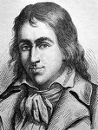
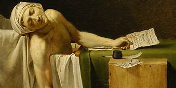
Marat, Jean-Paul 1743-1793 (28)
Doctor and scientist. Always calling for the deaths of traitors to the Republic; imaginary or real. Murdered in his bath by Charlotte Corday who thought he was becoming a dictator.
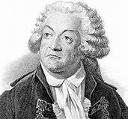
Mirabeau, Honoré 1749-1791
Was against the king at first, changed his views as the events were taking a turn he did not approve of. Worked secretly for the return of the king before dying of illness.
Pétion, Jérome 1756-1794
Lawyer. Moderate Girondin. Had to flee at the beginning of the Terror. Committed suicide as a result of having to run away.
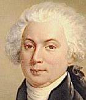
Robespierre, Maximilien 1758-1794 (29)
Most famous revolutionary of that era. Lawyer. Very much a supporter of the Terror. Co-creator of the Cult of the Supreme Being. Incorruptible. Was shot in the face before being sent to the guillotine. His death marks the end of the most savage phase of the revolution.

Saint-Just, Antoine 1757 1794
Political Theorist and friend of Robespierre. Like Fouquier-Thinville, he sent a lot of people to meet Madame La Veuve. Followed Robespierre to the gallows on the day of his demise.

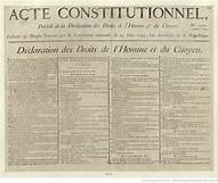
The events which took place during the 1789 Revolution changed France. For the first time the lower classes (Bourgeois, Artisans et ouvriers) had been able to have a say in how they should be governed through elections and representation. There was also a recognition that taking to the streets en masse could change things faster than putting a bit of paper in the ballot box. Finally, charters had been produced. Amongst them was the Declaration of The Rights of Man.
The estimated number of deaths due to the Revolution of 1789 varies between 24 000 and 40 000.
Le Premier Empire

« I am Charlemagne’s successor not Louis XVI’s » Bonaparte
« Napoléon…. is part of us » Emmanuel Macron 2021
By 1799, the Terror was over. The Directoire had taken over. The Directoire was a government of the bourgeoisie for the bourgeoisie supported by a Council of 500 + members who also came from that class for the most part. The Revolution, according to Bonaparte, had lost its way and was dying on its feet.
Bonaparte had been fairly successful as one of the leaders of the revolutionary army and had returned to France from Egypt in late 1799. The declaration of the 18 Brumaire, (9th November 1799) which was all his work, speaks of the weakness of the then government in power and called for a strong leadership for the future of the nation. It comes as to no surprise that he would be that strong and forward-looking leader.
There is no denying that Bonaparte redressed the Finances of the country, changed the basis of the judicial system by creating “Le Code Civil” (30), founded the lycées which are still the backbone of French education and restored religious tolerance.
His rise was meteoric, in December of that year, he became First Consul and by 1804 he made himself Emperor “at the express request of the French people”. The referendum gave the idea a thumping 99,4% of the votes. For the next nine years and 100 days, France became a country under a Military Imperial Dictatorship. Bonaparte who undeniably had charisma, did not invent anything when it came to deceiving people into believing his diatribes. Many other world leaders did the same after him. And still do.
Arguably, Continental Europe was composed of nations which were governed by monarchs whose power rested on an antiquated (legal) system: the Feudal System. The Feudal System meant that the peasants/manual workers were at the very bottom of the pile (serfs in some countries). Then came a small class of Burghers who had made their money in trades and commerce. The clergy and the aristocracy completed the picture. The monarch and the aristocrats had all the power and were always supported by the clergy. The Middle-classes were too small, as yet to play an important role in the affairs of states. That is until the advent of the Atlantic Slave Trade (this topic is discussed further under Colonialism) which enabled the Middle classes of Western European countries to become richer in larger number. And as had been the case in the American Revolution, the Middle-classes wanted representation if they had to pay taxes.
The Feudal system continued to prevail in Eastern Europe where monarchs still reigned with absolute powers. In Austria, Prussia, and Russia, the French upheaval of 1789 was a wake-up call. The demise of Louis XVI and Marie-Antoinette on the gallows sent a message of fear throughout the rest of Europe. The Old Houses/Regimes: Hapsburg of Austria, Hohenzollern of Prussia, Bourbon of Spain, Holstein-Gollop-Romanov of Russia, became aware that they would have to fight the newcomers if they were to survive. And after 1799, Bonaparte, the newcomer, was more persistent and aggressive.
Things turned extremely worrying when the Little Corporal (between 1m57 and 1m68 in height) as they called him derisively, started to win some big battles. Having disposed of all the resistance to his power at home, Bonaparte took the road south then east. Like the other corporal a 130 years later, he made the big mistake of wanting to go to Moscow. On the way he had invaded the Old Regimes and they did not like it one bit.
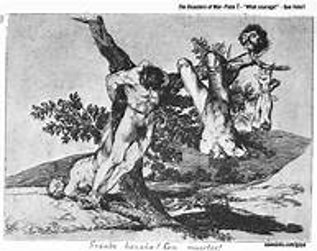
The best examples of hatred for the French were where the invasion was followed by some of the nastiest episodes of depravity in warfare ever encountered (some historians equate the war in Spain to the reign of Vlad III Dracul in Wallachia, aka Dracula). The invasion of Spain and Portugal saw some of the ugliest episodes of torture and murder in the history of warfare thus far. The artist Francisco Goya has left behind a series of drawings concerning this very sombre episode of the Peninsular Wars (31).
In June 1812, Bonaparte invaded Russia with the aim of taking Moscow with an army of 450 000 soldiers. After the uncertain outcome of the bloody battle of Borodino (32) outside the capital, he entered Moscow which was set alight. Bonaparte was left with no choice but to return to France. The army reached the river Berezina in November 1812. It had to cross it, but the bridges had been destroyed. The river was half-frozen, and the troops were harassed by the Cossacks who were adept at this type of guerrilla warfare. Some of the army managed to cross on newly built bridges. 10 000 were left behind at the mercy of the Cossacks who showed none.

As the soldiers continued into Belorussia and Poland towards home, the freezing conditions took their toll. Of the 450 000 soldiers who had gone east in June 2012 only 70 000 returned in December of that year. The Allies took the initiative and by 1814, after many more unnecessary deaths, Bonaparte was beaten and sent to Elba as a prisoner. He returned briefly for 100 days in 1815, only to be defeated at Waterloo. He was exiled to Saint Helena where he died in 1821.
It cannot be denied that Bonaparte had been Charlemagne’s successor, as he was so proud to say. He had “united” Europe under his sway. However briefly this lasted. The cost in lives was dramatic: 900 000 young soldiers under his command had lost their lives, 4 million people (men, women and children) of other countries had also perished as the result of his wars and nothing had changed politically in Spain, Germany, Austria or Russia. The systems stayed feudal for the most part and would remain so for at least one hundred years in the case of Russia.
In France the Old Regime was back with a vengeance.
It is difficult to disagree with Emmanuel Macron when he states that Bonaparte is part of us. He appears in the curriculum of schools. Bridges, roads, monuments and even ships were named after him. A lot of his victories appear in paintings by celebrated, yet sycophantic painters of the time. The Arc de Triomphe in Paris, even though not completed in his lifetime, was built to celebrate his achievements. And for some time, the only thing which jarred in the mind of some French politicians with a conscience was that he reinstated slavery which for the most part, had not stopped (33)Not the invasions, the battles, the deaths as he was and still is regarded as a military genius. One cannot help but wonder as to what would have happened had he won at Waterloo in the same way as if the other little man (with a moustache) had taken Moscow and the oilfields of Caucasia in 1942. Nothing good one would hazard to say.
La Commune de Paris 1871

For this section I would advise drinking a solid “vin rouge ordinaire”. When I was a child, my father used to send me to get a litre of Vin Ordinaire from the local shop for a few centimes. Corbières comes to mind and is a good one to try. Strong, a little heavy with an after taste of treason for not being able to have any more because it has become too expensive!
Louis XVIII had taken over from Bonaparte and had reinstated a form of absolutist regime. His younger brother Charles X (both were brothers to Louis XVI) took over when he died but the poor man was to lose his kingdom during the revolution of 1830. A slightly more democratically inclined king, Louis-Philippe, (Le Roi des Français) was enthroned until he too was dispensed with in the 1848 revolution. Taking to the streets to evince monarchs had become a national sport in France.
From the ashes of the 1848 upheaval emerged another Napoleon (a nephew of the first one) who, after a coup d’état, declared himself emperor in 1852. The first years of Napoleon III’s regime were marked by very oppressive policies, especially towards anyone who disagreed with his plans. Many of the more democratically minded citizens were exiled to the colonies of South America or the Pacific islands for having dared to speak openly against the rules set out by Napoleon III. Victor Hugo (34) (of Les Misérables fame) exiled himself to Jersey and then to Guernsey from where he could publish his highly critical views of the emperor.
Like his predecessor in name, Napoleon III wanted to be the creator of an empire. After all, what is the title without the real thing! So, he set about in all directions: North Africa, West Africa, Madagascar, Mexico, even Cochinchine Some he won, some he lost. Well, not him personally, but his military men or the explorers he would sponsor. Once again, colonialism was the flavour of the day.
My moment of fame. But like the military exploits of Napoleon III, it has nothing to do with me personally as I was not born, yet. The French emperor supported the invasion of Mexico planned by Maximilien, Archduke of Austria. A French contingent was sent to Mexico to overthrow a Liberal minded president who had been elected to do the job and place Maximilien on the throne as emperor of that country. For nearly three years, he was in power. However, as soon as the Civil War in the United States had finished, the Americans sent a force to reinstall the former president. Maximilien was taken prisoner, and despite the pleas of some powerful men (one of them Victor Hugo) for him to be spared, he was shot in June 1867 alongside two of his generals. When he had first come to Mexico, Maximilien had brought with him a number of people, amongst whom was his mistress. She too, at some point was killed by the Mexicans. The lady, who shall remain nameless, was one of my ancestors according to my parents. Scandalous!

The second half of Napoleon III’s reign was marked by a less aggressive set of policies at home as he was trying to become more popular. With the appointment of Baron Haussmann as Prefect of Paris, the emperor had also inadvertently made a good appointment for tourism in the capital as Haussmann destroyed large tracks of medieval sections of the capital to be replaced by the beautiful buildings which grace the city nowadays. By 1870, France was more prosperous than it had ever been and there were no signs that discontent was going to bring an upheaval.
For what happened next, the French blame(d) the Prussians who fought the war, Bismarck who orchestrated the whole thing, and the stupidity of the French emperor who took the bait. The result was that the Prussian army, which had had a good practice in a conflict against the Danes in 1864, defeated the French army in 1870. Napoleon abdicated and a government under a man called Adolphe Thiers was elected and sat in Versailles. Thiers wanted to negotiate an armistice with Bismarck and allow the Prussian Army to occupy Paris. The people of Paris did not want the Prussian army in their city any longer than necessary, and the more bloody-minded did not want Thiers as leader of the country. To their credit, they were angry with our Adolphe who had always secretly wanted to bring back the monarchy with all its trappings. A secret known to everybody.
The result was a three-way stalemate. The Prussians were in Paris. Thiers installed his government just outside Paris and the people of Paris declared a Commune-18 March to 28 June 1871. The Commune was the first large movement of the working-class lead by men and women who wanted to improve the conditions under which ouvriers and ouvrières were forced to live. Manual workers had seen three revolutions (1789,1830, 1848) go by without many improvements to their working and living conditions. They, for the most part, lived in overcrowded and disease-ridden rooms which should have been demolished long ago. They had to work long hours and their children had to be sent to the factories from a very young age (5 years old in some cases) to earn money if they were to make ends meet. In its brief few weeks of existence, the Commune tried to implement a lot of things which are still being discussed in this day and age:
- The rights of women
- The rights of children born outside marriage
- The hours of employment
- The conditions in which children are employed
- Some form of social protection
- The removal of arbitrary arrests of people from the statute book
- Free public education
- The takeover of factories by cooperatives of workers
- Fixing the price of bread (the main staple of the worker’s diet)
All that was swept aside when the French army entered Paris on the 20th of June. “La Semaine Sanglante” (The Bloody Week)took place in the next seven days. It is true that in their anger some Communards took it upon themselves to shoot a number of priests and civilians who had supposedly expressed support for Thiers and the Versaillais. But this is nothing compared with the number of Communards who were summarily executed. Both are wrong. In the end, between 15 000 and 40 000 people were executed in the capital during that week by the French army/gendarmes. Les Fédérés wall at Le Père Lachaise cemetery in Paris is still a place of commemoration for the working French person and is part of the culture of the country. (35)(36)
It is also important to state at this stage that the conditions imposed by Bismarck on France in 1871 were going to influence its policies of the next 70 years. These were:
- The loss of Alsace-Lorraine regions to Prussia. Two heavily industrialised (coal and steel) parts of France
- The payment of an enormous sum of money in war reparation: 5 billion Francs.
- The acceptance of Prussia in West Africa which so far had been the preserve of the French. (See chapter on Colonialism)
Some of the most prominent characters of the Commune (either for or against) are described in more detail in later chapters:
- Louise Michel will be mentioned in the Famous Women of France chapter
- Gustave Courbet will appear in the Artists Section
- Adolphe Thiers: already discussed pre-Commune. Sent the army in June 1871 to quell the rebellion. Became prime minister after June 1871 of a very repressive right-wing government. Died in 1877. Worked for the establishment of the monarchy but did not succeed. He has manty streets, avenues, squares, buildings named after him

- Louis McMahon. McMahon was of Scottish descent. Was in charge of the army which invaded Paris in March 1871. Was later elected as the First President of the Republic.

A final word bout the Commune. Some say, amongst them Lenin, that it was the first Marxist revolution. Only few of the leaders, if there were any men or women in charge of the event, were of that philosophical persuasion. Most of them were workers fed up with being trodden on by a system which did not care for them as they experienced it in their daily lives. The Commune could not succeed, in many ways because it cared about what it was doing, and it wanted to avoid the mistakes of 1789. It remains prominent in the minds of the French people as it showed the chasm which existed between the “haves and the have nots” in society of the late 19th century.
The period between the Commune of 1871 and the start of the 1914 conflict is marked by four main trends: the consolidation of a bourgeois Republic, the rapid expansion of Colonial France, economic progress at home and the gathering of a large number of forward-looking artists, writers and musicians from various countries who were going to transform the arts.
The Arts and Colonial France will be discussed in later chapters. Despite several attempts to derail the Republic, France became a slightly more democratic country. This despite the fact that women were not allowed vote or be candidates at elections and that the system was definitely rigged in favour of well to do candidates. Having paid the five billion francs to the Prussians for war reparation and having built the Sacre-Coeur Monument to remind the people of Paris that God was looking at them from the height of Montmartre, France embarked on a mission to improve its economy. The next forty years were booming times. Even if it meant using workers as near slaves as the novels of Emile Zola show us. Resentment at the Prussian (now German) occupation of Alsace-Lorraine as well as a need for revenge after the defeat of 1870, meant that even a powerful figure like Jean Jaurès (37) could not slow down the pace at which the country was galloping towards the catastrophe of 1914.
La Grande Guerre (14-18)
“C’est la plus monumentale ânerie que l’humanité ait jamais faite”
It is the most stupid thing humanity has ever done
Maréchal Hubert Lyautey (Ministre de la Guerre 1917)
” Fusillés pour l’exemple ”
Shot as an example to others
About French soldiers who had fled the front after suffering from shellshock (1914)
It is often said that the 1914 conflict started as the result of the over armament of the nations involved and because Europe had divided itself into two opposing blocks. Both arguments undoubtedly played a part in starting off the conflagration. Other factors derive from that: the wish of the central allies (Germany, Austria-Hungary) for empires which they had not managed to acquire as much as they wanted in the second half of the previous century, the need to keep their population occupied with something else than their everyday needs at home, a thirst for vengeance after defeats in the previous 50 years, a yearning to prove themselves on the battlefield. And finally, but not least in importance, the stupidity of some of the leaders involved which resulted in their lack of concerns for the outcome of a possible conflict.
“I must start playing dominoes again”
Extract from Tsar Nicholas II’s Journal (1917)
“Remember that you are a chosen people! The spirit of the Lord has descended upon me, because I am Emperor of the Germans! I am the instrument of the Most High. I am His sword, His representative. Woe and death to all those who resist my will! Woe and death to those who do not believe in my mission! Woe and death to the cowards! Let them perish, —all the enemies of the German people! God demands their destruction, —God who, through my mouth, commands you to execute His will. “
Wilhelm II, German Emperor (1914)
The murder of Archduke Ferdinand and his wife at Sarajevo on the 28June 1914 was the excuse some of the more belligerent nations of Europe needed to start a war. Two opposing blocks faced each other: Germany, the Austro-Hungarian Empire, the Ottoman Empire and Bulgaria on one side and Serbia, Romania, Italy, the Russian Empire, the United Kingdom and France on the other.

Amazingly, the obvious domino effect which happened after the assassination of Ferdinand seems to have caught everybody by surprise: Austria-Hungary declared war on Serbia because Duke Ferdinand had been killed by a Serbian Nationalist. As a result, Russia declared war on Austria-Hungary (Serbia being a client Slav nation of Russia), Germany declared war on Russia in support of Austria, France declared war on Germany in support of Russia and Britain supported France because of the Entente Cordiale agreement of 1906. The Turks were clients of the Kaiser and depended on the Germans for weapons. The Italians, who were friends with the Central Powers (Germany etc..) at first changed sides soon after the war started. One thing is sure everybody was in for it. It could have been stopped at an early stage by an exchange of telegrams between Wilhelm II and Nicholas II, but neither wanted to stop the momentum. In the end, it would cost them both their thrones and in one case, his life. All participants agreed that this was going to be a quick war: French and British soldiers shouted that they would be in Berlin by Christmas and German soldiers, taking the 1870 conflagration as an example, saw themselves in Paris by the end of 1914.


The arms race had started between the United Kingdom and Germany in 1898 in terms of who would build the largest and fastest war ship to protect their overseas empires. Developments in the technologies surrounding metallurgy and weaponry had also produced a competitive environment in relation to machines that could kill humans. The advent of the machine gun (Maxim, Lewis, Hotchkiss, etc..) as well as the construction of bigger and bigger guns, culminating in the German Gosse Bertha, ensured that this war was going to be like nothing anyone had experienced so far.
By the end of the conflict more than 70% of the casualties were the result of long-distance bombardments. Bertha could send shells up 75 miles (130 kms). A Hotchkiss machine gun could fire as many as 500 rounds a minute with the devastating effect of killing in a few seconds whole platoons of advancing soldiers. The First World War, as it became known, was a war of the machine against men.
During the four years of the conflict a staggering total of 68, 176 000 soldiers were engaged in the conflict either directly or as support for the front-line troops. They came from all manners of countries around the globe (from New Zealand to Argentina and from Japan to Senegal) which is the reason for its name. Furthermore, fighting was not restricted to the European field either East or West. Battles took place in the Far-East, the Middle East and Africa. The only continent to have escape war was the American one -North, Central and South (although there was a sea battle in the area of the Falkland’s).
The conflict in France started badly for the Entente Cordiale as the Germans broke through Belgium and Luxembourg and were stopped just short of Paris in October/November 1914. The following race to the seaports of Calais, Boulogne, Dieppe and Zeebrugge resulted in a stalemate line which ran from the Belgian Coast to the border of Switzerland. This marked the beginning of the Trench War.

After the battle of the Marne in August -November 1914 which nearly resulted in a defeat for the Entente Cordiale (UK and France), a number of significant actions took place without much change to the status quo:
- The Argonne, Champagne and Artois engagements of 1915 which caused numerous deaths on both sides with little gain.
- Verdun 1916. A town which is etched in the communal memory of the French nation. 900 000 soldiers were either killed, missing, or injured in the area of the Verdun bulge during the 300 days it lasted in 1916: 500 000 French soldiers and 400 000 German soldiers. The German high command was hoping to deal with the French army by killing as many young people as possible until there weren’t enough replacements to see the defeat of the French army. The resistance put up by the French surprised the Germans. But the conditions in which the men at Verdun had to fight lead to mutinies in the French army the following year. The men involved reported that they suffered from thirst, hunger, the presence of enormous rats, the lack of sleep, hills made of earth and human remains. But for all, the greatest torture was the sickening and ever-present smell of bodies decaying and this to such an extent, that they nearly welcomed the stink of the chlorine which accompanied a gas attack (38).

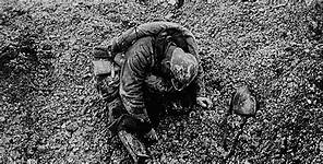
The Battle of the Somme of 1916 had been conceived by the Commander in Chief of the Western Front, Joffre and his British Counterpart, Haigh to relieve the pressure on Verdun. Although 80% of the troops involved were British the rest was made up of French soldiers who were no more successful than their British counterparts during the offensive. The reason behind the failure of the Somme attack was due to a lack of careful planning by the leaders of both armies. The result can be seen in the number of military graveyards scattered in the Somme region and dedicated to those who fell in the area in June and July 1916.
Apart from the evident effect the Russian Revolution of 1917 had on the political landscape of the world, it also had consequences on the conduct of the war. By early 1918, German troops were able to leave to Eastern front, as peace was agreed between Russia and Germany, and be redirected on what the Kaiser Wilhelm II hoped would be the final and victorious battle of the war. And he nearly succeeded: the offensive of April 1918 would have been a success had it not been such a success. German soldiers had advanced so rapidly that their supply lines could not keep up with them. The counter attacks by the French, British, Canadians and Americans forced the Germans back. As a result of this set back, the Kaiser had to abdicate, Germany was on the verge of revolution, and it sought an arrangement with the Western Powers to stop the war. On 11th November 1918, an Armistice was signed ending the war. (39)
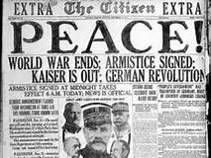
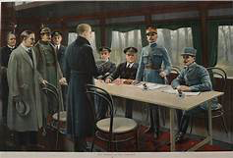
The outcomes of the First World War are somewhat staggering:

- 31 000 000+ men killed in action, wounded in action, or missing in action
- 7 000 000 civilians killed
- 8, 000 000 men were taken prisoner by both sides. Some never returned home
- Ethnic cleansing in the Ottoman Empire of Armenians, Pogroms in Russia and in the German Empire as well as the killing of civilians in Belgium became known to the world after the conflict had ended
- During the Blockade of Germany by the British and French fleets between 250 and 400 000 German civilians died of hunger
Total cost of the war
| Allied Powers | Cost in Dollars in 1914-18 |
| United States | 22,625,253,000 |
| Great Britain | 35,334,012,000 |
| France | 24,265,583,000 |
| Russia | 22,293,950,000 |
| Italy | 12,413,998,000 |
| Belgium | 1,154,468,000 |
| Romania | 1,600,000,000 |
| Japan | 40,000,000 |
| Serbia | 399,400,000 |
| Greece | 270,000,000 |
| Canada | 1,665,576,000 |
| Australia | 1,423,208,000 |
| New Zealand | 378,750,000 |
| India | 601,279,000 |
| South Africa | 300,000,000 |
| British Colonies | 125,000,000 |
| Others | 500,000,000 |
| Total of all Costs | 125,690,477,000 |
| Central Powers | Cost in Dollars in 1914-18 |
| Germany | 37,775,000,000 |
| Austria-Hungary | 20,622,960,000 |
| Turkey | 1,430,000,000 |
| Bulgaria | 815,200,000 |
| Total of all Costs | 60,643,160,000 |
- The table above does not take into consideration the devastation which had taken place in Northern and Eastern France and Belgium.
- The French Government under Clemenceau was determined that Germany should pay for the damage done to the farmland, the cities, and the factories during the years of occupation. The reparations asked by the French were astronomical.
- Article 231 of the Versailles Treaty of 1919 called for the acceptance by Germany of the guilt of having started the First World War. A point which was never accepted by the Germans.
- The Ottoman Empire and the Austro-Hungarian Empires were disbanded, and new borders were drawn in Europe and in the Middle East
- The Revolution in Russia succeeded and for the next 71 years a new empire emerged: The USSR. It would soon become the focus of attention in the West. There is always need for an enemy (for either side).
- France was nearly bankrupt. It had lost 20% of its workforce, a large amount of its reserves had been used to pay for the war effort and it needed to rebuild itself rapidly if it were to survive.
- The Versailles Treaty appeared to give the French the chance to get something back from the Germans. However, it only created resentment the other side of the Rhine and prepared for the advent of the next conflict.
- Foch summed it up nicely: This is not peace. It is an Armistice for twenty years”. Marshal Foch General CIC Western Front
When finally, the soldiers came back from the front, they were reluctant to talk or write about it. “The War to End all Wars” it was called with hope.
My grand-father, Isidore (1886-1949) was involved in the 1914-1918 war. I never knew him, and my father (his son) certainly never talked about him as a person or about his involvement in the conflict. It is only when my father died (1992) and I had inherited his desk, that I discovered an article which had appeared in the local newspaper after my grand-father’s death in 1949. It spoke about Isidore as hero of the First World war with no further details. I suppose that Isidore, like many of those who had survived, did not want to re-live the dark days of the trenches by telling stories about their experiences. My father was equally reluctant to talk about his war. But we will come to that in a short while.
The years following the War to End All Wars must have been extraordinary for those who lived them. On the one hand, people wanted to enjoy themselves after the hardship experienced between 1914 and 1918. “Les Années Folles” (The Mad Years) as the French would call them, saw the advent of Jazz, wild parties, and dances such as the Charleston which exemplified the wild nature of the times. A good number of Black American Musicians came to Paris as their music enjoyed a popularity which was not the case in their country due to their colour.
The 1914-18 conflict had forced the opposing nations into a technological race without precedent. This would continue during the inter-wars years which saw large amounts of money being spent on improving communications, the invention of the TV, improvements in transportation (focusing on air transport) and on the medical field especially in emergency surgery and in psychiatry.
The twenties and thirties are known for a time when political differences between systems were exacerbated. Three systems were thought to be in opposition (although two of the systems are so close to each other as to be almost indistinguishable from each other):
- The Communist System. Its premise: “The Dictatorship of the Proletariat” says it all. The system which was supposed to bring the working class out of its oppressed state created the right conditions for the exact opposite to happen. Stalin as a dictator oppressed and butchered his people from the 1920s till his death in 1953. He was a Tsar in disguise.
- The rise of Fascist regimes in Germany, Italy, Spain, Portugal was the outcome of confrontations between extreme right and extreme left elements in these countries which resulted in the victory of the extreme right parties. Hitler, Mussolini, Franco and Salazar were successful in becoming leaders of their countries and thus creating situations which would lead to wars by their aggressive policies.
- The Capitalist system based on economic progress at any cost was in the throes of replacing the Empire building system which had prevailed in the years before 1914. Britain, France, and Germany were overtaken economically by the United States where rich men aimed to get richer whilst the people at the bottom were living under the illusion that they could become rich through hard work and by conforming to the ethos of the country.
The three political philosophies claimed to bring happiness to mankind by different means (these will be looked at in the Philosophy Chapter).
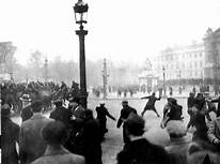
France, like other European countries felt the pull of the three strands of political philosophy on a very practical level: street confrontations between Fascists and Communists were common, some leading to eruptions which could have had severe consequences for a political system which was fragile to say the least: liberal democracy. Successive moderate governments of the left and right from the 1920s onwards faced frequent disruptions to everyday life due to strike or street battles at home, and an increasingly threatening situation abroad where the little man with the funny moustache was becoming less and less manageable.
Against the clear stipulations of the Versailles Treaty of 1919, Hitler had returned the army to the Ruhr and had re-armed on a grand scale. Another disaster was looming. His occupation of Austria, part of Czechoslovakia, and finally Poland led to the declaration of war of September 1939.
It only took three weeks in May/June 1940 for the Nazi army to get to Paris. De Gaulle then a Colonel in a tank regiment, fled to London where he made what would become his famous speech of the 18 June 1940 (40) calling for the French to resist against the invader. Few heard it and even fewer did anything about it. The reality was that the French people were exhausted, not having recovered yet from the last conflict. For the next four years the country will be occupied by Nazi troops and governed by a bunch of people who thought they were saving the nation from anarchy and the English. (People who resisted will be discussed in the Chapter relation to Famous Men and Famous Women). (41)
By the time the Western Allies (who until now had judiciously waited for the Soviets and the Nazis to destroy each other on the plains of Western Russia, it was hoped) decided to land on the Normandy beaches in June 1944, Germany was a still powerful, yet already ailing, force. It is with a very heavy heart that one has to acknowledge that some sections of the French population had taken part and relished in most cases, the torture and killing of other French men and women opposed to the regime, and the deportation of thousands of Jewish men, women and children to concentration camps. Some of these camps were in France.

Most collaborators were arrested and tried after the liberation of the territory in 1944/1945, but to our communal shame, some continued to occupy posts in the civil service or in the police/army and went unpunished for their crimes against their own citizens or for crimes against humanity. (For readers who are interested in that side of French history please search for the name of Maurice Papon (1910-2007), Prefect of Police for Paris). (42)
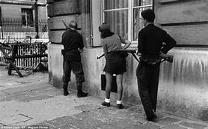

There are not many things which are known about my father’s past as he was reluctant to talk about it. Here are some stories which have come down to us via one relative or another. All are related to the war period:
My father was called up to do his two tears of Military service in 1936. As a child he had learnt to ride horses which made him a natural choice to be in the cavalry. In 1939, he was one of many soldiers sent to Versailles to police the last public execution outside the prison. A shy and retiring individual, he was never one for mass events. However, the way people behaved before, during and after the execution did not improve his view of the populace. Some people had brought picnics to be eaten during (?) the execution, some tried to push forward to get a better view, and finally others complained that it had been too fast (!)
By 1940, horses had been replaced by tanks. Somewhere in North-eastern France, he had been taken prisoner by the Germans and sent to a POW camp in the Champagne region from which he was allowed to escape. From there, he made his way to the Spanish border by any means possible to join the Free French army in North Africa.
The final story is not at all pleasant. In 1945, Max (my father’s name) was in Southern Holland with a tank regiment under the command of an American general. The outfit was facing fierce fire from what appears to have been Hitler Youth troops. The order came to go forwards and burn the lot with the flame throwers. Years later, Max could still hear the cries of the boys and smell flesh burning.
No wonder, the man was silent after that!
Les Trente Glorieuses
I would advise drinking Clairette de Dié: light, sparkling and very fruity. Extremely pleasant when being drunk. However, does not leave a very long life as it is all bubbles and very little substance, like the Trente Glorieuses.
Les Trente Glorieuses refers to the 30 years immediately after the end of the Second World War -1944-1974. France had been bled dried by the years of occupation as the Nazis had taken over every industrial outfit which had been of use in their pursuit of war or moved it to Germany. The US government had lent money and equipment for France to join in the final months of the conflict. It continued to do so after May 1945 under the Marshall Plan (43).
The post-war years, even if they were a struggle at first, resulted in an economic boom which saw full employment, industrial development on a scale never seen before and the creation of personal wealth and wellbeing which no one had imagined possible. New buildings had large windows, sanitation and several bedrooms which replaced small flats in areas which were not salubrious. Factories could not find enough workers to fulfil the orders which were on the books and had to find ouvriers outside France. In Italy, Spain and Portugal first, then in North and West Africa.
Real Counter Culture (Bar none!)
Le Havre 1970
The temperature must be below zero. I have to be at a certain café on the harbour at seven. I ride my moped without gloves because I have lost them or maybe I did not have any. My fingers are frozen when I get there. There are three men waiting outside the place when I park my mobylette. Cogne is one of them. He is well wrapped up in overcoats, scarves, and gloves. One of the others notices that my hands are blue.
“Did you ride without gloves? Bloody hell! I would not do it! Stay here lad, I have some in my cab”. He disappears for a few seconds and returns with woolly mittens and working gloves.
“Don’t lose them!” This is my first encounter with the world of full-time work. I have not even started. My new boss has not said a word yet.
“Right. Let’s get going.” They open the door of the café and plunge in. It is just after seven in the morning and the place is heaving and full of smoke. Cogne goes to the bar, and I am left at the table with the other two men.
“Don’t worry about Cogne. He’ll not say a word until he has had at least two coffees. It is like that every morning. He is a good bloke but can’t take early starts,” one of them says.
“Don’t try to force conversation with him before he has had his morning shots. Otherwise, you will have a bad day,” adds the other.
Cogne returns with a tray of steaming drinks for all of us. He sits down and dishes out the coffees and the glasses of yellowish liquid. The first thing they do is pour the amber drinks in their coffees and add some sugar. Cogne drinks one in a single gulp. Then does the same with the second one.
“Well. That’s better! Are you not drinking lad? You’ll need that to keep yourself warm. “
I look at the hot drink and the brandy. There is no choice. I mix the two and swallow the mixture.
Cogne is now looking at me.
“So, you have done some welding, I am told. That is useful. How much have you done?”
He is in his thirties. He has all the appearances of a boxer. His face is thin with what seems to be a broken nose in the middle of it. Yesterday’s dust is still in his blondish hair which has not seen a brush for quite a few years. His hands are so disproportionately large in comparison to the length of his body that he appears to be all fists, ready to fight anyone not agreeing with him. I will discover very quickly that his name is not Cogne. Nor that this patronymic has anything to do with fighting (Cogner is a verb which indicates hitting very hard). It was given to him because he cannot start the day without a Cognac or two. In fact, he probably is one of the kindest men I will ever come to work with.
The thirty years which have followed the end of the war have seen an unprecedented economic boom. Manufacturing and consumption are at their highest. Unemployment is at the lowest ebb for decades. There is plenty of work for those who wish to earn money and the pay in some jobs is good.
Cogne is a good master. He knows what he is doing and has patience with me. By seven thirty, we are at work. It is cold, dirty and sometimes very dangerous work. At the same time, Cogne is keeping my heart warm as he is always prepared to talk about his experiences which, more often than not, have a funny ending. Before working here, in this miserable harbour city, he was in sunnier climes where it was much easier to keep smiling. He explains quickly what I am supposed to do and expects me to understand and do it just as quickly.
“You have been to high school, lad. You have got brains. So, use them,” is his leitmotiv.
After a few weeks, he leaves me on my own for long periods of time. He sets it up and I weld it. Eventually, Cogne and I will meet at the café and will go our separate ways to work as I know what it is he wants me to do. As the end of the contract comes nearer, I will have to make a decision about what to do next. If I stay with Cogne, it will become a habit: a very comfortable and well-paid job with few strings. He is very keen for me to stay on as I have quickly learned the job and he is happy with what I am doing.
“I have talked to the bosses,” he tells me one day, “they’re prepared to offer you a proper contract with sick pay and holidays. Plus, a bonus at Christmas. Do you want it?”
After three months on the job, I move on.
A new Constitution had been written in 1945 (the fourth) but it led to instability. There were 21 different governments from 1945 to 1958, some lasted only a few days. And they had a lot of things to deal with:
- Future relations with the old enemy. Some very wise politicians thought that the only way to ensure that Germany would not create havoc in the world again, was to integrate it into a system of nations (what is now the European Union). The first step was the Rome Treaty of 1957 between France, Germany, Italy, Luxembourg, Holland and Belgium. So far, it has worked!

- The Colonies: Vietnamese, West African and North African people wanted independence. However, like Britain, successive French governments were reluctant to grant them their wish. This resulted in Wars of Independence which were lost by the French army (these wars are described in more detail in the Colonialism chapter).
- The relationship of the main parties in France with the Communist Party of France (PCF), and by extension with the USSR. The PCF on average obtained 20% of the votes in elections and sent a largish number of deputies to the National Assembly. More often than not, the PCF refused to participate in governments of the Left as their aim was to see the country becoming a satellite of the Soviet Union. The PCF still exists and has a few deputies, but its power has become insignificant.
- The French are a proud people (some say arrogant). The defeat of 1940 had been difficult for them to digest. They wanted to find some way of recapturing their pride. Vast amounts of money were invested in new technologies, namely the nuclear as a weapon and in the production of electricity. The testing of atomic bombs first in the Sahara and the in the Pacific continued well into the nineteen eighties. EDF, the owners with the state of 29 nuclear power stations, is one of the major providers of power throughout Europe nowadays.
The Fifth Republic (1959-now)
By 1958, the political leaders of France were at a loss on how to create a situation which would bring a stable administration. De Gaulle was called back from the wilderness (it is unbelievable how, in the news media of the time, it sounded like Jesus coming back after being in the wilderness of the desert) to find a solution. He found one. He changed the constitution. From parliamentary, as it had been under the IV Republic, it became presidential giving the man at the top a lot more power than had been the case under the previous constitution. The new constitution was as close De Gaulle could make it acceptable to the people without it being an instrument of dictatorship. (A new Constitution brings in a new Republic) It also had the possibility of calling for Emergency Powers. After many unnecessary deaths, Algeria became independent in 1962, followed by many other African nations. However, most became clients of France even though they wanted to break all ties with the old colonial power. (The chapter on Colonialism will explain this contradiction in more detail). De Gaulle presided over an unprecedented period of financial, industrial and consumerism boom. By 1968, young people were tired of the old general and of his rhetoric. They wanted something else.
The tall and very old-school martial man who had been in power for the last decade was losing his grip on the effects his successful economics policy had produced: namely a very dissatisfied and disenfranchised generation of young people who were born just after the last Great Conflict. There was near full employment, but young people wanted something else: recognition. They did not agree with the anonymous and existentially rather dispiriting “Metro -Boulot- Dodo” (Tube-Work-Sleep) which was an offer. There had been calls for more universities, a greater range of tertiary courses, a share in the management of educational institutions and fewer restrictions in society; they had been ignored.
To everybody’s surprise, the movement which was begun by a small group of very politicized but extremely competent organizers, took off in no time at all. Students in many countries -even ones in the other Imperial-Power-in-the-East Sphere- (the USSR) began by refusing to attend what they saw as pointless old-fashioned lectures. Meetings were organized and votes were taken. Old Trotsky would have been proud of them: everything had to be questioned and nothing was permanent. Is there anything new in this world?
In the space of a few days, high schools had followed suit. Amazingly, factory and office workers went on strike at first spontaneously but, eventually at the bidding of their political parties or of their unions. The police were called in. The infamous riot police (CRS) were let loose on the students and had a good time. Barricades were constructed and cars set on fire. Demonstrations were charged by the CRS who, in turn, received a fair amount of cobble stones in return. The situation was nearly out of hand. The tall martial man in charge went to consult a close military ally in the country next door to ascertain if he had the support of his colleagues in uniform. Tanks were understood to be in the suburbs of the capital, and it was now a question of nerves.
The country had come to a standstill, and it was anyone’s guess as to what was going to happen next. Revolutionary forces were still out in the streets whilst a large reactionary demonstration was in progress, well protected by the cops. Politicians, as usual, tried to highjack the situation for their benefit. Early elections were called and as Claude Nougaro (44) sang:
“Chacun est rentré chez son automobile ” – They all went back to their cars
From Paris Mai. Claude Nougaro 1969
Maybe, and not for the first time, a lot of dead people from an island to the south just above Sardinia, far more than were actually alive in some instances, voted for the reactionary forces which ensured their victory. (45)
Ironically, the after-war generation is the one which has produced the present technological revolution with its train of disasters both economically and environmentally. The extreme political and religious reactionary forces which are now in power in the world are also guided by some of the children of the 1968 Small Revolution.
Notwithstanding the fact that we were high school students in the provinces, we were encouraged by the management of the school to take part in the local events (imagine that happening now in the UK!). Eventually, not content to be left out of the main action, we made our way to the capital. I learnt a number of things during those heady days. Crowds are both exciting and scary. Exciting because you are part of something over which you have no control, but which is a historical happening. Scary because the imagined protection numbers afford you, can be broken at any time by a baton charge.
For every action, there is a reaction. At the corner of one of the main streets in the city, a fight developed between a group of protesters and a unit of CRS. We threw projectiles at them and for a few moments, they did not respond hoping we would come closer. We did. They charged. They caught up with us. We learnt about pain. Next time, we would stay at a safe distance and run faster if it came to it. Whilst we were demonstrating against the failings of the capitalist system, our colleagues in an eastern European country (Czechoslovakia) were fighting for their lives – guns versus tanks – as they wanted the freedom which we had.
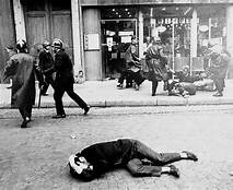
I am of the same mind as Cicero: O Tempuras! O Mores!
Since those heady days, France has been governed by a succession of presidents who have either been remembered for buildings which are named after them: Georges Pompidou (1969-1974) and the Centre at Beaubourg in the middle of Paris or because they have been so crooked, Chirac and Sarkozy, that they were going to or have been condemned to prison terms. One, Mitterrand, lived the double life of the bigamist and should have been in court for crimes against humanity before being elected. His case will be discussed under Colonialism. The others have been so non-descript that they have left no impression – Who remembers Valery Giscard d’Estaing or Francois Hollande? At the time of writing this chapter, Emmanuel Macron is president and is seeking re-election in 2022. So far 18 politicians have declared themselves as possible candidates for the post of president of France. This concludes the chapter on the history of the French nation. Brief as it is, I hope it helps to understand how the past is informing the present but also how things can change rapidly in a country which sees taking to the streets as a leisure activity. Like every country in the world, France is experiencing something new and rather destabilising, unsettling and potentially leading to a confrontational situation: the pandemic. The polarisation between the Libertarians (Anti-Vaccination) and those with a Social Conscience (Pro-Vaccination) is new as it transcends party politics and has already been marked by physical clashes. It is difficult to see how a peaceful resolution of this situation could be found as new variants of the Covid 19 are exploding amongst the population and governments are trying to deal with it the best they can by restricting certain liberties.
Read about the History of France in Chapter Two (PDF) or Chapter Two (Word download).
Quiz
Try out the History Quiz.